
The Saudi-UAE clash is reshaping dynamics across Yemen and the Horn of Africa. Europe needs to pay attention as new alignments crystallise against what is increasingly framed as a UAE-Israel-Ethiopia axis.
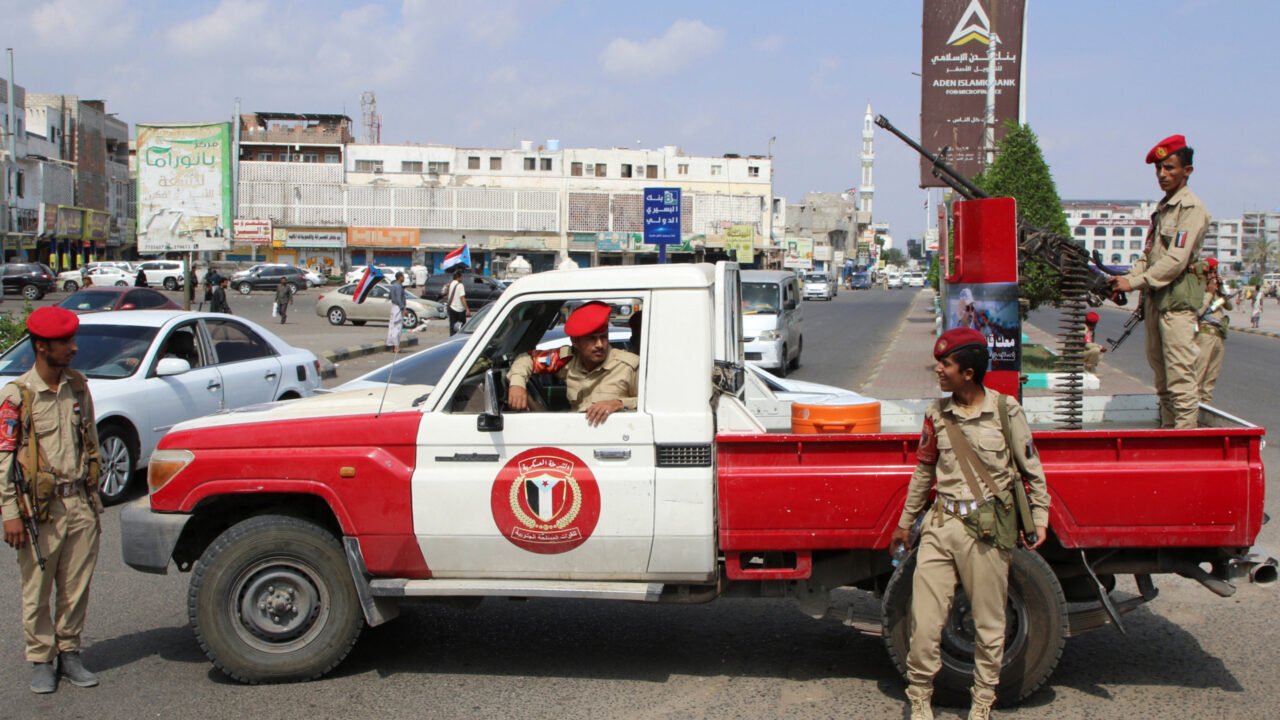
In late 2025, the Southern Transitional Council—a political Yemeni organisation backed by the United Arab Emirates—staged a military takeover of Yemen’s Hadhramaut and Mahra governorates. In response, Saudi Arabia launched a forceful diplomatic and military pushback, striking what it described as Emirati weapons supply routes. It also dissolved the STC and pushed the UAE to announce a full withdrawal from Yemen.
After years of simmering competition between Riyadh and Abu Dhabi, their clash is having an impact beyond Yemen and into the wider Red Sea region. This is reshuffling regional alliances and threatening to further destabilise Red Sea geopolitics. The fall-out confirms the region as a persistent flashpoint, which Europeans need to monitor closely.
In parallel to the developments in Yemen, Saudi Arabia increased its pushback against Emirati actions in Sudan. International actors have accused Abu Dhabi’s support for the Rapid Support Forces (RSF) of helping prolong the civil war against the Sudanese Armed Forces (SAF). This has increasingly frustrated Saudi Arabia, which backs the SAF and has positioned itself, alongside the United States, as a supporter of mediation efforts.
During Saudi Crown Prince Mohammed bin Salman’ visit to Washington in November 2025, he reportedly urged the Trump administration to increase pressure on the UAE over its role in Sudan. In the weeks that followed, Riyadh stepped up its material support to the SAF.
Israel recognises Somaliland
Israel’s recognition of Somaliland in late December 2025 has also caused turbulence: the move is widely expected to be linked to Somaliland’s authorisation of an Israeli military presence—or at least intelligence-gathering facilities—aimed at monitoring Houthi activity in Yemen. Many observers also suspect the UAE was involved in the decision. It has long maintained a substantial economic and security footprint in Somaliland, notably through its role in developing the port and airport of Berbera, and previously facilitated contacts between Israeli and Somaliland authorities.
This would not be the first time that the UAE has cooperated with Israel in the area. In 2021, the two countries participated in joint naval drills in the Red Sea and reportedly developed joint listening posts on the Yemeni islands of Perim and Socotra. The UAE also played a crucial intermediary role between Sudan and Israel to facilitate Sudan joining the Abraham Accords in 2021.
The UAE’s activities in Somaliland have long fuelled tensions with Somalia’s federal government in Mogadishu, which accuses the UAE of undermining Somalia’s territorial integrity. These accusations resurfaced in 2024 when Ethiopia threatened to secure access to the Red Sea via Berbera, echoing an earlier UAE–Somaliland–Ethiopia understanding on developing such a corridor.
Israel’s recognition of Somaliland is alarming officials in Mogadishu. They fear such a deal could revive Ethiopia’s ambitions towards Berbera, despite Somalia and Ethiopia securing a fragile peace deal in late 2024. The latest developments has seen Mogadishu, which notes the Emirati footprint behind the Israel-Somaliland rapprochement, call for a Saudi military intervention in Somaliland and announced the severing of ties with the UAE.
Riyadh’s regional reinvestment
Developments in Somalia, Sudan and Yemen have triggered Saudi Arabia’s remarkable diplomatic and military reinvestment in the Red Sea region, as the country aims to rally an anti-UAE-Israel regional alliance.
As of January 2026, Saudi foreign minister Faisal bin Farhan has already visited Egypt to secure Cairo’s rhetorical support on Yemen and initiate joint Saudi–Egyptian efforts to constrain UAE-linked RSF logistical networks into Sudan. These efforts reportedly included restricting Emirati use of Egyptian and Saudi airspace for cargo flights suspected of supplying the RSF, as well as coordinated pressure on Libyan military officer and Libyan National Army (LNA) leader Khalifa Haftar to disrupt smuggling routes used by the UAE to support the RSF. This includes via the temporary closure of Libya’s Al-Kufra airport, a key logistical hub on this corridor.
Haftar relies heavily on Emirati backing. As such, Egypt and Saudi Arabia have offered cooperation and alternative financial and military support to offset reduced UAE assistance. Saudi Arabia also initiated a Saudi–Egyptian–Somali military partnership following Somalia’s call for support after Israel’s recognition of Somaliland. In parallel, Riyadh held consultations with Turkey on Yemen and signalled its appetite for greater cooperation on Somalia.
It announced a trilateral military framework with Turkey and Pakistan and further reinforced its support for the SAF, including through the negotiation of a $4bn deal with Pakistan to provide the group with fighter jets. Saudi Arabia is also trying to position itself as a potential alternative to the UAE for Sudan’s gold trade, and has signalled its interest in investing in several Red Sea ports in Sudan and Djibouti, where the UAE recently lost contracts.
Battling strategic encirclement
Saudi frustration with Emirati activism has grown steadily in recent years.[1] Despite Saudia Arabia and the UAE’s strategic partnership, the former increasingly views the latter’s assertive foreign policy—particularly support for non-state and separatist actors in Libya, Somalia, Sudan and Yemen—as a source of instability. But a critical new factor to explain Riyadh’s shift is that Saudi Arabia now sees Israel as a major driver of regional instability and a direct security concern, almost level with Iran in terms of its perceived threat.
Therefore, the deepening UAE–Israel partnership (which extends to Saudi Arabia’s western flank in Yemen, the Red Sea and the Horn of Africa) now raises fears of strategic encirclement in Riyadh.
Moreover, Israel faces unprecedented levels of unpopularity across the Middle East and the Horn of Africa. This allows Saudi Arabia to frame regional dynamics around a UAE–Israel axis and provides a narrative through which Riyadh can to rally regional partners against the UAE.
The Ethiopia factor
Saudi Arabia’s diplomatic offensive focuses on countering UAE influence—but it conveniently overlaps with the agendas of several Horn of Africa states seeking to counter Ethiopia. Therefore, the framing of this diplomatic counter-offensive is being broadened and presented as regional resistance to the development of a UAE-Israel-Ethiopia cooperation triangle.
Ethiopia’s assertive rhetoric and actions to secure Red Sea access—whether through Berbera in Somaliland or Assab in Eritrea—has heated up since 2020, triggering acute diplomatic tensions. The crisis with Somalia peaked in late 2024 and has stabilised after a fragile deal mediated by Turkey, while relations with Eritrea sharply deteriorated in 2025, fuelling concerns about a potential Ethiopian military incursion.
Ethiopia’s long-standing dispute with Egypt and Sudan over Nile waters has further pushed Cairo to expand its diplomatic and military engagement across the Horn, including with Djibouti, Eritrea, Somalia and Sudan, and to promise to deploy troops to Somalia. Given Abu Dhabi’s close relationship with Addis Ababa, Egypt sees an opportunity in Saudi Arabia’s current anti-UAE drive to advance its own counter-Ethiopian agenda.
A nexus of instability
It is too early to determine whether these realignments will translate into a sustained erosion of Emirati influence and lasting Saudi reassertion in the Red Sea. Abu Dhabi’s swift de-escalation in Yemen and its withdrawal signal a clear desire to avoid further confrontation with Riyadh.
However, while the UAE is likely to adopt a lower profile in the short term, its regional ambitions may resurface in new forms. Fully countering the Emirati networks in the Horn will be difficult. For instance, Somalia’s decision to declare all agreements with the UAE null and void—including the UAE’s investments in strategic ports along the Somali coast—is unlikely to have immediate practical effects, given Mogadishu’s limited control over the actions of its federal member states and separatist entities.
Recent developments reinforce a broader trend: the Red Sea remains a nexus of instability, shaped by overlapping rivalries and the entanglement of Middle Eastern and East African geopolitics. The Saudi–Emirati rivalry is likely to continue fuelling volatility.
What Europeans should do
Europe needs to pay attention to the latest developments, despite having other geopolitical priorities in areas like Ukraine and Greenland. It should balance its approach to the UAE and Saudi Arabia carefully, to avoid getting caught amid regional rivalries.
But the current anti-UAE pushback is also an opportunity for Europeans to press the UAE towards a more constructive behaviour in places where it has previously clashed with European interests. In Yemen, the Saudi takeover could open a narrow window to reunify anti-Houthi forces and push the conflict toward a political settlement.
In Sudan, the conflict continues with no clear resolution on the horizon. Nonetheless, mounting international pressure on the UAE offers an opportunity for Europe to maintain coordinated pressure over Abu Dhabi’s support to the RSF and help advance diplomatic efforts in Sudan.
While Israel’s recognition of Somaliland risks further fragmenting Somalia and feeding extremist narratives, it may also embolden Ethiopia to revive its ambitions over Berbera. If Saudi Arabia deepens its engagement in Somalia, Europeans should support increased Saudi development assistance and enhanced counter-terrorism cooperation in Somalia, in order to support stability—rather than fuel internal fragmentation.