
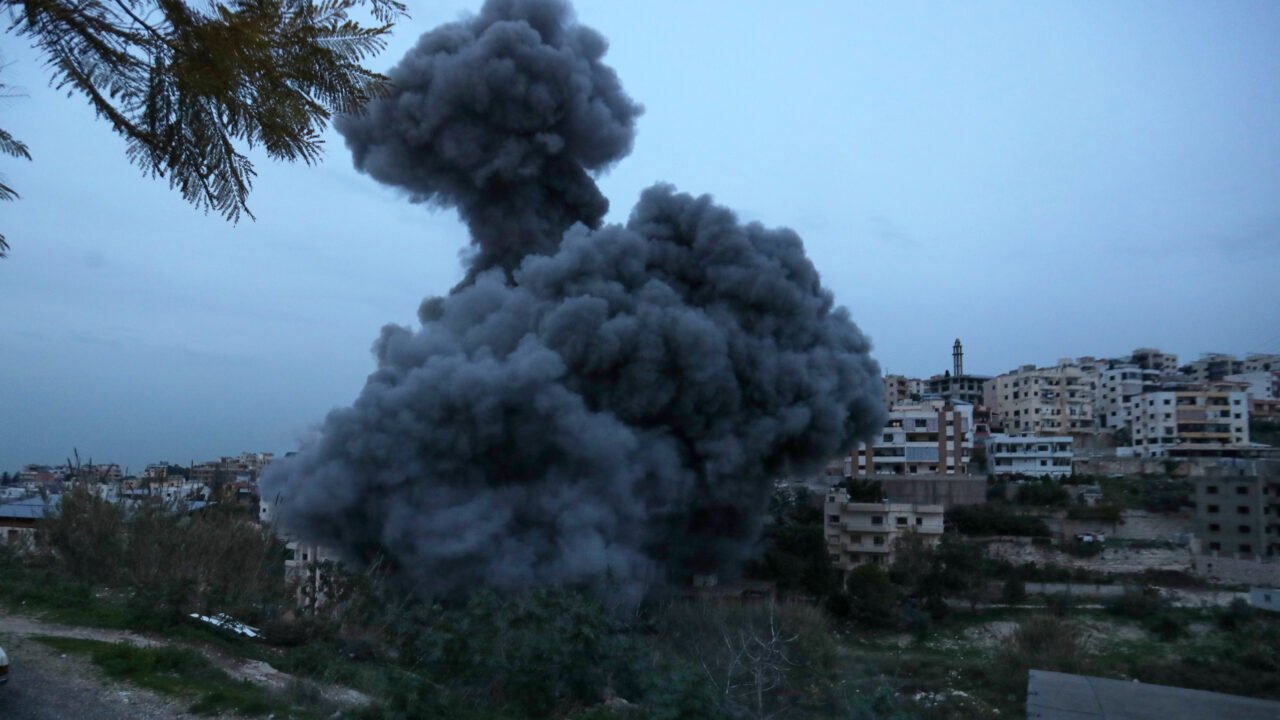
Israel is agitating for US strikes against Iran, while preparing for renewed war in Lebanon. Europeans should work to contain Trump and Netanyahu to prevent renewed offensives in both arenas, while supporting Lebanon’s fragile governance.
On Friday, February 6th, American and Iranian diplomats will gather in Oman in a last-ditch attempt to prevent a return to war, following intensive regional diplomacy. After Tehran’s brutal crackdown on protesters, President Donald Trump has threatened strikes and deployed his “beautiful’” armada to the region. Iran’s supreme leader, Ali Khamenei, for his part, has responded with increasingly bellicose rhetoric.
In these tensions, Israeli prime minister Binyamin Netanyahu sees a historic opportunity. Following the shock of the October 7th attacks, Israel harnessed its military power to force a new order on the Middle East, weakening Iran, Hamas in Gaza and Hizbullah in Lebanon. Now, Netanyahu is seeking to further weaken the Iranian regime, reportedly pushing for more American, and possibly Israeli, military action. Meanwhile, in Lebanon, the Israeli military prepares for a new offensive, on standby as events unfold in Iran.
With elections approaching this year and political crises at home, Netanyahu may hope that renewed military action could salvage his languishing poll ratings, rather than making unpopular diplomatic concessions. This is despite the fact that the previous wars against Hizbullah or Iran did little for him beyond a temporary bump in the polls, and that the public is split over further military action in Iran or Lebanon.
Trump, on the other hand, appears caught between contradictory impulses: as a military strongman and as a dealmaker. Intensive diplomatic efforts by Middle Eastern and Gulf states have been vital in delaying a US attack on Iran and creating space for negotiations. Now, Europeans must work with Arab partners to outweigh Israeli pressure, persuading Trump that renewed wars in Iran or Lebanon would risk his objective of “peace on earth” and his status as “deal maker in chief.” Instead, they should entice him with the prospect of diplomatic wins and work to convince him to restrain Israel from launching its own campaigns on either front.
Iran: Netanyahu hopes for regime change
Netanyahu has reportedly long been lobbying Trump to strike Iran or at least green-light Israeli strikes. Then, the eruption of protests and Trump’s threats of military action seemed to present an opening. The Iranian regime’s bloody crackdown has quelled the protests for now, halting the momentum and weakening Trump’s stated rationale for striking. Despite the US military buildup in the region, the president appears to be wavering, and is reviving negotiations with Tehran (though he also did so prior to his 2025 strikes on Iran).
Publicly, Netanyahu and his ministers have been restrained. Former Israeli security officials say Israel is following Trump’s lead to avoid disrupting the president’s efforts or appearing to interfere with the protests.But behind the scenes, high-level meetings have taken place between Witkoff and Netanyahu and senior Israeli and American security officials. Israel is reportedly continuing to press the US towards military action, sharing intelligence and targets. Netanyahu likely hopes for a wide-ranging US-led attack that would, if not depose, at least destabilise the Iranian regime. Reports indicate that Israel opposed Washington’s original strike plans, fearing they were too limited and symbolic, while risking a costly Iranian retaliation against Israel.
Netanyahu worries that Trump will be dissuaded from military action and reach a ‘bad deal’ that rejects Israel’s maximalist demands and inhibits its freedom of military action. Indeed, Iran’s insistence on excluding non-nuclear files from the negotiations in Oman has raised alarm in Israel. Despite the damage done to Iran’s nuclear and missile programmes during last year’s 12-day war, Israel remains concerned about the remaining stockpile of near-weapons-grade uranium and residual missile capabilities. Israel is particularly disturbed by the missile programme, given that some missiles penetrated its air defences last June, causing severe damage in Israeli cities. Israel, therefore, will likely continue to press the US to strike and for it to adopt maximalist negotiating positions, in the hopes of preventing a ‘bad deal’.
Israel would welcome regime change, though most in the defence establishment understand this is not within its control, according to ECFR’s interviews with former Israeli security officials and analysts. The prevailing assessment is that it “it can’t get much worse”. Toppling the Iranian regime is, therefore, in the Israeli view, a risk worth supporting. Israel’s best-case scenario would involve a new Iranian leadership with which it could establish friendly relations. Israel had hoped that pressure from the protests combined with American military action could usher in exiled opposition figure Reza Pahlavi, though this has not materialised. Another possibility is that the more hardline Islamic Revolutionary Guard Corps (IRGC) seizes power. Some in the Israeli defence establishment say this would be no worse than the current regime, or even that the IRGC could prove more “pragmatic” interlocutor without the ideological and religious conviction of the current leadership.
Lebanon: The next battleground
Before protests erupted in Iran, Israel appeared close to renewing the war against Hizbullah in Lebanon. As the group began to rearm, Israeli generals drew up plans for a new offensive. Reports in December indicated Trump had approved plans during his Mar-a-Lago meeting with Netanyahu.
For now, both Israel and America may prefer to wait and see what happens in Iran. As one senior Israeli military source put it, “there is no point in rocking the boat now if there is a chance that it will sink on its own”, suggesting the collapse of the regime in Tehran could fatally wound Hizbullah. Short of this, Israeli attention will inevitably return to a new offensive in Lebanon. “Israel may have no choice but to go for another round”, one Israeli security analyst said. “If we are destined for another round of confrontation, then it is better for Israel that it happens before Hizbullah grows significantly stronger.
Israel assesses that Hizbullah is rearming faster than the Lebanese Armed Forces (LAF) can disarm it under the ceasefire agreement, which tasks the LAF with dismantling the armed group’s military sites and confiscating its weapons south of the Litani river.Israeli intelligence estimates that Hizbullah retains hundreds of long-range missiles, thousands of medium and short-range missiles and thousands of drones,and has found new channels for funds and arms.
After October 7th, Israel refuses to tolerate a well-armed Hizbullah on its northern border. Dissatisfied with the LAF’s performance, the IDF has refused to withdraw from five strategic outposts in southern Lebanon and continues to strike targets (over 700 times in the past year). Israeli analysts cite the LAF’s inadequate capabilities and a lack of “will”. Israel frequently operates outside the new monitoring and implementation mechanism, claiming that, when it flags activity, the LAF does not act, acts too slowly or even leaks information to Hizbullah.
Yet Israel’s constant bombardments, intended to weaken Hizbullah, undermine the credibility of the Lebanese government and armed forces. The attacks further validate Hizbullah’s narrative that only armed resistance can protect Lebanese sovereignty, a paradox acknowledged by the former head of Israel’s military intelligence.
How Europe can deliver Trump to diplomatic victory
Europeans share a legitimate distaste for Iran’s ruling elite given the horrific scenes from the recent crackdown. They are also sympathetic to Israel’s assessments of Hizbullah’s destabilising role in Lebanon. But given the grave risks of regional instability and bloodshed that come with Israeli military action, Europeans should oppose renewed military intervention and press the case for diplomacy. Together with Arab states, they should play on Trump’s desire for deal-making to show him that more military action will not serve his agenda of regional peace. If they are successful in preventing Trump or Israel from attacking Iran, focus should then quickly move to Lebanon to prevent a renewed Israeli offensive.
As evidenced by the intensity of diplomatic activity, Arab and Middle Eastern states are looking for ways to de-escalate. European states should engage, working with Arab Gulf partners and Turkey to support nascent US-Iran talks. They should push for pragmatic rather than maximalist engagement, and for any agreement to include an end to the repression of protesters.
Unlike in Iran—or Gaza—Trump has demonstrated less sustained interest in Lebanon. That neglect could play either way. If America is not invested in any diplomatic process for Lebanon, it may green light Israel relaunching a military offensive. Rather than letting things veer off track, Europeans and Arab partners should try to convince Trump of the historic opportunity to transform Lebanon into a functioning sovereign state. They should demonstrate that they have the technical know-how and financial resources to support the Lebanese government and armed forces to deliver governance and security sector reform. That, in turn, would unlock investment and reconstruction funds. And—should Israel return to its war plans—Europeans and Arabs must persuade the US to constrain Israel.
Without diplomacy, Israel’s next war is in the making, and the one after that. Europe and its Arab partners should entice Trump with the prospect of deals, rather than yet more war.