
As diplomats gathered in Washington earlier this month to mobilise humanitarian funding for Sudan, while the UK announced new sanctions aimed at dismantling Sudan’s “war machine”, a distinct contradiction became even clearer: international action is accelerating on paper, but on the ground, civilian protection and recovery efforts remain dangerously undeveloped.
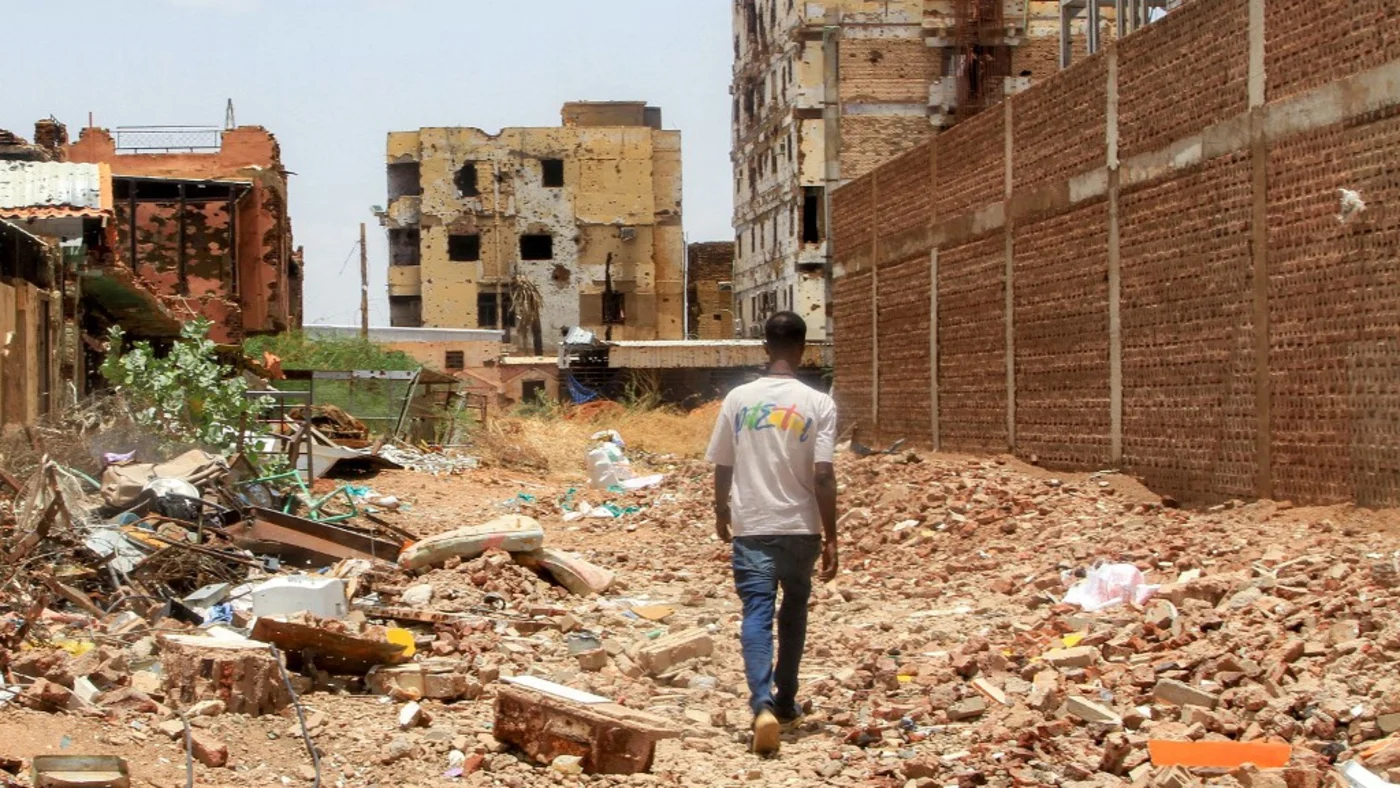
Millions of Sudanese civilians are returning to destroyed cities with no electricity, no hospitals, and no functioning public services. The world is becoming more efficient at punishing belligerents – but not at protecting survivors.
Nearly three years after war erupted in April 2023 between the Sudanese Armed Forces and the paramilitary Rapid Support Forces, global policy on Sudan risks confusing moral signalling with operational strategy.
New sanctions packages and donor pledges demonstrate political engagement, but the humanitarian catastrophe continues to deepen, exposing a widening gap between diplomatic activity and civilian reality.
The UK’s newly announced sanctions target individuals accused of sustaining Sudan’s conflict economy and enabling military operations. British officials framed the measures as an effort to weaken the financial structures underpinning violence and impunity.
The announcement came just as the US launched its “Sudan Humanitarian Fund Call to Action Event” in Washington, aiming to mobilise donor commitments, coordinate international agencies, and reinforce humanitarian response mechanisms for Sudan’s escalating crisis.
Taken together, these two developments capture the dual track shaping the international response: expanding punishment on one hand, and increasing humanitarian pledges on the other. But neither initiative – at least as currently structured – resolves the central operational vacuum: a coherent, enforceable framework for civilian protection, safe return and infrastructure restoration.
Collapsed systems
Sudan remains the world’s largest displacement crisis, according to the International Organization for Migration (IOM), with millions of people forced to flee their homes since the war began.
But an overlooked trend is the massive scale of return movements: IOM tracking indicates that more than three million Sudanese people have returned to areas including Khartoum state, Gezira and parts of Darfur – not because security has improved, but because displacement has become economically and socially unsustainable.
Returnees are walking in to collapsed systems. According to Unicef, more than 70 percent of health facilities are nonfunctional, while millions of children remain out of school, and critical water infrastructure has been destroyed or looted.
In Khartoum, once Sudan’s administrative and economic centre, electricity grids, universities, hospitals and water networks have been heavily damaged. Markets operate irregularly, public administration is fragmented, and local security remains volatile.
Return without reconstruction does not represent recovery. It represents part of a cycle of displacement, one in which families leave, return out of desperation, and are forced to flee again when conditions prove unliveable.
The UK’s new sanctions reinforce a familiar pattern. Accountability mechanisms continue to expand through EU, UK and US designations targeting commanders, financial networks, and alleged perpetrators of atrocities.
These measures – naming perpetrators and restricting financial mobility – matter. But sanctions alone do not rebuild water systems, reopen hospitals, or secure neighbourhoods.
Illicit networks
Armed actors in Sudan are not constrained primarily by western banking access. They operate through regional patronage networks, illicit trade routes, gold markets and alternative financial channels. Sanctions can contribute to long-term accountability and elite isolation – but their short-term capacity to alter battlefield behaviour or protect returning civilians remains limited.
Without enforcement mechanisms tied to ceasefire compliance, humanitarian access guarantees and civilian monitoring systems, sanctions risk becoming performative instruments – signalling condemnation without materially reshaping the environment civilians must survive in.
The Washington humanitarian fund initiative reflects a recognition that relief funding must expand urgently. If designed effectively, coordinated donor engagement could support essential service restoration, rehabilitation of critical infrastructure, and strengthened protection mechanisms for returnees.
But Sudan’s history is filled with conferences that have generated pledges rather than structural change.
The real test of the Washington initiative will be whether it integrates humanitarian funding into a broader peace architecture – one that links relief to ceasefire monitoring, civilian protection corridors, and localised governance restoration. Without that integration, the conference risks repeating a familiar pattern: strong diplomatic optics paired with weak field-level impact.
What is missing is a broader peace architecture and civilian inclusion. Peace negotiations remain fragmented. Multiple mediation tracks operate simultaneously, external actors compete for influence, and ceasefire initiatives have repeatedly stalled. Sudanese civil society – including resistance committees, professional associations, women’s groups and humanitarian networks – remain on the margins of formal negotiation structures.
Research on peace processes consistently shows that agreements involving civil society participation demonstrate higher durability and compliance rates. Sudan is repeating a known failure model: elite negotiations without social legitimacy.
Justice and accountability
Sanctions and donor conferences may shape the environment around negotiations, but they cannot be a substitute for an enforceable peace framework rooted in local legitimacy and civilian protection.
The uncomfortable truth is that sanctions and conferences are politically easier than peace enforcement and infrastructure reconstruction. Freezing assets requires less political risk than deploying monitoring mechanisms. Announcing pledges is simpler than funding electricity restoration or securing urban neighbourhoods.
Justice and accountability remain essential components of Sudan’s long-term recovery. Sanctions should remain part of a broader accountability architecture, particularly for postwar legal processes and asset tracing. But they should not sit at the top of the policy hierarchy while civilians return to cities without water, electricity, schools or protection.
A credible international strategy would invert today’s priorities. The global community must enforce and monitor ceasefires through coordinated international mechanisms. It must establish protected civilian corridors and return frameworks, and rehabilitate essential infrastructure, including water, electricity, healthcare and education systems.
Importantly, Sudanese civil society must be directly embedded in negotiation processes. Sanctions should be sustained as complementary accountability tools, not as a primary strategy.
Sudan does not lack condemnations, sanctions packages or donor conferences. It lacks aligned operational priorities grounded in the lived hierarchy of civilian survival: safety before symbolism, infrastructure before optics, and peace before posturing.
For the families returning to devastated neighbourhoods, sanctions are invisible. What matters is whether the lights turn on, whether the clinics open, whether clean water flows, and whether armed groups withdraw.
International policy should be measured the same way: not by what it declares, but by what civilians can actually live with.