
Beth Oppenheim
The UN Security Council has passed a resolution to enact Trump’s Gaza plan. To sustain the fragile ceasefire, Europeans need to work with Arab partners to implement it in a way that addresses its flaws and secures Palestinian sovereignty
UN Security Council Resolution 2803 was a major diplomatic achievement for Donald Trump. Or, as he put it, it was “a moment of true Historic proportion!” The resolution created the legal framework to enact the US president’s 20-point peace plan for Gaza, including the establishment of an “international stabilisation force” (ISF) and a “board of peace” (BoP) to oversee the strip’s transition from Hamas’s rule. The plan deserves credit for ending full-scale hostilities and securing a hostage and prisoner exchange. But the resolution enshrined problematic elements, in particular the sidelining of Palestinian sovereignty and international law, and disregard for Israel’s responsibilities, including in the West Bank. These problems are now stalling the second phase of the ceasefire.
The US exerted pressure on European and Islamic UN Security Council members to support the resolution, despite their misgivings. While they were unable to fundamentally change the text, their engagement secured references to international law and a requirement for the BoP to report to the UN every six months. Ultimately, their overriding desire to keep Trump involved and stop him circumventing the UN led them to support the “only show in town”.
Now, Europeans find themselves at an impasse: neither willing to fully implement the plan in line with US demands nor risk confrontation with Trump. But they must not default to passivity. Instead, they should work with Arab partners to present Trump with a joint initiative that can operationalise the resolution to achieve his ambition of a sustainable peace in Gaza.
Resolution 2803
The UN resolution authorises an ISF to secure the strip, tasked with “ensuring the process of demilitaris[ation]” by destroying military infrastructure and decommissioning Hamas’s weapons. This is a peace-enforcing, not peacekeeping, mission—an Israeli demand—meaning the ISF could use force to disarm the group. But no country will agree to fight Hamas on Israel’s behalf, nor will they provide troops for this purpose. As unpalatable as it may be to Israel, Hamas’s consent will be needed, and its disarmament negotiated rather than imposed.
Even if an ISF can be assembled, the thorny question of governance remains. The resolution hands the BoP extensive powers to “supervise” Gaza until December 2027, after which the UNSC would need to renew its mandate. The board will have the final say over every aspect of Gazan life. This extends from managing the strip’s reconstruction and economic recovery, to coordinating public services and aid, facilitating movement of people and “any such additional tasks … necessary” to support the 20-point plan. Trump has said he will lead the BoP, which will reportedly comprise around ten leaders from Arab and Western countries, with an executive board underneath it that will include Britain’s former prime minister Tony Blair, Trump’s informal adviser and son-in-law Jared Kushner and US special envoy Steve Witkoff. It is unclear whether there will be Palestinian representation.
According to the plan, the BoP will supervise and support a “technocratic, apolitical committee of competent Palestinians from the Strip”, that is, no Palestinians affiliated with Hamas or Fatah, another Israeli demand. The committee will manage day-to-day governance, organise public services and serve as the local “face” of the international administration. Progress has stalled due to difficulties in selecting members agreeable to Israel, the US, regional powers and the Palestinian Authority (PA).
The resolution conditions the PA’s return to governing Gaza on “faithfully” completing an extensive “reform programme”, citing the New York Declaration and Trump’s 2020 plan. The latter privileges Israeli demands, such as the suspension of international legal action against Israel. Israel will aim to shift the goalposts for PA reform, locking the PA out of Gaza and maintaining Palestinian divisions, offering a pretext to postpone any political process and block a two-state solution.
The sweeping powers of the BoP and the sidelining of Palestinian decision-making and sovereignty risk shaping Gaza’s institutions, legal system and economy according to external, rather than Palestinian, interests. Would, for example, the BoP issue laws that supplant existing Palestinian ones, adjudicate on land and property claims outside Palestinian courts, or sign off on international agreements without PA consent?
Without Palestinian ownership, the new arrangements are bound to lack legitimacy, fuelling instability and endangering the already fragile ceasefire. While the PA and Fatah have publicly welcomed the arrangements—reflecting the authority’s weak standing—Hamas and other factions have rejected them as an “imposed trusteeship … against Palestinian national will”.
Without addressing these problems, it will be impossible to fully implement the resolution. States will be reluctant to contribute troops to the ISF, join the BoP or finance reconstruction. The default is a perilous holding pattern of low-level conflict and dire humanitarian conditions.
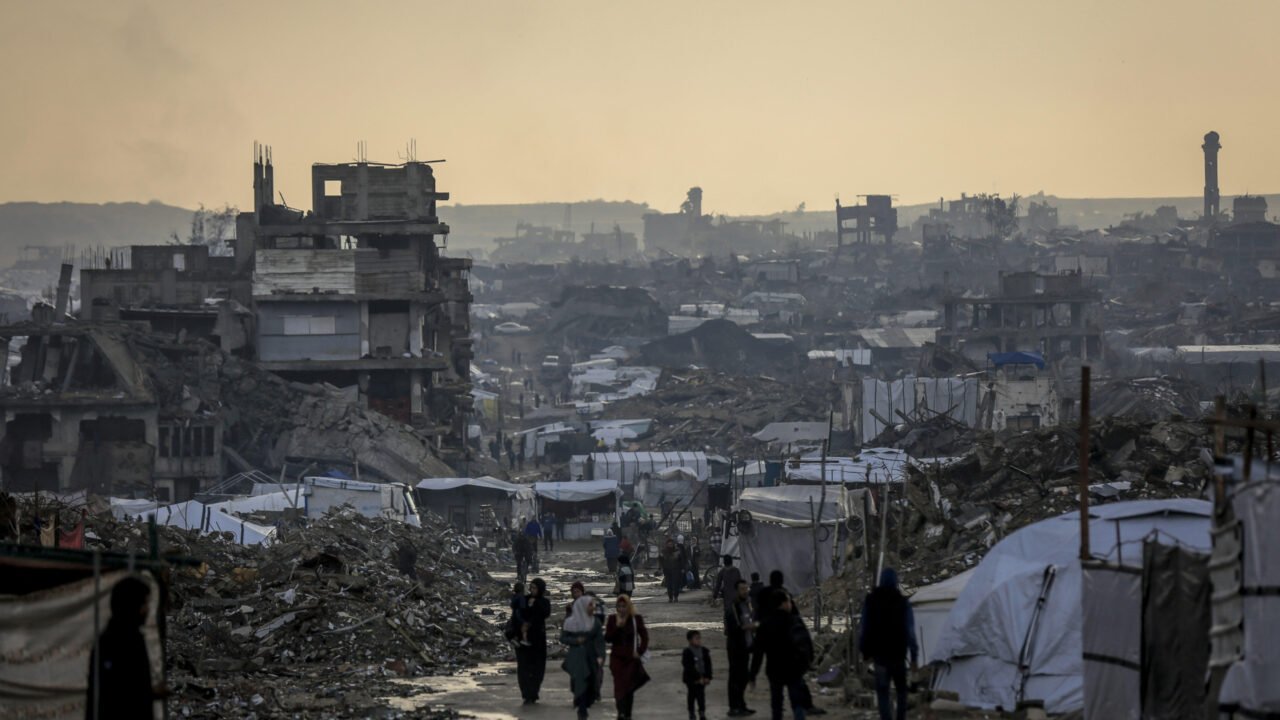
Gaza is split in two: the Israeli military controls 53% of the territory in the east, while Hamas holds the west, where most of Gaza’s 2.1 million residents are crowded. Given the political difficulties, the US appears to be contemplating piecemeal reconstruction in the east. But this limbo cannot last. Without a transition to phase two, the ceasefire will eventually collapse. Hamas will recover, and in the absence of an ISF, Israel will try to persuade the US to allow its military to return to Hamas-controlled Gaza to “finish the job”.
A joint European-Arab initiative
Europeans cannot shape US plans alone. With Arab partners, particularly Gulf states, they should pitch a joint offer to Trump to help him implement the resolution. They will need to show willingness to cooperate, while working to persuade the president that his plan will flounder in the absence of real Palestinian decision-making, a greater role for the PA, Hamas’s consent, and an Israeli commitment to uphold its obligations and advance a political track.
Europeans and Arabs could offer a “peace support” package but stress that, for their efforts to succeed, the above conditions will need to be in place. This offer could include participation in the BoP and ISF, funding for reconstruction and the PA, and technical support (in the EU’s case, through the bloc’s border assistance mission for the Rafah crossing and its police mission for the Palestinian territories). They should agree to commit troops to an ISF with a peacekeeping, rather than peace-enforcing, mission. Britain or Ireland should offer to lead on decommissioning and make the case for a phased approach tied to political negotiations, as in Northern Ireland.
Europeans and Arabs should also work to convince Trump that meaningful Palestinian involvement will be essential for legitimate governance and a sustainable peace. Jointly, they must use their participation in the BoP to ensure the body does not override Palestinian laws and sovereignty and allows for Palestinian decision-making. They should shape the US approach to PA reform, steering it away from purely technocratic fixes and politicised Israeli demands and towards genuine political renewal.
With Arab partners, Europeans should push to finalise membership of the Palestinian committee and press PA president Mahmoud Abbas to issue a decree to establish it under Palestinian law. Together, they should convince the US that, in order to unlock Hamas’s cooperation on decommissioning, the new governance arrangements should be linked to reconciliation with Fatah and revitalising the PA, including an election in 2026.
Without Israel’s cooperation, Trump’s plan will fall flat. Europeans must maintain pressure on Israel, in alignment with firm Arab messaging to the US. As Israel’s largest trading partner, the EU has leverage. Europeans must continue to press Israel to uphold its obligations during phase two and commit to specific steps towards a two-state solution, as well as curb its destabilising actions in the West Bank. If Israel is obstructive, the EU could, for example, suspend its association agreement with the country. In addition, while a two-state solution remains politically toxic in Israel, Europeans can influence Israel’s domestic debate ahead of its 2026 election by signalling the diplomatic dividends of advancing that vision, such as regional integration and restored international standing.Rather than falling into passivity, Europeans must seize the initiative to help Trump achieve a stable peace. With Arab partners, they have a chance to shape US plans to ensure Palestinian ownership and a political track towards a two-state solution. The alternative is an unstable, partitioned Gaza—or a return to war.
https://ecfr.eu/article/taming-trumps-gaza-plan-a-european-arab-initiative-for-lasting-peace/