
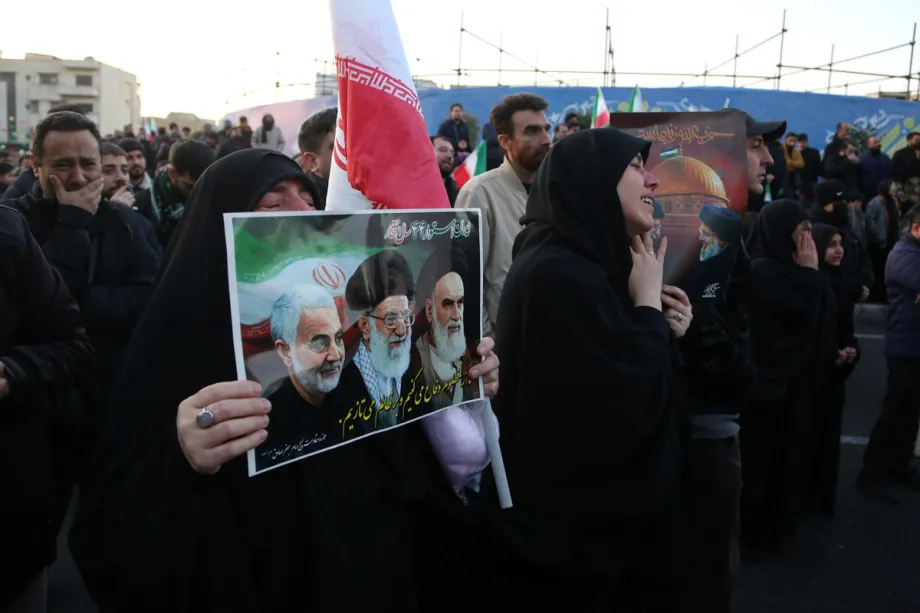
Sayid Marcos Tenorio argues that Imam Khamenei’s martyrdom transforms rather than ends Iran’s Islamic Revolution, turning his death into a unifying symbol of spiritual resistance, continuity, and renewed legitimacy against imperial powers attempting to undermine Iran’s revolutionary legacy.
The martyrdom of Imam Seyyed Ali Khamenei does not represent the end of an era, but the transformation of the Islamic Revolution into an even deeper, politically and spiritually irreversible movement.
By being assassinated in an attack by the United States and “Israel”, the Supreme Leader of the Islamic Republic was not eliminated as a political leader, but was elevated to the condition of martyr, inserting his death into the long tradition of sacrifice that marks the history of Islam and particularly of Shiism.
The Supreme Form of Fidelity in Shiism
In the Islamic tradition, especially in the historical consciousness of Shiism, martyrdom does not represent defeat. On the contrary, it constitutes the supreme form of fidelity to the covenant with God.
Since Karbala, when Imam Hussein fell before unjust power, martyrdom has become a founding principle of resistance. Khamenei’s death is inscribed in this historical continuity, that of a leader who crossed decades of struggle against imperialism and Zionism and who died as a witness to a cause that surpasses his own life.
Four Decades of Revolutionary Continuity
For almost four decades as Supreme Leader, since 1989 Khamenei represented the continuity of the Islamic Revolution founded by Imam Khomeini. His role was unique. As the country’s highest religious and political authority, he exercised decisive influence over the major orientations of the State, including foreign policy, the armed forces, and the supervision of the central institutions of the Islamic Republic.
Although often portrayed in the West as an absolute ruler, the Iranian political system has a complex institutional structure, with a parliament, a presidency and religious supervisory bodies. The Supreme Leader acts as guardian of the fundamental guidelines of the Revolution and of Islamic law, ensuring the continuity of the revolutionary project.
The Paradoxical Effect of Assassination
The strategists who planned his elimination probably expected to provoke internal disorganisation, political divisions, and perhaps even the collapse of the system. However, the signs point to the opposite effect.
The death of the Supreme Leader caused profound national commotion and led Iranian authorities to declare the need for revenge and the defence of the country’s sovereignty, signalling that the assassination may intensify regional confrontation.
Spiritual Guide Beyond Everyday Politics
The cowardly assassination of Imam Khamenei therefore marks a breaking point. Unlike other figures of the resistance, such as military commanders or political leaders, Khamenei was perceived by millions of Iranians as a spiritual guide.
His figure went beyond the sphere of everyday politics. He embodied the historical continuity of the Islamic Revolution and the link between religion, national sovereignty, and resistance against foreign domination.
For this reason, his death tends to produce a paradoxical effect. What his enemies imagined as a decisive blow against the Islamic Republic may turn into a powerful factor of mobilisation.
Comparison with Soleimani and the Religious Dimension
In this sense, Khamenei’s martyrdom may be compared to the assassination of General Qassem Soleimani in 2020, which provoked an unprecedented popular mobilisation.
However, there is an essential difference. Soleimani was a military commander directly involved in war operations. Khamenei was the country’s highest religious authority. His death is perceived by many Iranians not only as an act of political aggression, but as a spiritual profanation.
This religious dimension is fundamental to understanding the present historical moment. In the Shiite worldview, history is not merely a political process, but a spiritual path guided by divine justice.
The expectation of the coming of Imam Mahdi, the promised guide who will restore justice in the world, forms part of this historical vision. The martyrdom of leaders faithful to the covenant with God is interpreted as a sign of perseverance and preparation for this future justice.
Institutional Continuity and Civilisational Experience
Thus, far from weakening the Islamic Revolution, the assassination of Imam Khamenei tends to reinforce its spiritual character. The Islamic Republic is not merely a State; it is also a civilisational experience that affirms the possibility of political and cultural independence in the face of the great powers.
The assassination of Khamenei was conceived as a demonstration of strength, but it may enter history as the moment when the Islamic Revolution acquired a new legitimacy.
The very mechanism of succession provided for in the Iranian Constitution demonstrates that the system was designed to survive individuals. After the death of the Supreme Leader, an Interim Leadership Council assumed the functions until the Assembly of Experts chooses the new religious leader, ensuring institutional continuity.
This reveals the fundamental reality that the Islamic Revolution does not depend on one man. It is based on religious, political, and historical principles that continue to mobilise millions of people inside and outside Iran.
Sacred Memory and the Promise of Continuity
The martyrdom of Imam Khamenei must therefore be understood as a moment of historical transition. In falling, he ceases to be merely the leader of a revolution and becomes part of its sacred memory. His death does not end the process initiated in 1979, but will deepen it even further.
Those who imagined that the elimination of the Supreme Leader would mean the weakening of Iran may have misunderstood the nature of the Islamic Revolution. Revolutions based solely on power may disappear with their leaders. Revolutions based on faith survive the centuries.
The death of Imam Khamenei marks the end of a historic leadership. But it also inaugurates a new stage in which the Islamic Revolution redefines itself as spiritual heritage, memory of sacrifice, and promise of continuity.