
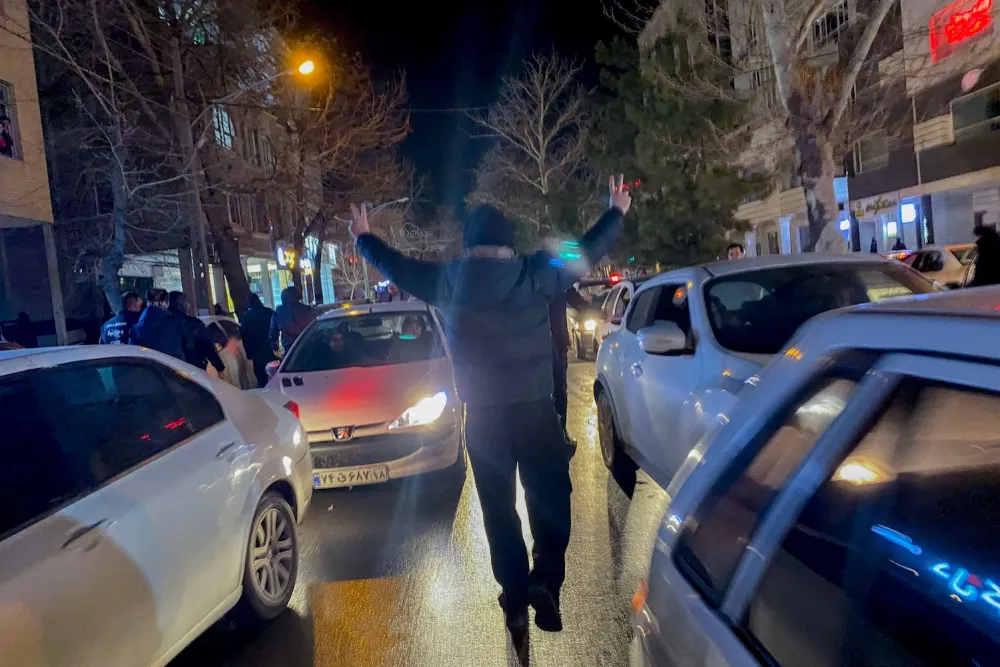
Washington can intervene militarily, but any regime change strategy needs to start in Iran itself.
U.S. military interventions to achieve regime change have rarely ended well for the countries involved, including the United States itself. Saddam Hussein was hanged, but Iraq continues to struggle to get back on its feet 20 years later. The Taliban are back in Afghanistan after the United States spent two decades and billions of dollars in the country. Muammar al-Qaddafi was dragged through the streets after a military intervention, but Libya remains split and floundering between parallel power centers.
Yet, as the Iranian government killed thousands of protesters under the cover of an internet blackout in recent weeks, the question of a military intervention to support the Iranian opposition is again on the table—and so is the question of whether it can make any difference in the absence of a more organized Iranian political opposition.
Last Wednesday, after thousands of protesters were reported dead and many thousands more arrested, U.S. President Donald Trump said he had been told “the killing in Iran is stopping—it has stopped—it’s stopping,” indicating a pause in plans for military action. But the broader strategic question remained unanswered: What sort of military intervention in Iran could realistically promise to tilt the balance in favor of protesters calling for an end to the theocratic state?
A large-scale military operation is deemed risky. Saudi Arabia, Oman, and Qatar have warned the United States against regime change, owing to fears of regional unrest and an upset in the oil prices. Israeli officials have reportedly conveyed that the regime isn’t yet at the point of collapsing.
One scenario would involve targeted but limited strikes on the facilities and properties of those threatening the protesters on the ground. High on the list of targets could be the offices and business interests of the Islamic Revolutionary Guard Corps (IRGC), which was formed in 1979 to protect the regime.
The United States could also target the Basij militias, the plainclothes operatives who impose the regime’s moral code at the local level and suppress protests with violent means. A sustained campaign over a short time could have a chance of weakening the IRGC, encouraging protesters to publicly demonstrate and opposition groups to organize.
Hitting the regime with cyberattacks has also been reported as a possibility. Shmuel Bar, who served in the Israeli intelligence community for 30 years and heads the software firm IntuView, said conventional military strikes on the IRGC infrastructure would “embolden the protesters.
But he said cyberattacks would be less effective. “Planning cyberattacks may take a while, and the damage would not necessarily be focused on the regime,” Bar said. “If you disable all the petrol distribution system via a cyberattack, you are harming the public more than the regime.” The Stuxnet attack on Iran’s nuclear program, which was uncovered in 2010, took years of intricate planning.
Other hybrid and covert warfare tools could be deployed to distract the regime and spread the IRGC thin. Bar said the United States retains the option to reach out to Balochi and Kurdish separatists and was already perhaps gathering intelligence on possible defectors to be lured from government agencies, including the IRGC. More than 60 percent of Iran’s population is Persian, and a majority are Shiite Muslims.
But the population is at least 10 percent Kurds and 2 percent Balochis—both have sought greater political and economic rights and are seen by the Iranian state as secessionists. The thinking is that an uprising in Kurdish- and Balochi-dominated areas could keep the IRGC occupied while allowing protesters more room to plan, demonstrate, and organize. But any effort that involves foreign support to the ethnic minorities could be used by Iran to coalesce the majority around the flag and weaken the protests.
In the absence of foreign boots on the ground that can physically topple the regime, the position taken by Iran’s conventional armed forces—or Artesh—may prove to be decisive. There is a possibility that Artesh, which is mostly believed to be apolitical, could explicitly side with the protesters and take on the IRGC. Some have suggested any such clash could produce a less authoritarian Iran, more in step with the times. But it could equally lead to a civil war and chaos that engulfs not just Iran but also spills over into the region.
However, under an external threat, Artesh has always sided with the regime. Trita Parsi, the executive vice president of the Quincy Institute, said that in the wake of the U.S. threat, the army was already standing alongside the regime. Shahin Gobadi, a spokesperson for the People’s Mojahedin Organization of Iran (PMOI)—an opposition group in exile—said Artesh has been co-opted by the regime. “One should not count on them defecting at this moment. But in the last stages, rats will start to jump the ship,” he told me over the phone from Paris.
For now, the main problem is the lack of a coherent political opposition in Iran. The last time one existed was 2009, when the Green Movement erupted on the streets after hard-liner Mahmoud Ahmadinejad claimed victory in that year’s presidential election. Former Prime Minister Mir Hossein Mousavi emerged as a symbolic leader at the time but has since been under house arrest. In the intervening years, the regime has essentially not allowed any dissenting voices to organize in any fashion.
“The government has systematically repressed all attempts to organize political opposition in Iran—by banning entities, imprisoning leaders, and disrupting or fully dismantling even nonpolitical NGOs such as charities and unions with spurious politicized charges,” said Maryam Alemzadeh, an associate professor in the history and politics of Iran at the University of Oxford. “Even nonpolitical public figures—actors, artists, writers—face persecution if they take the slightest politically charged stance against the government.”
https://foreignpolicy.com/2026/01/21/the-u-s-military-cant-fix-irans-opposition/