
US-Israeli strikes on Iran, amid ongoing diplomacy, undermine the NPT’s credibility. Tehran will likely pursue nuclear weapons for survival, viewing non-proliferation as a strategic error. This erodes the “grand bargain,” encouraging threshold states to prioritize deterrence over restraint, with grave implications for the global non-proliferation regime.
The conflict in Iran will have far-reaching consequences, not only hardening Tehran’s position and willingness to negotiate on the nuclear issue in future, but also by undermining the broader credibility of the non-proliferation regime.
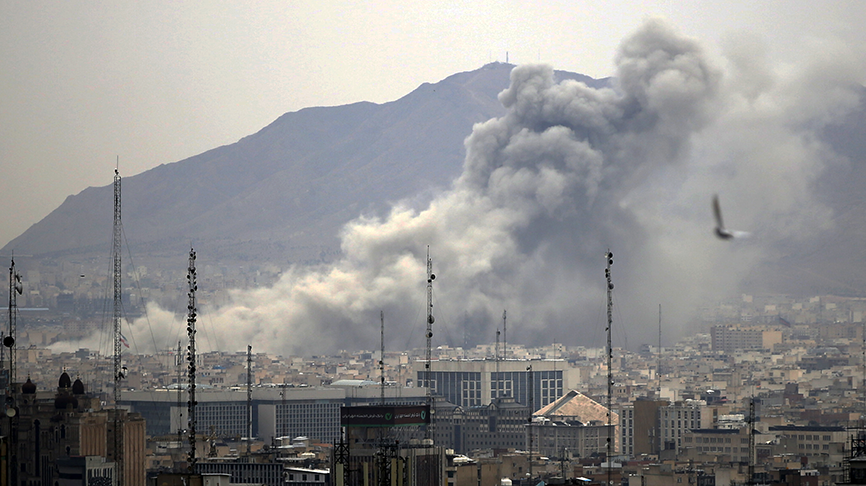
On 28 February, the United States and Israel launched joint missile strikes and airstrikes targeting several Iranian cities. This included a decapitating strike that assassinated the country’s supreme leader, Sayyid Ali Khamenei. The apparent objective of these strikes was to fuel regime change in Tehran (as US President Donald Trump framed the situation speaking to the Iranian people: ‘When we are finished, take over your government. It will be yours to take’) and conduct preventive counter-proliferation measures. The principal disagreement between Washington and Tehran – evident before and during their latest round of nuclear talks – has concerned the latter’s uranium enrichment levels, and monitoring mechanisms. Trump’s hardline stance with respect to Iran’s nuclear compliance – a consistent feature of both his presidential terms – has gradually narrowed the scope for negotiated de-escalation.
Diplomacy falters
In February 2026, high-level talks between the US and Iran, facilitated through third-party mediation, were underway in Oman and Geneva. These sought to reconcile the United States’ and its allies’ demands for caps on Iran’s enrichment levels with Tehran’s insistence on its legal rights as laid out in the Treaty on the Non-Proliferation of Nuclear Weapons (NPT).
Late in the month, several media reports and a statement by Oman’s foreign minister, the principal interlocutor in the talks, hinted at Iran’s willingness to discuss the ‘level and purity’ of uranium enrichment in return for military de-escalation, respecting Tehran’s right to enrich uranium, and sanctions relief. This could potentially have led to terms exceeding Iran’s original commitments under the Joint Comprehensive Plan of Action, which required it to cap uranium enrichment at 3.67%, possibly offering Trump an opportunity to claim a victory, overcome the deadlock and reach a diplomatic solution, thereby living up to his claims to be a ‘Peace President’. As Iran opposed the inclusion of other issues, such as its ballistic-missile programme, in the scope of talks, no significant progress was achieved.
However, there have been questions raised about the extent to which both parties were negotiating in good faith in this latest round: Iran sought to retain large-scale uranium enrichment capability, reportedly including IR-6 centrifuges, raising suspicions that it wanted to shorten nuclear breakout timelines; while Washington’s decision to opt out of technical talks in early March 2026 suggests it did not seek to first exhaust the negotiating process before considering military options.
Indeed, the timing and sequence of US and Israeli military action on 28 February – despite an announcement one day prior that talks would continue in Vienna – have raised serious concerns that the diplomatic process was merely a procedural formality to legitimise an already decided course of action. The ensuing conflicting justifications offered by the US and Israel – initially focusing on how quickly Tehran could develop nuclear weapons, then on its missile development programme, and later on a claim of an imminent threat of a possible Iranian first strike – as well as the resurfacing of a narrative about Iran being close to producing nuclear weapons, provide little to discredit this assessment. These justifications are further undermined by Washington’s claim in its latest National Defense Strategy that its June 2025 strikes against Iran (Operation Midnight Hammer) had ‘obliterated’ Iran’s nuclear programme, as well as International Atomic Energy Agency Director General Rafael Grossi’s assessment in early March that there was neither a structured programme in Iran to manufacture nuclear weapons, nor was it days or weeks away from building a bomb.
Prospects for future diplomacy, and the broader non-proliferation regime
The US and Israeli campaign is unlikely to yield the desired results for the Trump administration. In the event of regime collapse and internal instability, loss of control over existing Iranian nuclear material could lead to further risks of proliferation. A more probable outcome is the Iranian regime surviving, disengaging from further nuclear talks and concluding that only a nuclear weapons capability can guarantee its survival. Pushing a weaker state in a situation where it considers its survival to be threatened generally leads to overt resistance rather than restraint; in coming years, the Iranian government is likely to adopt a more hardened stance while drawing two crucial takeaways from this experience. Firstly, it may conclude that giving up the sovereign right to develop a nuclear-deterrent capability by signing the NPT in 1968 was a significant strategic error. Secondly, it may note that its long-standing strategy vis-à-vis its nuclear programme could neither provide a deterrent nor assure the international community of Tehran’s commitment not to develop a nuclear weapons capability. Indeed, Iran apparently had to pay a heavy price for something it did not possess. And while Iran entered into fresh negotiations following Operation Midnight Hammer – in which its Fordow and Natanz enrichment facilities and its Isfahan metallurgy facility were targeted – the damage caused by this latest, mid-negotiation attack might outweigh any perceived incentive for Tehran to negotiate in good faith.
For the broader global nuclear non-proliferation regime, the most significant implication of this conflict will be the undermining of the ‘grand bargain’ as enshrined under Article II of the NPT, which requires non-nuclear weapons states signatory to the treaty to not develop or acquire nuclear weapons, in exchange for vague disarmament promises and technical assistance in developing nuclear technology for peaceful applications. Ironically, the US has worked with Israel, a non-signatory, to conduct ‘preventive counterproliferation’ strikes against an NPT signatory engaged in negotiations on its nuclear programme. Future Iranian governments may be more convinced than ever that a nuclear weapons capability is essential insurance against attack from powerful adversaries. Furthermore, these developments are happening against the backdrop of the war in Ukraine; there has been growing belief in Ukraine that its decision to denuclearise in 1994 without credible security guarantees left it vulnerable to external aggression.
Outlook
The example of Iran, and the resultant undermining of the nuclear non-proliferation regime’s credibility, might exacerbate perceptions among non-nuclear-weapon states that they need nuclear weapons to guarantee deterrence, pointing to a serious risk of proliferation. In this context, the upcoming NPT Review Conference is expected to be deeply contentious. Recent events in the Middle East can be expected to have far-reaching consequences, lowering confidence in diplomatic processes, the effectiveness of third-party mediators and, ultimately, the credibility of the ‘grand bargain’ that incentivised restraint over sovereign rights to develop nuclear-deterrent capabilities. States might also draw the conclusion that a nuclear-weapons capability is the most effective tool to deter possible aggression. (The growing salience of nuclear weapons capabilities in the national-security strategies of nuclear-weapons states suggests this.) After witnessing the consequences of the political decision to not develop nuclear weapons in Iran and Ukraine, nuclear-threshold states may come to privilege deterrence over restraint in pursuit of security.