
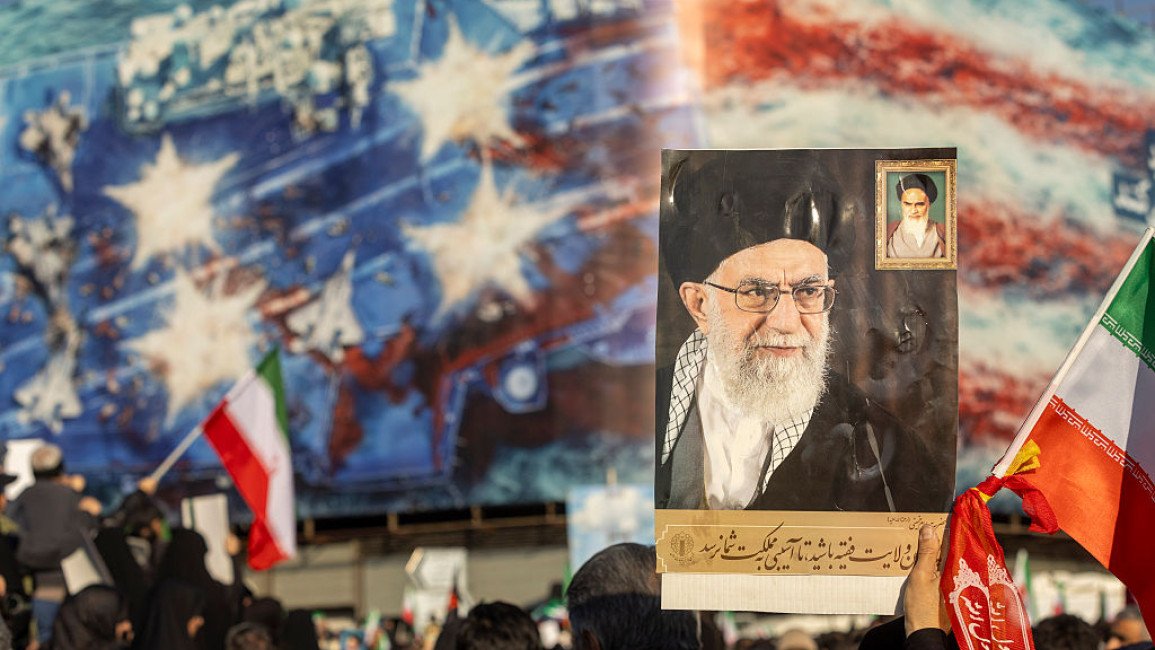
The opening phase of the current US–Israeli campaign against Iran has been defined by an explicit theory of change: decapitate senior leadership from the air, degrade the coercive apparatus, and avoid a ground war. In practice, that has meant a joint strike killing Supreme Leader Ali Khamenei and other senior figures, followed by an expanding air campaign against military and security bases framed as decisive pressure rather than limited punishment.
This approach sits inside a longer-running American constraint: post-2008 US strategy has increasingly favored airpower, financial leverage, and partner-enabled pressure over large occupations. That shift doesn’t remove coercion; it changes its preferred instruments.
If you accept those constraints, Washington’s operational menu is often framed around two broad tracks. The first is a hope that weakening the security state creates an opening for mass uprising. This option has precedents. Libya in 2011 showed how external military pressure can intersect with internal fragmentation and mobilization to accelerate regime collapse.
The Islamic Republic is not politically stable, popular, or economically healthy: since 2017, repeated uprisings, cumulative legitimacy erosion, and the strain of sanctions-driven crisis governance have underscored real vulnerabilities. Donald Trump’s calls for Iranians to rise up, combined with strikes aimed at military and security infrastructure, suggest at least rhetorical openness to this pathway.
No boots on the ground
The second track is more technocratic and increasingly attractive under “no boots on the ground” conditions: a Venezuela-style model. In January 2026, the United States removed Venezuelan president Nicolás Maduro through a direct capture operation and then sought to shape the post-Maduro order without assuming the burdens of full occupation. The episode is often described as a new form of “regime management”: not state dismantlement, but the external management of elite bargaining and policy direction after leadership removal.
It is tempting, especially under “no boots on the ground” constraints, to treat that sequence as a transferable template: remove the apex, keep the bureaucracy intact, use sanctions relief and diplomatic recognition as leverage, and secure a political settlement aligned with US demands.
The problem is that the mechanism people imagine in Venezuela does not map cleanly onto Iran. And the danger is not just conceptual sloppiness. A bad analogy can harden operational choices that intensify war while making the promised political outcome less, not more, likely.
The 2026 Venezuela episode is often invoked as a proof of concept. At most, it supports a narrower set of claims than its advocates usually admit.
First, apex removal can matter a great deal in systems where authority is highly personalised and senior elites calculate that accommodation is safer than resistance. If the coercive core believes it can preserve institutional continuity, immunity, and economic position by accepting a new bargain, leadership removal can accelerate realignment.
Second, post-removal steering can occur through selective leverage, including the sequencing of sanctions relief, access to financial assets, and international recognition, without the coercer needing to administer the country. That is the practical meaning of “managed transition” in this narrower sense: a controlled reconfiguration of elite incentives.
Those propositions are specific to a political system where authority is concentrated enough that removal is structurally transformative, and the successor can plausibly consolidate control without triggering systemic fragmentation. Several indicators suggest Iran is a different type of case.
Power in Iran
Iran’s system is a dense, institutionalized coalition in which coercion, political authority, and economic control are interlocked. Two features matter most for any attempt to engineer a Venezuela-style outcome.
Over the past two decades, Iran’s political economy has been shaped by what I call the military–bonyad complex: a dense ecosystem that links the military and security apparatus to revolutionary foundations and parastatal institutions controlling key economic nodes under the Supreme Leader’s umbrella and his trusted, entrenched clerical network.
Recurrent cycles of sanctions and crisis have generally reinforced, rather than weakened, this system by increasing the value of privileged access and reliable channels. It has become a central pillar of the state, shaping domestic politics and foreign policy alike, including Iran’s deeper alignment with Russia and China in recent years. This is a governing architecture that fuses coercion with political economy to preserve power and privilege.
This is also why treating Khamenei as a removable “dictator-king” misstates how power worked. He was a dictator in the sense that ultimate authority rested under his office, and dissent was coercively contained. But analytically, he functioned as a powerful arbitrator and system manager, a central node who fostered the growth of the military–bonyad complex, allocated rewards and protection, and brokered among competing elites to keep the system running.
The institutions and coalitions he curated matter more for regime continuity than the survival of any one leader.
In such an ecosystem, leadership loss can trigger succession bargaining, but it does not automatically generate a compliant pivot because continuity is a collective project. Multiple veto players have both the capability and the incentive to block an externally steerable transition if they read it as threatening institutional survival.
Furthermore, a central assumption in many Venezuela analogies is that the security sector can defect as a bloc, or that compliance cascades once the leader is removed. Iran’s coercive architecture complicates that logic.
The Islamic Revolutionary Guard Corps is not a single actor in the way outside commentary often implies. It is a federation of semi-autonomous components with overlapping mandates, layered command relationships, and ideological oversight. That structure raises the transaction costs of coordinated defection and tends to channel elite conflict into bargaining and internal reprioritization rather than open rupture. It also means that destabilization in one part of the system does not necessarily produce collapse in another.
Under wartime conditions, these dynamics usually intensify. When elites interpret the conflict as existential, the incentive to preserve the governing coalition rises, particularly for actors whose power, wealth, and personal security are tied to the system’s survival.
The impact of war
The current war further weakens the Venezuela analogy in one additional way: Iran can export costs. Venezuela could not credibly widen a regional battlefield. Iran can, and is attempting to do so through retaliation against US assets and partners in the Gulf and through the wider axis network, even if those efforts have variable military effectiveness.
That matters for regime-management strategies because it changes escalation control. A pressure campaign designed to “manage” internal fragmentation can become, in practice, a widening regional conflict that forces the coercer into harder choices: escalate further, accept partial objectives, or search for a de-escalation exit.
If Tehran reads decapitation and air campaigns as steps toward dismantlement, then widening the battlefield is not irrational adventurism. It becomes a bargaining instrument. Under its own deterrence logic, exporting costs may look more rational than accepting an externally engineered transition.
This is where the Venezuela analogy stops being merely weak and becomes actively misleading. The more Iran’s leadership treats decapitation and sustained air attack as existential, the more likely it is to respond by turning endurance and escalation into leverage rather than by submitting to externally managed political reordering.
None of this implies Iran is stable, popular, or economically healthy. The Islamic Republic carries a deep legitimacy strain, recurring protest cycles, and serious economic vulnerabilities. The point is narrower: Venezuela 2026 does not show that leadership removal plus external leverage reliably produces an externally steerable transition.
The more plausible near-term trajectory is intensified succession bargaining and tighter securitized coordination inside the coercive–economic bloc, not elite capitulation. And if mass mobilization fails to break through while the system holds, Tehran has a rational path available to it: convert endurance into leverage, stretch the conflict, impose intermittent but persistent regional costs, and wait for political pressure to build in Washington so that any de-escalatory exit becomes a negotiated off-ramp rather than a surrender.
The danger, then, is that a strategy marketed as low-occupation “regime management” mutates into a prolonged coercive contest in which escalation control erodes faster than political steering succeeds.
If Washington’s core objective is to avoid another occupation, the central question is not whether it can impose costs. It is whether apex disruption can be converted into a controllable political settlement, and whether the region can absorb the escalation risks incurred in the attempt. On institutional structure and early wartime dynamics, the Venezuela analogy is more likely to mislead than to guide.