
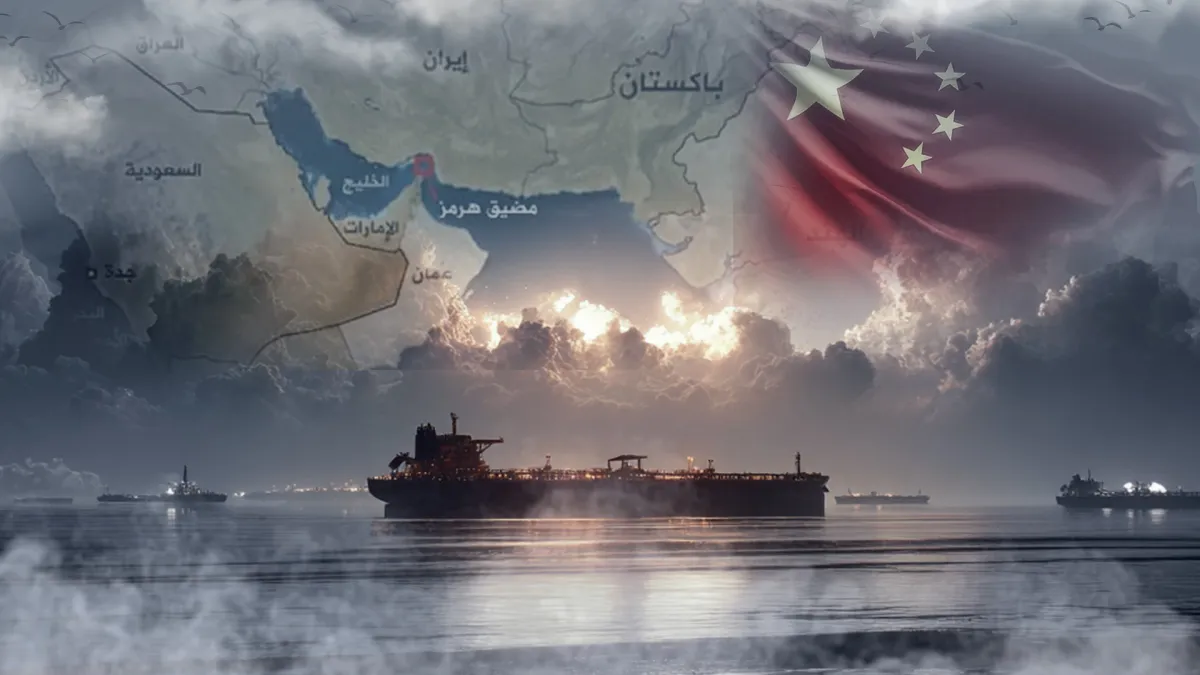
As U.S. and Israeli strikes on Iran continue, Iranian Foreign Minister Abbas Araghchi said in an interview with NBC News that Tehran would not close the Strait of Hormuz.
However, the waterway has been almost effectively shut down by the war. Commercial ships and oil and gas tankers have chosen not to pass through it, driving up transport and insurance costs and disrupting energy markets in both exporting and importing countries.
Among those countries is China, the world’s largest energy importer. Beijing quickly moved to hold talks with Iran to allow Qatari crude oil and liquefied natural gas vessels to pass safely through the Strait of Hormuz, according to three diplomatic sources who spoke to Reuters on Thursday.
China relies heavily on Middle Eastern oil. According to Henry Tugendhat of the Washington Institute for Near East Policy, “Hormuz remains China’s main concern, because about 45% of its oil imports pass through it.”
So how could any disruption in the Gulf region affect China’s economy?
Price Shock
The fastest way the war’s impact could reach China is through energy prices. As tensions in the Gulf escalate and Iran targets some oil facilities, crude prices have surpassed $80 per barrel, amid fears of supply disruptions or an expansion of the conflict.
For China, this increase represents a direct economic burden, as it imports most of its oil needs. International energy estimates suggest that more than half of China’s oil imports come from the Middle East.
The effects have already begun to appear. Some Chinese refineries have reduced operating rates or accelerated maintenance work to avoid buying expensive crude, while the government has taken steps to stabilize the domestic market, including temporarily reducing refined fuel exports.
The greatest pressure is appearing in energy-intensive industries such as steel, petrochemicals, and cement—sectors that are central to an economy heavily dependent on manufacturing and exports.
Nevertheless, researchers believe China has several buffers that could give it time to manage the crisis.
“Three Chinese Buffers”
The first margin China can rely on temporarily is its oil reserves.
Tugendhat estimates that Beijing has been seriously building up its strategic oil stockpile over the past year, enough to cover about 104 days of demand. This gives China time that many Asian economies dependent on daily imports do not have.
A comparison with South Korea highlights the difference. A South Korean official said the country’s liquefied natural gas reserves would last only about nine days, while Seoul imports 20% of its LNG through the Strait of Hormuz.
The second buffer involves Iranian oil already at sea. As Chinese demand declined somewhat during 2025, many Iranian tankers remained anchored offshore awaiting unloading—a trend that has been visible since last December. In this sense, the cargo aboard those tankers has become a “floating stockpile” that China could draw upon if needed.
Another factor providing Beijing some flexibility is domestic production. According to Tugendhat, China still produces about 27% of its oil consumption domestically, slightly reducing its dependence on maritime imports.
But these buffers, even if they give China more time, do not eliminate the risks if the war drags on.
The Strait’s Dilemma
According to Antoine Halff, a nonresident fellow at the Center on Global Energy Policy at Columbia University, Beijing’s ability to absorb the shock remains limited over time.
Halff warns that a prolonged closure of the Strait of Hormuz would not only cause oil supply shortages but could also trigger a global economic slowdown due to disruptions in energy markets and international trade.
The strait is one of the world’s most critical energy arteries, carrying around one-fifth of global oil trade and a large share of liquefied natural gas exports. Its sensitivity for China lies in Beijing’s heavy dependence on Gulf oil.
This dependence explains China’s heightened vigilance toward any escalation in the region, as it seeks to protect its energy interests.
It also explains Beijing’s efforts to maintain secure navigation through this vital passage.
Even without a formal closure, shipping can still be disrupted because of higher insurance costs and shipping companies’ reluctance to transit the area—what energy experts call “logistical choke points.”
Consequences of a Strait Closure
The most dangerous scenario remains a prolonged disruption to shipping. According to Halff, the scale of the impact would depend largely on how long the closure lasts.
“It is difficult to overstate the scale of the impact if the closure continues,” Halff said, noting that China depends on the Gulf for more than half of its oil imports. Any major supply disruption would therefore deliver a clear shock to the Chinese economy.
Some oil could be rerouted through alternative routes bypassing the strait, such as Iran’s Jask Port or the UAE’s Port of Fujairah, or through pipelines to the Red Sea. However, Halff stressed that these routes would replace only a limited portion of the disrupted supply.
More importantly, China does not appear ready to become directly involved in the conflict, despite the risks it faces.
As Tugendhat put it: “This crisis is not the hill China will die on, but that does not mean it will remain unconcerned.”