
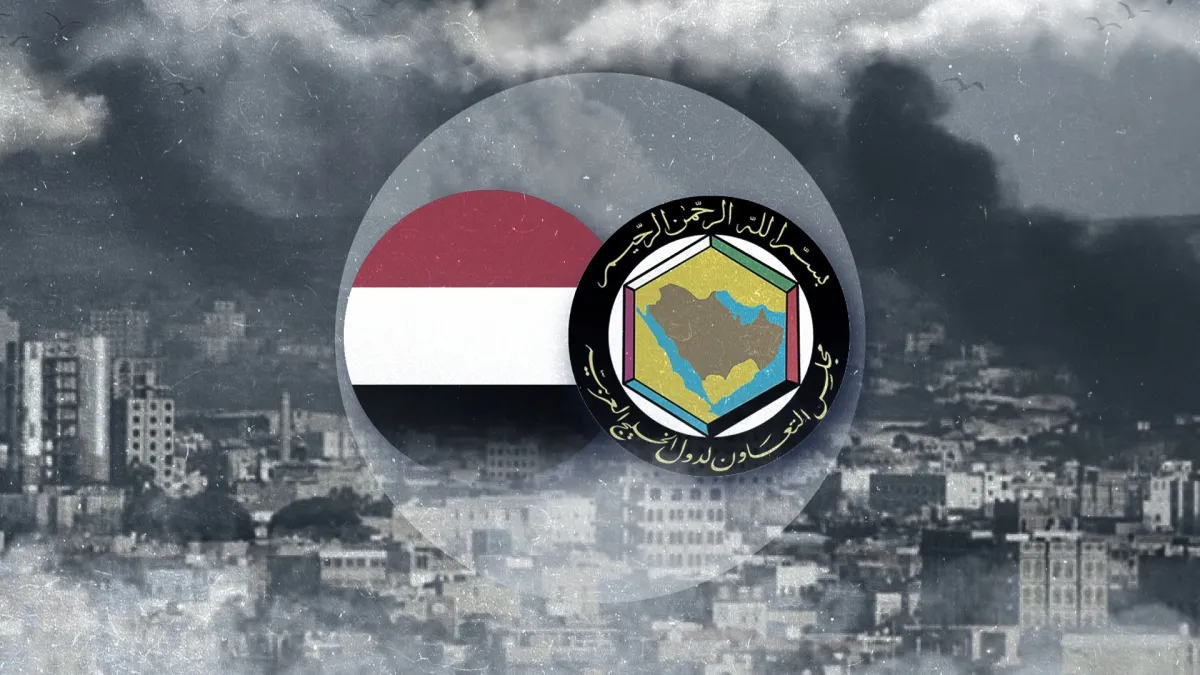
Discussion has resurfaced about Yemen’s potential accession to the Gulf Cooperation Council, following official Yemeni statements that have returned the issue to the forefront of regional political debate.
Last week, Yemeni Presidential Leadership Council Chairman Rashad al-Alimi renewed his call for the country’s full integration into the Gulf Cooperation Council through what he described as the “Saudi gateway,” underscoring the importance of elevating Yemeni-Gulf relations to the level of a comprehensive strategic partnership.
During a dialogue session organized by the Gulf Research Center in cooperation with the International Crisis Group on the growing role of Gulf states in conflict resolution, al-Alimi expressed his government’s aspiration to build institutional integration and comprehensive geo-economic alignment with GCC countries. He proposed launching a Gulf “Marshall Plan” for Yemen’s reconstruction, inspired by the Saudi Development and Reconstruction Program for Yemen.
For his part, Yemeni Deputy Foreign Minister Mustafa Ahmed al-Ta’man told Alhurra that Yemen’s accession to the GCC is “natural by virtue of geography,” pointing to the depth of historical and political ties linking the country with GCC states, particularly Saudi Arabia and Oman.
He noted that the council’s name could, in the future, open discussion about its geographic framework should Yemen join, given that the country is part of the Arabian Peninsula and represents strategic depth for it. However, he stressed that this path remains contingent on achieving political, security and economic stability in Yemen.
This is not the first time the issue has been raised. For years, Yemeni calls for full GCC membership have recurred, receiving varying responses from Gulf figures. Bahrain’s king, Hamad bin Isa Al Khalifa, has voiced support for Yemen’s accession, while Kuwaiti National Assembly Speaker Marzouq al-Ghanim has called for its inclusion based on shared social fabric and historical ties.
In a similar context, Saudi Prince Turki al-Faisal proposed developing the GCC toward a Gulf or “peninsular” union that would include Yemen once its conditions stabilize.
Saudi writer Suleiman al-Oqaily argues that Yemen’s accession is not a new idea but has long faced several constraints, including developmental disparities, differing economic conditions and the contrast between Yemen’s political system and the monarchies of GCC states. However, he believes rapid regional shifts have revived the debate from a strategic and security perspective, as Yemen’s continued exclusion from the Gulf framework has become a source of challenges extending beyond its borders and affecting the region’s overall security and stability.
Current debate centers on whether present transformations could pave the way for a historic step that redraws the GCC’s map, or whether the road to full membership remains tied to unresolved internal Yemeni requirements and the limits of mutual benefit from such a move.
Realism of the proposal
By virtue of geography, Gulf states have for decades been vulnerable to developments in Yemen, particularly as the country has become an arena for regional and Arab influence.
Former Yemeni Human Rights Minister Mohammed Askar told Alhurra that a decade of war and division has weakened state sovereignty and turned Yemen into a field of competing external influence, negatively affecting regional security and stability.
But Askar stressed that Yemen’s full accession to the GCC is impossible amid division and instability, meaning there is a need to “find a gradual integration path governed by timelines and clear institutional mechanisms.”
Yemen joined several GCC-affiliated educational, economic, health and sports bodies about 25 years ago, but this did not lead to major steps toward full integration.
For that reason, Askar called for “preparations for full membership to begin today, even if it cannot currently be announced.”
Al-Oqaily likewise told Alhurra that Yemen’s accession may initially appear to be an economic burden and developmental challenge due to disparities in development levels. However, this perception could change as institutional harmonization and integration progress. He ruled out near-term accession, explaining that time is needed to complete Yemen’s political settlement and implement economic reforms and institutional rehabilitation.
Humanitarian Reality
Yemen faces one of the world’s most complex humanitarian crises. About 19.5 million people require humanitarian assistance and protection services – an increase of 1.3 million compared with 2024 – according to the United Nations, reflecting widening vulnerability and deepening basic needs.
Indicators show that roughly 17 million people suffer from food insecurity, while more than 1 million children under age five face acute malnutrition. The health sector has also experienced a sharp decline in operational capacity, with many facilities functioning only partially or out of service due to shortages of funding, equipment and personnel.
Economically, Yemen has lost about $90 billion of its GDP since 2015, and around 58% of the population lives in extreme poverty, deepening reliance on external aid.
Describing this reality, former Yemeni Minister of Local Administration and head of the Supreme Relief Committee Abdulraqib Saif Fatah told Alhurra that war has destroyed basic foundations of life across most provinces – from electricity, water and food to currency and public services. He explained that the national currency has fallen from 215 to 1,625 per dollar – an approximately 650% decline – and that per-capita government spending dropped from $480 in 2014 to about $39 in 2025, placing Yemen among the worst economic conditions in terms of the state’s ability to fulfill responsibilities toward citizens.
Fatah therefore considers launching a Marshall-style project for Yemen an urgent necessity, provided it is multi-track and addresses basic needs alongside reconstruction, at an estimated cost between $100 billion and $150 billion.
A Gulf Marshall Plan
Al-Alimi’s call for a Gulf Marshall Plan for Yemen’s reconstruction was preceded by Saudi Arabia’s 2018 announcement of a development and reconstruction program for Yemen that includes implementing development and service projects across Yemeni provinces.
Al-Oqaily expects the Saudi program to continue operating even before a comprehensive political settlement is completed, “as part of the kingdom’s vision to achieve Yemen’s stability and strengthen its governmental and national sovereignty.” He noted that roughly $2 billion has been spent so far under the program – a significant figure in the economic context – allocated solely to development and reconstruction projects, excluding aid from the King Salman Humanitarian Aid and Relief Center.
Many observers agree that Yemen’s accession to the GCC requires, in addition to ending armed conflict and unifying the country, structural economic reforms and massive investment across sectors exceeding the Gulf assistance provided in recent years.
Askar noted that the term “Gulf Marshall Plan” will remain a media description unless its elements become clear – such as the identity of donors, governance of grants and strategic projects, the availability of a security environment protecting projects, and a clear financial center to regulate currency and manage funding.
Instead of waiting for a political settlement, Askar proposed phased recovery beginning with salaries and basic services – electricity, water, health and education – through institutional programs, “along with unifying revenues in liberated areas and channeling them to the Central Bank in Aden, then moving toward productive projects.”
He concluded that reconstruction neither fully precedes politics nor waits entirely for it; rather, it can be used as leverage to reduce the war economy and lower the cost of state paralysis.