
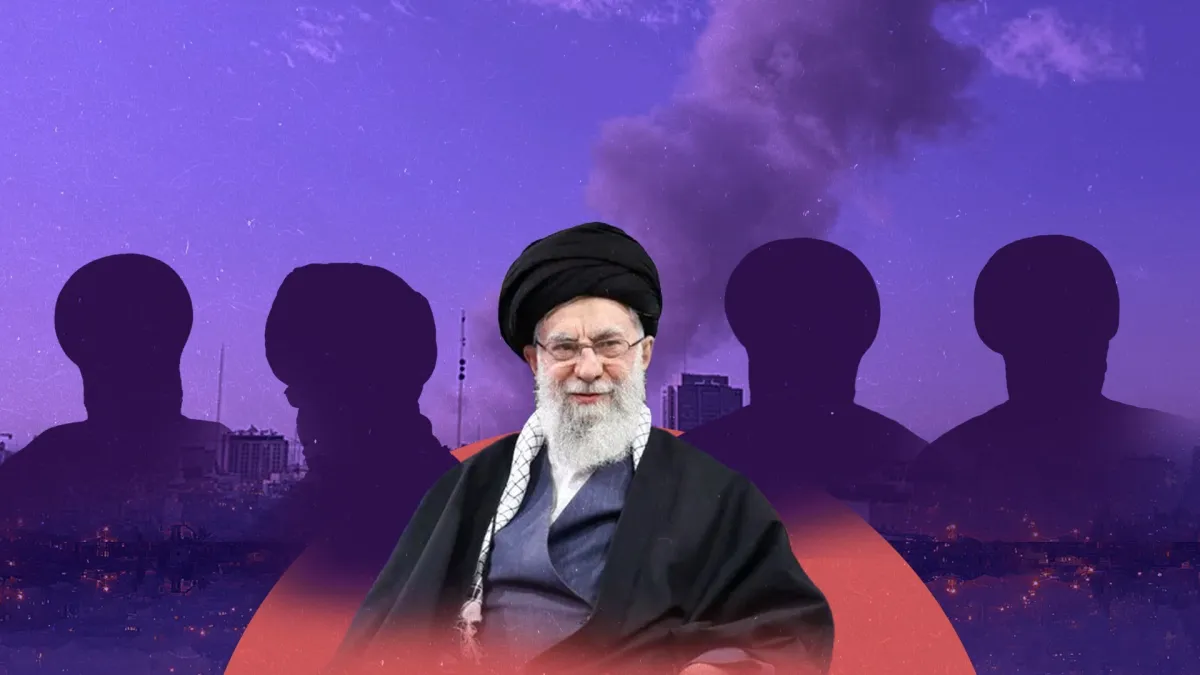
Iran’s wartime succession is a power struggle between clerics favoring continuity (Arafi) and an IRGC pushing military rule. A battered society, fresh from brutal repression, could erupt again. The outcome hinges on elite unity and protest scale.
Because Ali Khamenei was killed in a foreign airstrike rather than dying in bed, the succession is unfolding under a different set of rules. Instead of a planned insider handover, Iran now faces a war‑time power struggle. The IRGC can point to the assassination and the U.S.–Israeli attacks to argue for an overtly military system run under sweeping emergency powers.
Iran’s political future now depends on how three arenas collide: the leadership struggle, a security establishment fighting for its own survival, and a battered society radicalized by years of repression and economic collapse. A succession that might once have been carefully controlled can easily turn into a scramble after strikes that decapitated senior leaders and damaged key security sites.
Leadership struggle
A narrow, managed succession is still the default in the Islamic Republic, but the chance of a sharper turn toward the military, or of elite infighting, is real. Formally, the next move belongs to the 88‑member clerical Assembly of Experts, which chooses the new supreme leader. On paper, it can pick a single cleric or set up a temporary leadership council.
In the “business as usual” scenario, regime insiders stage a tightly managed handover and the Assembly simply ratifies a candidate agreed by senior clerics and surviving security chiefs. The three names that come up most often, roughly from most to least likely, are:
Alireza Arafi, a senior jurist with deep roles in the Guardian Council, Assembly of Experts and as Friday prayer leader in Qom, the country’s main clerical center
Hashem Hosseini Bushehri, at the top of the Assembly of Experts presidium and Qom establishment
Mojtaba Khamenei, the late supreme leader’s son, with enormous informal power but facing strong public opposition to a hereditary succession
Other possibilities include:
Gholam‑Hossein Mohseni‑Ejei, chief of the judiciary and a long‑time security insider, widely viewed as more plausible as king‑maker or member of a leadership council than as sole religious authority
Mohsen Qomi and Mohsen Araki, names that surface in Tehran gossip but usually as second‑tier options
Hassan Khomeini, symbolically important as grandson of the first supreme leader but sidelined as politically unreliable and potentially too independent
In wartime, Arafi and Bushehri may look safer because they promise continuity; by the same logic, Mojtaba or a collective council can look like a gamble.
Mobilized security establishment
The war pushes the Islamic Revolutionary Guard Corps to the center of every scenario. The IRGC went into this crisis already dug into the economy, the bureaucracy and provincial power structures, with its own intelligence and media networks. U.S.–Israeli strikes have damaged some IRGC assets but also handed commanders a pretext to centralize authority and claim that only a security‑dominated state can defend the country.
Some senior officers may now prefer either a weak cleric as supreme leader, paired with de facto IRGC rule, or a system more openly run by national‑security institutions. That could mean backing someone like Mohseni‑Ejei, whose career bridges judiciary and security, or trying to turn the leader’s office into a collective body where generals sit alongside clerics.
Society
Iran enters this transition fresh from the uprising that began just two months ago to the day, with mass protests, a massacre‑scale death toll, and a population exhausted and alienated from the system after forty‑seven years of the Islamic Republic.
Against that backdrop, a wartime or postwar succession run as if nothing has changed, with the same tightly vetted insiders and emergency‑law repression, is likely to spark new waves of protest. By contrast, even limited signs of pluralization, power‑sharing beyond hard‑liners, or amnesties for detainees, could encourage the opposition to push harder.
What really matters now is five things: whom the Assembly ultimately settles on; how assertive the IRGC becomes; how large and organized public protest can be amid airstrikes and a newly emboldened IRGC; whether elite networks close ranks or splinter; and how long U.S.–Israeli operations continue.
A process that begins as a controlled clerical handover during a bombing campaign could, under pressure from generals, the street or foreign powers, tip into overt military rule or a much deeper crisis of the state. The endgame could be anything from a reconfigured but still resilient Islamic Republic to a long, chaotic fight over what replaces it.In 1989, Ali Khamenei was elected supreme leader within twenty‑four hours of Ayatollah Khomeini’s death. We are about to find out how different this succession will be.