
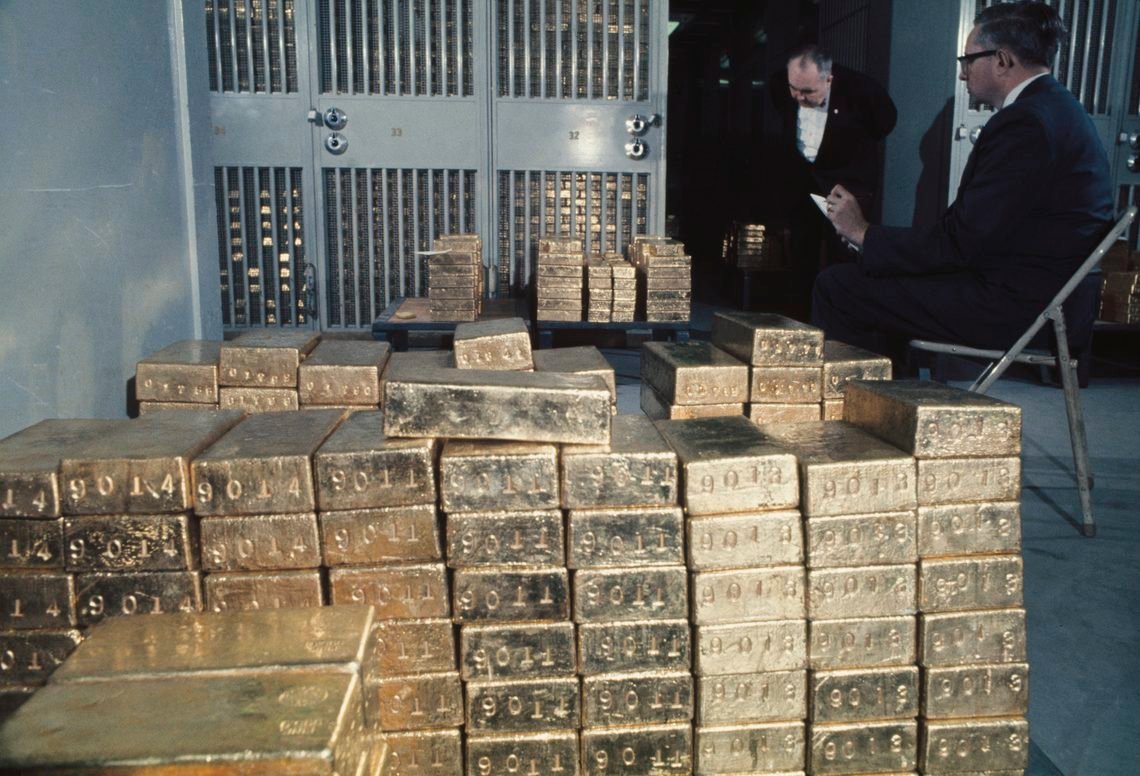
The Dutch central bank moved 86 tons and cited geopolitical risk openly, France completed full withdrawal, and Germany and Italy face pressure, as Gold repatriation shifts from quiet prudence to explicit contingency planning against American custody.
Gold Repatriation Signals Eroding Trust
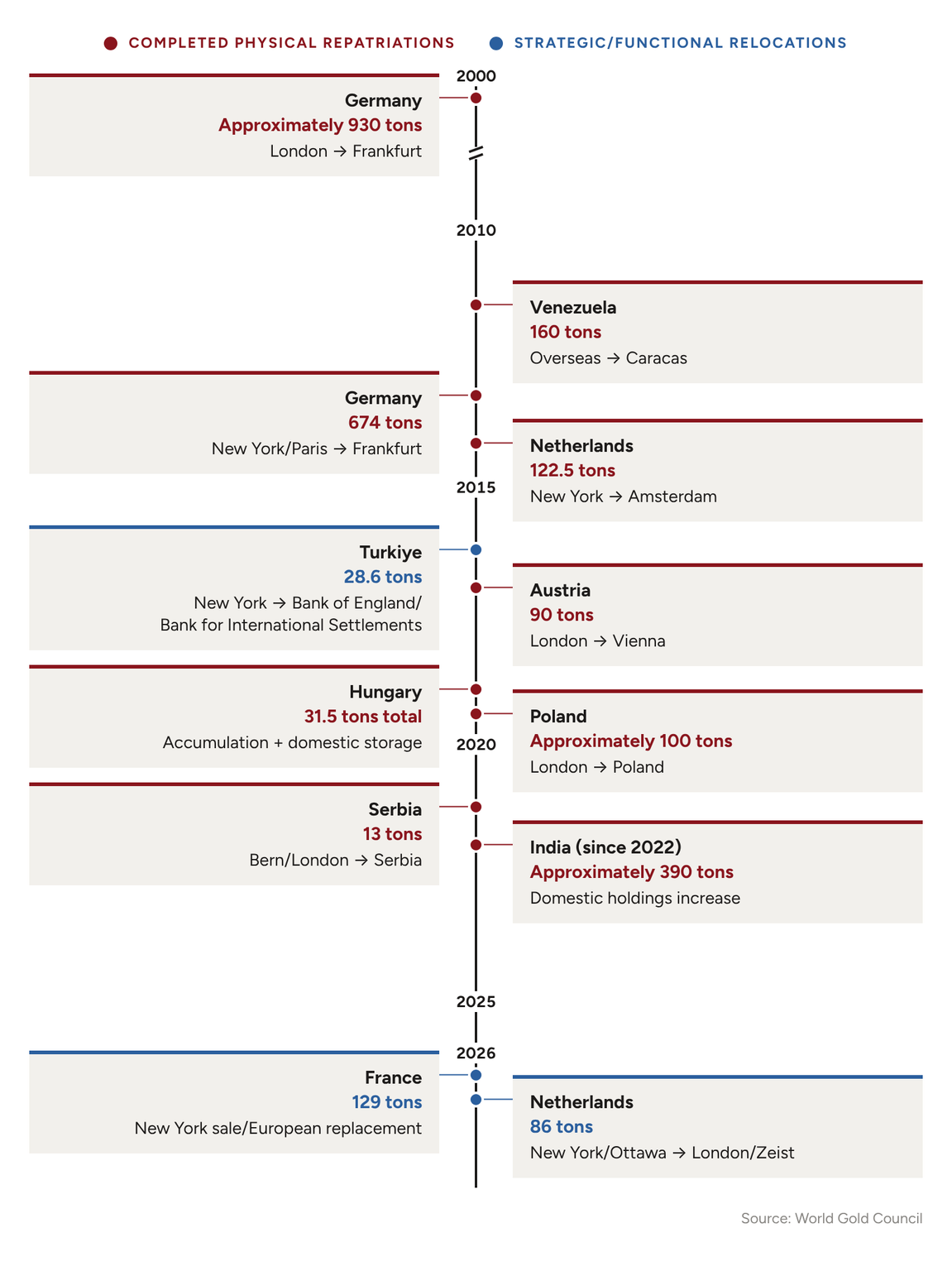
On September 2, 2026, the Dutch central bank (DNB) announced that between March and August it had relocated approximately 86 metric tons of gold from facilities in the United States and Canada to London and the Netherlands. The bank attributed this operation directly to rising geopolitical risks, emphasizing its commitment to strengthening crisis preparedness.
Improving the liquidity and tradability of its gold reserves formed part of those preparations, as did a more balanced distribution among North America, the United Kingdom and the Netherlands. Specifically, DNB sold around 59 tons held in New York and replaced them with equivalent gold in London. It also physically transferred more than 27 tons from the U.S. and Canada to its domestic Zeist facility.
As a result, London’s share of the Dutch gold reserves rose to 32 percent, surpassing the 31 percent held at home in Zeist. New York and Ottawa each account for 18.5 percent of the 612-ton total reserve.

Europe’s gold on the move
DNB Governor Olaf Sleijpen said that the bank did not expect to use the gold, but the move still drew attention, especially since it was not the first time a European nation had moved gold reserves out of the U.S. in recent years. Between July 2025 and January 2026, the Banque de France sold 129 tons of older, non-standard bars held at the Federal Reserve Bank of New York (about 5 percent of France’s total gold reserves) and purchased an equivalent amount of London Good Delivery bars for storage in Paris.
Officials described the decision as technical rather than political because many of the bars dated to the 1920s and no longer met the current purity and weight specifications used in international markets. However, the timing coincided with heightened transatlantic tensions under the second administration of U.S. President Donald Trump. Ongoing trade disputes and broader concerns about the reliability of U.S. custodianship after the 2022 freeze of Russian reserves also fueled speculation that the decision was not purely technical. Either way, France has removed the last of its gold from New York, and its entire 2,437-ton reserve is now held domestically.
Germany made similar moves earlier. Between 2013 and 2017, the Bundesbank repatriated 674 tons from New York and Paris, bringing roughly half of its reserves home to Frankfurt. Approximately 1,236 tons, or 37 percent of Germany’s total, remain at the New York Fed. In 2026, as trade tensions with the U.S. intensified, economists, taxpayer associations and politicians renewed calls to bring the rest home.
Former Bundesbank research head Emanuel Moench argued that storing such a large share in the U.S. had become risky and that greater strategic independence was warranted. However, Bundesbank officials have indicated that no new repatriation plan is under consideration. Italy faces similar domestic pressure, with about 43 percent of its reserves still stored in New York.
Why central banks are rethinking where they keep gold
These cases are part of a wider pattern evident in central-bank surveys and in individual countries’ actions. More institutions have increased domestic storage or diversified overseas locations in recent years. India has steadily repatriated gold from London. Serbia has concentrated its holdings at home. Austria previously rebalanced to hold half its gold domestically. Poland returned 100 tons from London in 2019 while expanding its overall reserves.
Several mutually reinforcing motivations lie behind these adjustments. Liquidity remains important, and London continues to offer the largest and most efficient physical gold market, which helps explain why the Dutch chose it over purely domestic repatriation.
Political considerations also matter, especially given the current geopolitical climate and the increasingly complex relations many countries have with the U.S. Demonstrating national control over a core reserve asset carries symbolic weight. Geographical diversification, meanwhile, is standard prudential practice.
Most importantly, the freezing of Russian assets in 2022 demonstrated that foreign-held reserves can be immobilized when geopolitical interests dictate, and that lesson has not been forgotten. Sanctions, trade disputes and regional conflicts have introduced new calculations about access and reliability. The Dutch statement is notable because it is rare for a major European central bank to cite the geopolitical rationale so openly.
Each reduction in New York holdings is a small signal that American custody is no longer viewed as risk-free by default. When even close allies adjust their storage maps and cite geopolitical risk as the reason, the message is that alliance membership no longer guarantees unqualified trust in institutional continuity.
What Scenarios Lie Ahead
Of course, this does not imply an imminent collapse of the dollar’s reserve status or a mass exodus from Treasuries. It does, however, reinforce parallel trends – the rising proportion of gold in central-bank portfolios, sustained official purchases and experimentation with non-dollar payment arrangements – that suggest countries are seriously considering contingency plans.
None of these developments is irreversible. A prolonged period of geopolitical stability and clearer norms around financial sanctions could slow or reverse the trend. Central banks continue to value the liquidity and security of major Western hubs. At the same time, recent decisions have pointed consistently in one direction. Once institutions have demonstrated both the capacity and the willingness to reallocate gold to prepare for geopolitical crises, the political threshold for future moves falls. Germany’s remaining New York holdings and Italy’s substantial exposure are the most consequential open questions in Europe.
Gold has always carried geopolitical significance. In an environment of renewed great-power competition and the weaponization of financial infrastructure, that significance is increasing, and the optics of these moves should not be underestimated. More nations now prioritize physical control of their ultimate reserve asset than during the long period when alliance structures and open financial systems were largely taken for granted. While the volumes involved so far remain limited, their broader strategic logic has far wider implications.

Gold Repatriation Accelerates Gradual Shift
Scenarios
Most likely: Continued gradual diversification away from New York
Gold’s share of official reserves will continue to rise, making the question of where it is held increasingly important. Additional European and Asian central banks will reduce concentration risk in New York and, to a lesser extent, London, citing tradability, preparedness and geographic balance.
London is likely to remain the preferred alternative for those who still seek high liquidity. Nations such as Germany and Italy could face recurring domestic pressure but are bound to move slowly, constrained by political considerations and the desire to avoid further friction with Washington.
Less likely: Acceleration triggered by a sanctions episode or access dispute
Another significant sanctions episode, a sharper deterioration in transatlantic relations or a high-profile dispute over access to foreign-held gold – such as the earlier dispute between Nicolas Maduro’s government in Venezuela and the Bank of England – could produce faster and more visible repatriations. The political cost of inaction would rise for governments that keep large shares abroad, and moves that currently take years could be compressed into months.
Least likely: Full restoration of the previous status quo
Restoring the earlier level of trust would require sustained geopolitical calm and a credible commitment that Western financial infrastructure will not be used against allies. That combination is difficult to envision today.
Paradoxically, one event could drastically increase the likelihood of this scenario. If a direct conflict between Russia and Europe broke out, central banks could move gold reserves off the continent, and the U.S. could once again be seen as the safest location to store them.