
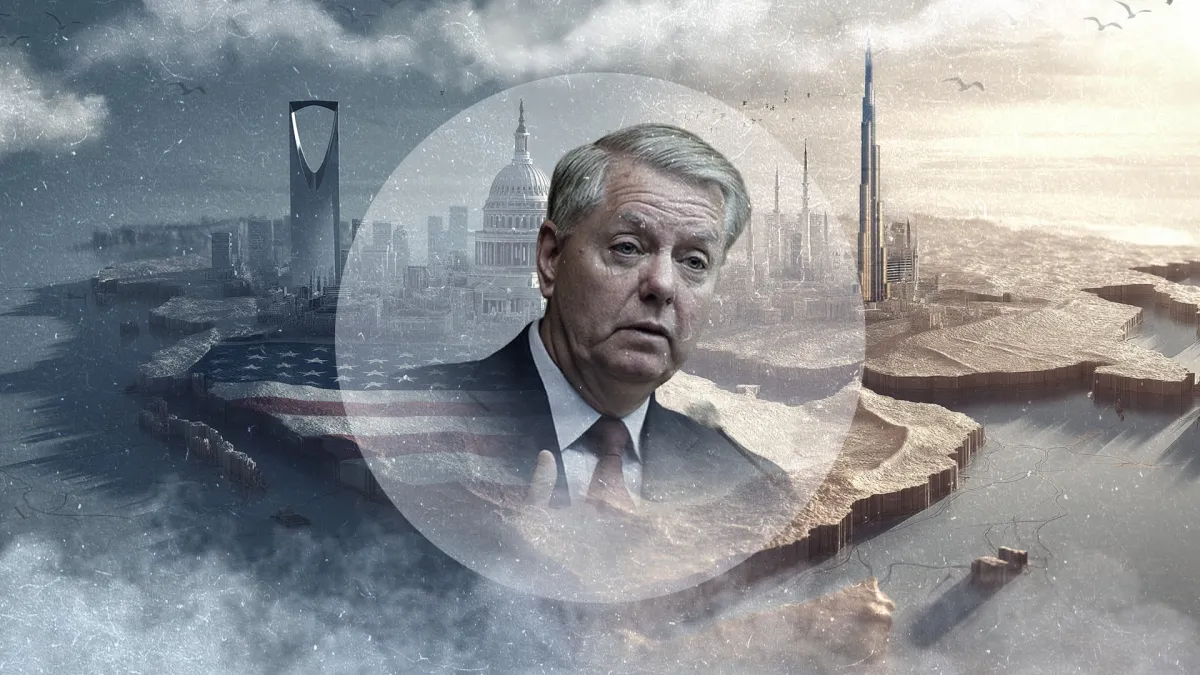
From Abu Dhabi, which he arrived in on Wednesday, U.S. Senator Lindsey Graham – known to be close to President Donald Trump – announced that he was “on his way to Saudi Arabia,” in a move that clearly aims to bring an end to the months-long tensions between Saudi Arabia and the United Arab Emirates.
Disagreements between the two countries began last December over developments in Yemen, but they quickly expanded to include the Red Sea, Somalia, Sudan, Ethiopia, Eritrea, Libya, and Algeria.
The two countries are the most prominent economic powers allied with the United States in the Gulf region. As such, their bilateral relationship carries significant importance for Washington amid rapid regional developments – chief among them the possibility of a war breaking out between the United States and Iran.
“Everyone in Washington wants this dispute resolved,” Tom Warrick, a researcher at the Atlantic Council, told Alhurra. “Officials are aware of the policy differences and personal dynamics behind this divide, but Washington considers both the UAE and Saudi Arabia to be key allies and essential partners in military, economic, and security cooperation.”
Graham did not explicitly discuss the details of any mediation efforts between the two countries, but his visit coincided with recent remarks by Trump, who said he could “resolve the matter easily.”
Robert Mogielnicki, a nonresident fellow at the Arab Gulf States Institute in Washington, believes that Trump holds sway in the Gulf, “even though it is unclear how – or whether – he would seek to intervene in this aspect of Saudi-Emirati relations.”
“He may try to apply pressure to reach some form of settlement, or he may see an opportunity to push for greater bilateral economic cooperation with the United States,” Mogielnicki added in comments to Alhurra.
After arriving in Abu Dhabi, Graham announced on the social media platform X that he had met with UAE President Mohammed bin Zayed Al Nahyan, criticizing what he described as “false narratives” being circulated about the UAE and its leader.
Earlier this week, speculation spread on social media regarding bin Zayed’s health after Turkish President Recep Tayyip Erdoğan postponed a scheduled visit to Abu Dhabi. Erdoğan’s office posted a message on X claiming that the Emirati president was suffering from a “health issue,” before deleting the post.
At the same time, Saudi media outlets in recent weeks have begun issuing explicit accusations against the UAE, describing it as engaging in “betrayal,” “investing in chaos,” and “supporting separatists” from Libya to Yemen and the Horn of Africa.
Despite this, experts say that social media disputes surrounding the Saudi-Emirati rift do not necessarily reflect actual political decision-making trends.
“Major decisions are usually made away from this noise,” Saudi writer and political analyst Salman Al-Sharida told Alhurra. “Continued media debate may complicate the scene on the surface, but it does not preclude the existence of quiet communication channels working to manage differences and prevent them from escalating into an open crisis.”
From this perspective, Washington can play a central role in reaching a resolution, according to Emirati writer and political analyst Mohammed Khalfan Al-Sawafi, who believes Trump’s comments on the dispute signal the possibility of intervention to end it.
“There are many important regional files managed by Washington that require a return to Saudi-Emirati cooperation. This intervention has been anticipated for some time,” Al-Sawafi said.
Parallel to Graham’s efforts, the UAE last week hosted two simultaneous visits – one by Egyptian President Abdel Fattah el-Sisi and the other by the Emir of Qatar, Tamim bin Hamad Al Thani – both of whom maintain close relations with Saudi Arabia.
Additionally, amid the escalation campaign between the UAE and Saudi Arabia, political and security alliances were formed among regional states in ways that appeared to reflect competition between Riyadh and Abu Dhabi.
Last month, the UAE president met Indian Prime Minister Narendra Modi in New Delhi, where the two countries agreed to work toward establishing a strategic defense partnership.
That move was preceded months earlier by Riyadh signing a joint defense agreement with India’s rival, Pakistan. Turkish Foreign Minister Hakan Fidan later stated that his country was holding talks to join that alliance.
Experts believe that the recent visits by Gulf, Egyptian, and Qatari officials – along with the postponed visit by the Turkish president to Abu Dhabi – represent quiet diplomatic efforts aimed at containing the dispute away from the media spotlight.
“All parties maintain good relations with both the UAE and Saudi Arabia and therefore have a vested interest in restoring relations to their normal course,” Al-Sawafi said.
Still, it remains uncertain whether the crisis will end soon. “So far, there are no decisive indicators, or an announced negotiation track leading to an imminent settlement,” Al-Sharida said. He added: “Disputes between states are not measured by what is said in the media, but by what is managed behind the scenes. Unless official indicators or concrete, announced steps emerge, talk of a near settlement remains closer to analysis than to confirmed reality.”