
The US launched Operation Epic Fury without clear strategy or unlimited resources, facing an unpredictable Iran that must retaliate to survive. With costly interceptor stockpiles, no invasion force, and Tehran’s vast arsenal, Washington risks losing control of a war it started.
With Operation Epic Fury, the U.S. seeks to reshape the balance of power without falling into a quagmire, while Iran believes it must strike back hard enough to avoid permanent strategic loss.
On Feb. 28, the Trump administration launched Operation Epic Fury against Iran but has yet to articulate clear, comprehensive strategic objectives. President Donald Trump’s initial statement, released that Saturday morning, cited efforts to prevent Iran from obtaining a nuclear weapon and the destruction of its ballistic missile program as key objectives, while also encouraging the Iranian people to take over their government.
In the roughly 48 hours following the initial strikes, the Trump administration has subsequently suggested that the operation could last days, weeks or “as long as it takes” based on varying conditions that remain vague and evolving.
Trump’s remarks on March 2 even suggested that U.S. “boots on the ground” remain a possibility. Such shifting messaging makes it impossible to assess how the White House will ultimately decide to proceed.
In this context, both Washington and Tehran, Iran, must evaluate their respective risks as they determine their next moves.
America’s military resources aren’t unlimited
First, while the United States and its regional partners have been successful in thwarting Iranian missiles and drones with advanced air defenses, the costs of the munitions involved are orders of magnitude more expensive for America than for Iran.
Moreover, during the 12-day war in June, the U.S. military expended about 150 of its Terminal High Altitude Air Defense (THAAD) interceptors, roughly a quarter of its stock, and in 2025 was only scheduled to procure 12 more.
Iran’s stockpile of ballistic missiles was also diminished last year, but leading into Epic Fury remained the region’s largest and most formidable arsenal. Successful U.S. and Israeli targeting of Iran’s launchers will be crucial, but it is important to note that the regime also possesses roughly 80,000 Shahed “kamikaze” drones at its disposal.
As the campaign’s duration extends, the supply of interceptors will become increasingly important, both for the sustainability of the current operation and for maintaining readiness for other potential military actions.
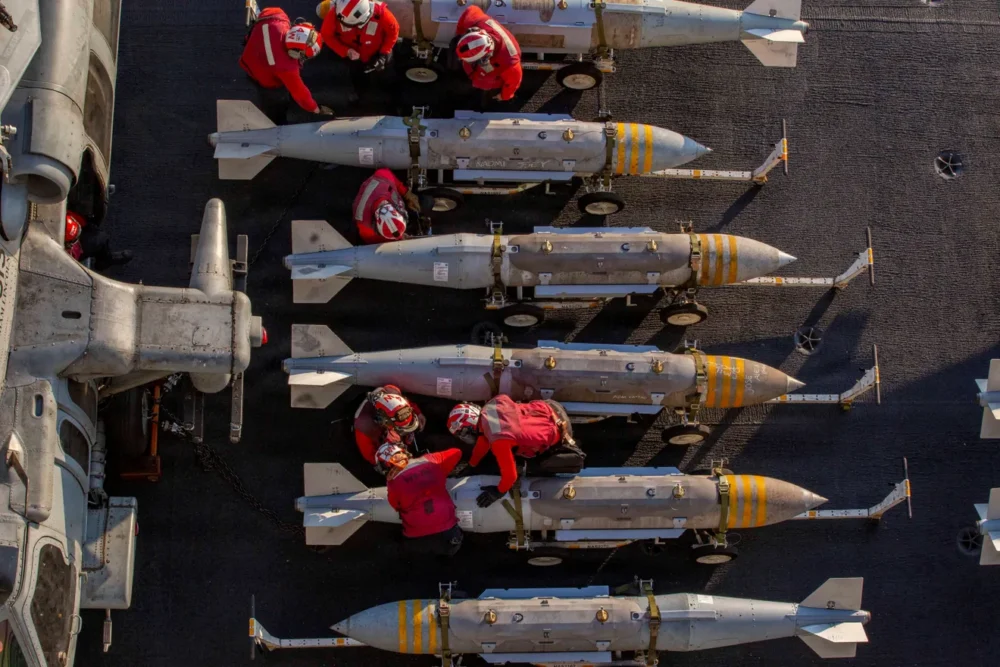
Aside from potential defensive limitations, Operation Epic Fury also faces limitations tied to U.S. force posture. Importantly, while the Pentagon has amassed a significant amount of military assets in the region, these reflect a massive strike force and not an invasion force incorporating ground troops.
Other constraining factors notwithstanding, airpower alone has a poor historical track record of either encouraging regime change or extracting major concessions.
Additionally, the USS Gerald R. Ford, one of the two aircraft carrier groups recently sent to the region, was already on an extended deployment before being diverted. Should it remain at sea through mid-April, as expected, it would exceed nearly 300 days at sea and break a post-Vietnam War record for duration.
The lack of U.S. forces on the ground makes seeing through some of the president’s conditions, such as the surrender of Iranian security forces, more difficult to achieve. Trump’s mention on March 2 of keeping ground forces on the table suggests he may be reconsidering his options, but the process of mobilizing sizable ground units is time-consuming and hasn’t started.
Iran’s response is going to be unpredictable
From the perspective of “the enemy gets a vote,” the onset of Washington’s hostilities has shifted Tehran’s strategic calculus toward survival. This means ensuring that Iran’s military counter-response also carries profound hazards.
Any retaliation strong enough to signal resolve risks inviting a second wave of strikes that could further weaken Iran’s remaining strategic depth. Yet an overly cautious response could embolden the United States and fuel perceptions of Iranian vulnerability.
Tehran’s command-and-control challenges, already exposed in the early hours of the conflict, only compound the danger: Dispersed forces might not reconstitute quickly enough to prevent additional losses if the war expands.
In practical terms, this has prompted the regime’s rapid retaliation, regional escalation and signaling that any attack will be met with immediate and unpredictable consequences. For Iran’s leadership, the alternative to hitting back is not de-escalation; it is becoming a sitting duck in the next round of conflict.
Over the past year, the Islamic Republic of Iran has now been spurned twice at the negotiating table by the United States, once prior to the 12-day war and again before Epic Fury, and must maintain its grip on internal power after the death of its supreme leader and other senior officials. Combining these complexities with Trump’s mixed messaging makes identifying diplomatic off-ramps to conflict difficult.
In launching strikes against Iran, America has unleashed a series of events it cannot fully control. With the war underway, diplomacy now operates in a landscape defined by simultaneous military escalation and political erosion.
The United States seeks to reshape the balance of power without falling into a quagmire, while Iran believes it must strike back hard enough to avoid permanent strategic loss.
And beneath these calculations lies a deeper anxiety shared by both sides, that the conflict unfolding across the region may soon be matched by a struggle over the future of Iran itself.