
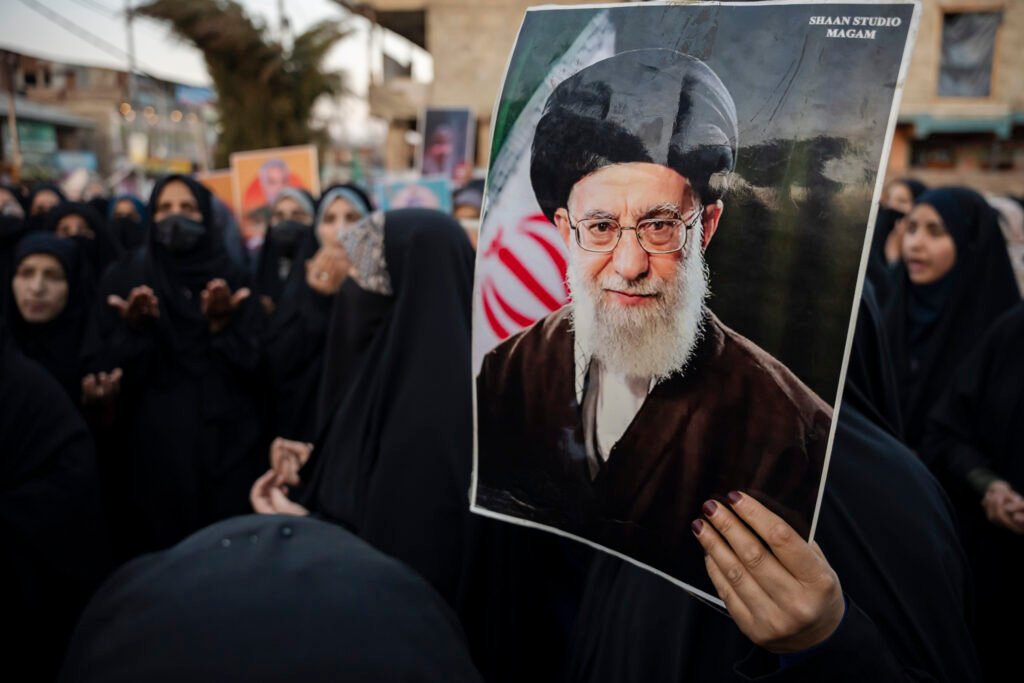
This analysis examines the aftermath of Khamenei’s death in a US-Israeli strike. Victims celebrate, but assassination legality concerns remain. Iran’s retaliation appears calibrated; succession is uncertain. Despite public relief, IRGC entrenchment makes regime collapse premature.
It was a decapitation strike. Ayatollah Ali Khamenei, the supreme leader of Iran, was killed along with several top lieutenants in a US-Israeli bombing campaign on Saturday, according to US and Israeli leaders. His death, ending a thirty-seven-year reign, leaves the Islamic Republic teetering amid an unprecedented military operation designed to carry out regime change. Below, our experts assess the significance of a development that could transform Iran and the broader region.
The meaning of the moment
Khamenei “has not merely led the system—he has defined it,” Danny tells us. “His ideological rigidity, strategic patience, and reliance on the Islamic Revolutionary Guard Corps (IRGC) shaped the Iran we know today: confrontational abroad, tightly controlled at home, and deeply invested in its regional axis of influence.”
Gissou, who serves as counsel or legal adviser on five different legal cases against Khamenei, tells us that the supreme leader “sat at the top of a command structure responsible for crimes against humanity and war crimes in Iran and the broader region.” But he was “an almost impossible target for international law,” since he had not left Iran for decades.
Khamenei will never see a courtroom for these crimes, and the manner in which he was killed raises concerns around international law regarding assassinations, Gissou says. But, she adds, “the truth is that the victims and survivors who brought the allegations and are named in the charges are already rejoicing along with huge parts of the population of Iran, if initial videos of folks celebrating are any indication.”
Gissou spoke to some survivors on Saturday who “feel a sense of relief, yet some also lament that they didn’t get to see Khamenei in the dock answering for his many crimes like Hosni Mubarak did in Egypt and Saddam Hussein did in Iraq.”
Expectations of retaliation
Since it appears that Khamenei was killed in the first wave of strikes, that means Iran’s retaliatory strikes on Saturday were “directed either by his designated successor or by senior officials within the chain of command,” Alex tells us.
So what did we learn from this post-Khamenei leadership? “Thus far, Iran’s counterstrikes have reflected rational decision-making,” Alex says, with “an effort to calibrate responses proportionally rather than ignite a broader regional war.”
Danny says that Iran’s regional proxies, particularly Lebanese Hezbollah, “would face pressure to respond in the name of deterrence and revenge. Yet escalation is not automatic. Iran’s strategic culture has long favored calibrated retaliation over emotional reaction.”
Alex is waiting on more battle damage assessments to figure out whether Iran’s ballistic missiles have been mostly destroyed or whether it is holding more in reserve for a protracted conflict: “The coming days will reveal whether decapitation yields escalation, fragmentation, or a recalibrated balance of deterrence.”
A new ayatollah?
The names most commonly discussed to replace Khamenei, Danny tells us, are his son Mojtaba Khamenei, grandson of the first supreme leader Hassan Khomeini, or members of the Larijani family. “Yet none commands obvious consensus,” he adds. “The vacuum itself is destabilizing.”
But the bigger question, Danny notes, is whether there will be a similar power structure “or could we see a diluted, more collective arrangement designed to prevent the concentration of authority in a single figure?”
Meanwhile, Danny adds, “Unlike 1979, there is no unified, organized opposition capable of immediately capitalizing on elite disarray. Public dissatisfaction is real and widespread, but fragmentation and repression limit its political translation.”
Khamenei is gone, but “predictions of regime collapse would likely be premature,” Danny tells us, especially given the entrenched nature of the IRGC: “a military, political, and economic powerhouse with immense stakes in preserving the current order.”