
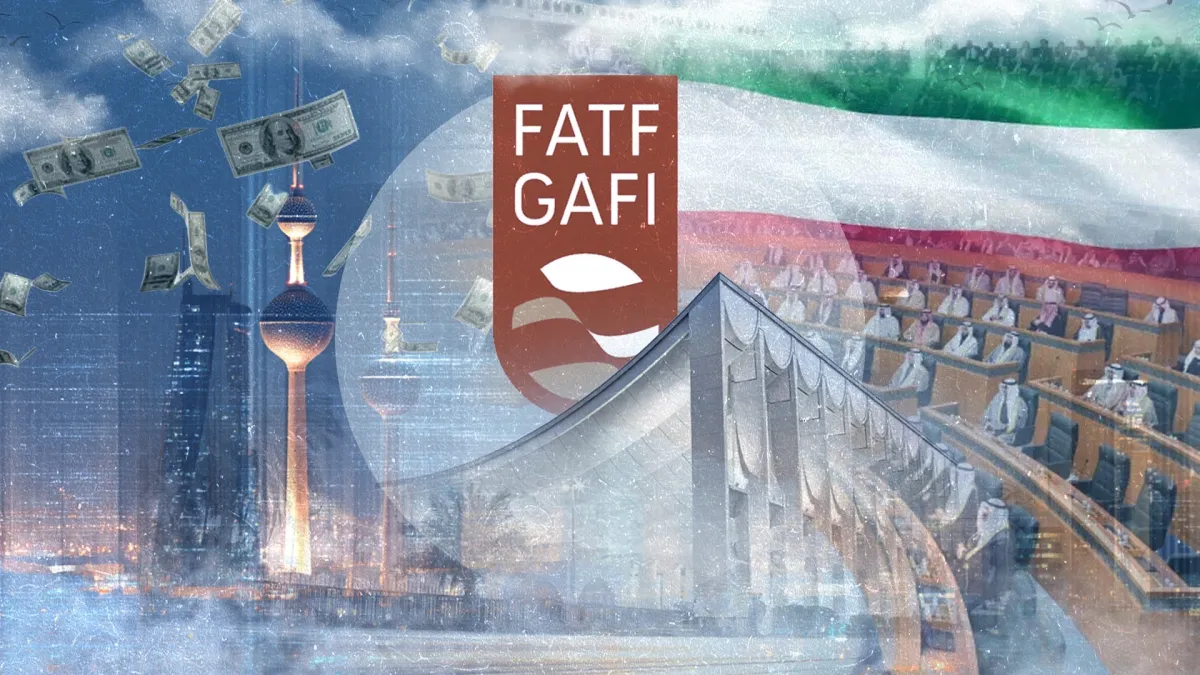
The Financial Action Task Force (FATF) has placed Kuwait on its list of states under increased monitoring, commonly known as the “grey list.”
This designation indicates the presence of potential strategic deficiencies in the country’s system for combating money laundering and terrorist financing, subjecting Kuwait to heightened international scrutiny under a time-bound action plan aimed at addressing existing gaps.
Although the listing does not entail the imposition of direct sanctions or immediate economic restrictions, it carries a clear message: Kuwait has not yet met some of the effectiveness standards adopted by the Task Force.
In response, Kuwaiti authorities announced a high-level political commitment to cooperate with FATF and its regional affiliate for the Middle East and North Africa, with the stated goal of strengthening the efficiency of the supervisory framework and improving compliance indicators.
According to the Task Force’s statement, since the adoption of the follow-up report in June 2024, Kuwait has made progress on several recommendations. These include adopting a new national strategy to combat money laundering and terrorist financing, improving the technical framework related to targeted financial sanctions, enhancing risk understanding, and implementing risk-based supervision and outreach programs with financial institutions and designated non-financial businesses and professions.
Why the Classification?
In assessing the reasons and background behind the designation, Qais Al-Shatti, head of the Foresight Future Consulting and Studies Center, said Kuwait’s legislative and regulatory framework is relatively strong. However, he noted that the shortcomings stem less from the absence of laws than from weaknesses in implementation and real-world effectiveness.
He pointed to limited understanding of terrorist-financing risks, weak oversight of sectors such as real estate and precious metals, inaccuracies in beneficial ownership information, a low number of cross-border investigations and prosecutions, and challenges related to freezing terrorism-linked assets.
Corruption and Money Laundering
The FATF classification comes amid developments in Kuwait over recent years related to money-laundering cases.
In 2020, the so-called “Malaysian fund” case dominated headlines in Kuwait, after investigations revealed that nearly one billion dollars had entered the account of an “influential Kuwaiti figure” before being transferred abroad. The transactions followed a route involving companies in Kuwait and China, through dealings described as fictitious and involving forged contracts.
According to numerous Kuwaiti and international media reports, Malaysian and American investigators estimated that approximately $4.5 billion had been embezzled from the fund since its establishment in 2009.
In June 2024, Kuwait’s Court of Cassation sentenced Sheikh Sabah Jaber Al-Mubarak, the son of a former prime minister, along with two business partners and two expatriates, to 10 years in prison, while sentencing a lawyer to seven years. The court ordered the defendants to return $1 billion and jointly fined them 145 million Kuwaiti dinars (about half a billion dollars).
That same year, another case emerged, widely referred to by the media as the “Kuwaiti celebrities’ money-laundering case.” Prosecutors announced an initial list of charges involving around 12 celebrities and corporate offices, with roughly 27 additional suspects under investigation following the detection of unusually large growth in their bank accounts.
After months of investigation, the cases were closed due to insufficient evidence, and the following year the seizure orders on the defendants’ funds and bank accounts were lifted across all local banks, according to multiple press reports.
Legal Impact
Although Kuwait’s economy is not typically classified as open or highly complex compared with some other Gulf economies that host large real estate or digital markets, the recurrence of such cases raises questions about the nature of existing loopholes—and whether the problem lies in legislation itself or in oversight and enforcement mechanisms.
Lawyer Saud Al-Subaie said Kuwait does have a legal framework to combat money laundering and terrorist financing. However, modern standards no longer suffice with the mere existence of laws; they focus instead on measurable outcomes, such as the number of cases resulting in court rulings, the value of confiscated assets, and the transparency of beneficial ownership data.
Developing and mid-sized financial systems often face a range of challenges, including the need to improve the quality of reporting in certain non-banking sectors, enhance the accuracy of beneficial ownership data, and increase the value of asset seizures in proportion to the level of risk.
Al-Subaie stressed that real deterrence in financial crimes is achieved when the cost of violating the law exceeds the potential gains. “The faster the rulings and the stronger the confiscations, the greater the confidence in the financial system,” he said.
The impact of a country’s placement on the FATF grey list varies depending on the strength of its banking sector and the structure of its economy, Al-Subaie added. In Kuwait’s case, he expects the short-term impact to be limited, mainly involving higher compliance costs and increased procedural requirements for some international transactions.
What Needs to Be Done?
Economist Qais Al-Shatti believes that Kuwait’s inclusion on the grey list directly affects its reputation and economy, increases international monitoring and compliance costs, and “is reflected in its credit rating,” while discouraging some foreign investment from entering the Kuwaiti market.
This, he said, could complicate Kuwait’s international banking relationships due to enhanced financial scrutiny and additional requirements imposed on transfers—potentially giving other countries in the region, such as Saudi Arabia and the United Arab Emirates, a relative advantage in attracting investment and strengthening their economies.
Al-Shatti argued that Kuwait must act on three fronts. First, it should strengthen oversight of the real estate sector and precious-metal traders. Second, it must ensure the accuracy of the beneficial ownership registry and impose deterrent penalties for violations. Third, it should increase investigations and prosecutions in money-laundering cases, particularly those with cross-border dimensions.
Al-Subaie, for his part, sees Kuwait’s new FATF classification as an opportunity to enhance the effectiveness of its regulatory and judicial systems. He recommends focusing in the coming phase on “raising the level of financial investigations, strengthening the transparency of beneficial ownership data, expanding the culture of compliance in non-banking sectors, and demonstrating measurable, practical results.”
“Exiting the grey list is possible in the coming years if clear progress is achieved in practical implementation—not merely through legislative amendments,” Al-Subaie said.