
COMMENTARY
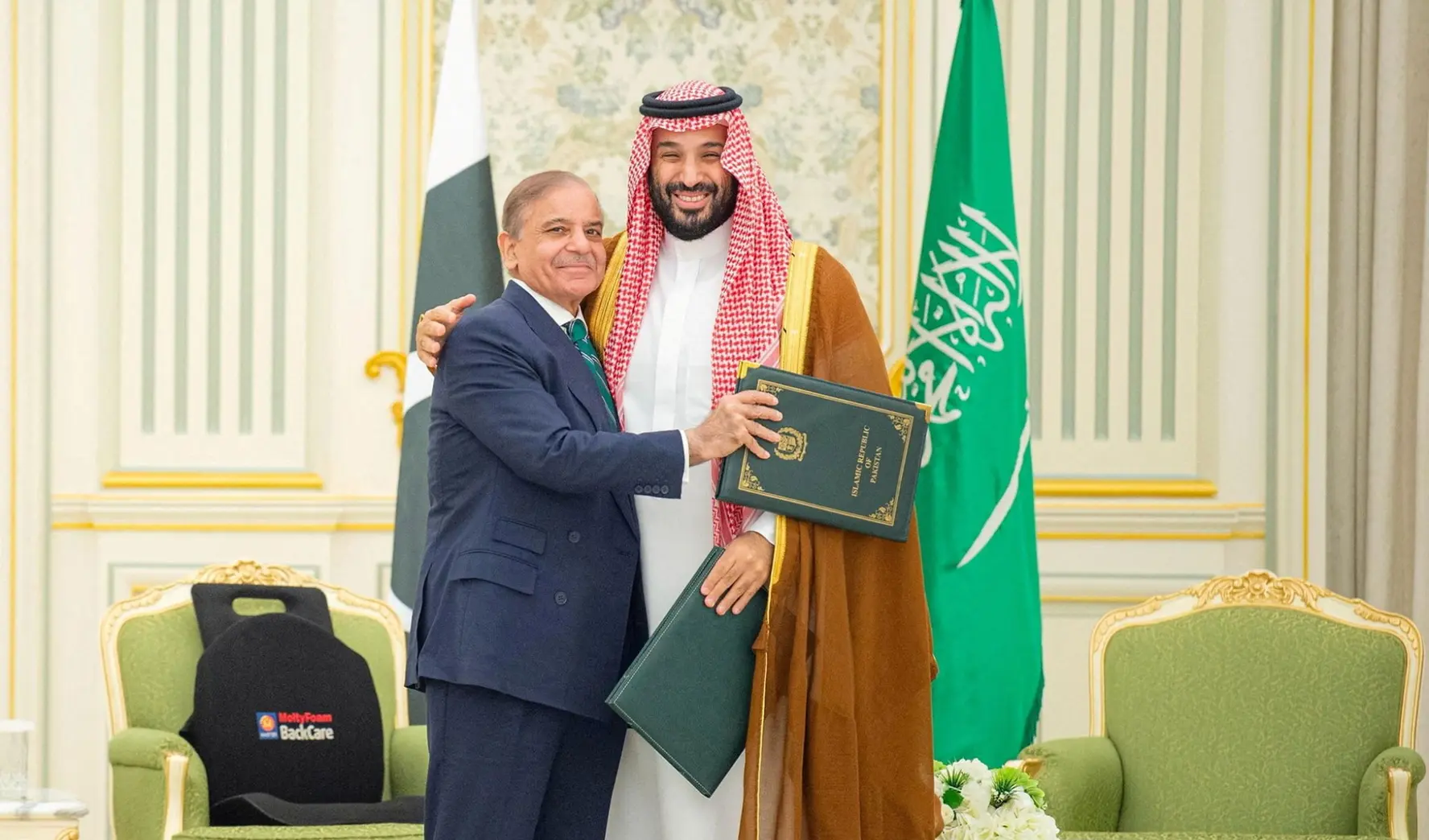
The mutual defense pact signed this month between Pakistan and Saudi Arabia has largely been interpreted as Riyadh’s attempt to secure access to nuclear deterrence, hedging against the possibility of an Israeli strike. But who else is it important to? Western media attention has focused on Israel and the United States as involuntary stakeholders.
For Riyadh, Pakistan has long been just a client state—to be bailed out financially in moments of crisis on the grounds of Muslim brotherhood. That Saudi Arabia is now seeking security support from Islamabad reflects a significant shift: the kingdom, shaken by Israel’s strike on Qatar, appears more willing to treat Pakistan as a partner rather than a dependent.
It is doubtful that Riyadh and Islamabad acted without Washington’s knowledge. Even so, the United States has little incentive to pick sides. Israel has already demonstrated its independence by striking Qatar despite American concerns. Iran’s nuclear program is in disarray and unlikely to be affected by the Saudi-Pakistan agreement. For Washington, the agreement offers neither leverage nor a significant policy pivot.
But there are others. What has received little attention is the impact on India. Over the past decade, New Delhi has cultivated a strategic partnership with Riyadh. Military cooperation has expanded, with the two countries conducting joint exercises as recently as August 2025. In 2023, India and Saudi Arabia joined the United States, the European Union, Israel, and the United Arab Emirates in an initiative, the India-Middle East-Europe Economic Corridor, to build a land-and-sea transport corridor linking India to Europe via the Gulf and Israel. The relationship is also solidly grounded in economics: in 2024, Indian workers in Saudi Arabia remitted $7 billion to India, remittances constituting an important contribution to India that dates to the 1970s. Currently, over 2.5 million Indians work in Saudi Arabia.
At the same time, India remains locked in a suspended war with Pakistan. From India’s perspective, the current lull in fighting that stopped on May 10th, 2025, is merely a pause, not a ceasefire. Under the new defense pact, any renewed Indian military operation against Pakistan could now be interpreted as an attack on Saudi Arabia. This raises the prospect of wider regional complications, including strained ties with Gulf Cooperation Council members, whose states collectively host millions of Indian expatriates who remit nearly $30 billion annually to India—about three quarter percent of its GDP.
Still, the significance of the pact to India may be overstated. Pakistan is economically weak, its value to other countries lying mainly in its location rather than its intrinsic merits. As a gateway to Afghanistan, Pakistan has been of critical value to the security of the United States in the Cold War in the 1980s, for launching the U.S. invasion of Afghanistan in 2001, and for addressing terrorism originating in Afghanistan subsequently. Pakistan has been valuable to China for applying pressure on India’s western flank. On economic grounds, China is deeply interested in Pakistan’s transit potential for expanding the Belt and Road Initiative into Afghanistan and Iran, as are Central Asian countries looking to transport petroleum and gas to Southeast Asia and East Asia.
For the United States, Pakistan’s geography has been of episodic value. Consequently, Pakistan’s importance has waxed and waned over the decades: ignored after the Bangladesh debacle in 1971, a Cold War partner in the 1980s, a pariah under the Pressler Amendment in the 1990s for its nuclear program, a reluctant ally during the U.S. war in Afghanistan after 2001, and an afterthought during the Obama and Biden years. Even recently, U.S. assistance to Pakistan amounted to less than $200 million annually between 2022 and 2024, underscoring its marginal role except when geopolitics demanded attention.
More recently, however, President Trump has extended warmer attention to Islamabad than any U.S. administration since the early 1970s. That shift may carry consequences for India far greater than the Saudi-Pakistan pact.