
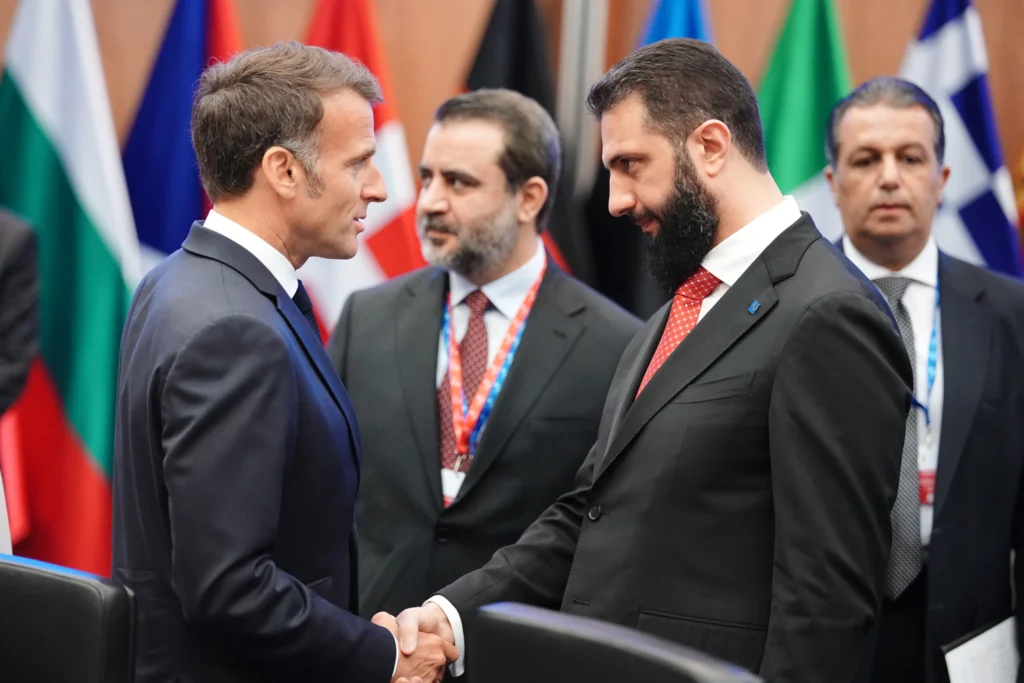
The EU-Syria partnership enters a new era with high-level talks in Brussels. Syria’s stable yet fragile economy needs recovery. The EU offers trade, energy corridor integration, and Gulf synergies, positioning Syria as a strategic Mediterranean hub.
The EU-Syria Partnership has reached a historic turning point as formal dialogues resume in Brussels for the first time in over a decade. This evolving EU-Syria Partnership aims to transform the war-torn region into a strategic intersection for global energy and trade routes. As the EU-Syria Partnership deepens, both parties seek to foster synergies that stabilize the Middle East through economic integration. Ultimately, the EU-Syria Partnership serves as a cornerstone for post-war regional reconfiguration and prosperity.
EU-Syria Partnership: A High-Level Political Dialogue
On May 11, Syrian Foreign Minister Asaad al-Shaibani, European Union High Representative for Foreign Affairs Kaja Kallas, and European Commissioner for the Mediterranean Dubravka Šuica all plan to meet in Brussels for a EU-Syria High-Level Political Dialogue. This formal and structured talk—a first since the fall of Bashar al-Assad—marks deeper bilateral engagement and a step toward a closer partnership, against the backdrop of regional reconfiguration after more than two months of war.
Over the past year, the EU has worked on reshaping its relationship with Damascus and lifting most of its sanctions. The regional restructuring presents opportunities for Syria and the EU to strengthen their partnership and cooperation, boosting Syria’s position as a strategic intersection of energy and trade routes and fostering synergies with other European partnerships in the Middle East.
Fragile Stability and the EU-Syria Partnership
Syria, which has not been involved in the recent conflict across the region, has appeared as a stable and constructive actor.
But its stability is fragile and partly reliant on economic recovery. And the prospects for that recovery are tied in large part to Gulf states, which have pledged billions of dollars of investment to support the reconstruction of Syria but bore the brunt of economic disruption caused by the Iranian attacks.
As the conflict subsides, they are likely to prioritize rebuilding their destroyed oil and gas infrastructure, strengthening their defense capacity, and diversifying their strategic partnerships, which may translate into less money for for Syria. Meanwhile, mutually beneficial opportunities are emerging between Syria and the EU on three fronts.
Trade Instruments in the EU-Syria Partnership
First, an array of European instruments can facilitate trade, investment and public-private partnerships, centered on shared interests around the Mediterranean. The EU announced a €175 million financial recovery package in 2025 and intends to renew similar packages in 2026 and 2027. The EU has also proposed to fully resume its 1978 Cooperation Agreement (which was partially suspended in 2011), supporting trade and development. Meanwhile, Europeans are considering additional measures to facilitate trade. Before the war, the EU was Syria’s largest trading partner.
The Syrian economy could also benefit from projects as part of the Pact for the Mediterranean and Global Gateway, two flagship EU cooperation frameworks. These initiatives mobilize public and private investment at a large scale and allow the development of public-private partnerships in fields including trade, energy, digital technologies, and transport, ultimately contributing to the economic development and regional re-integration of Syria.
These opportunities will be part of the upcoming High-Level Political Dialogue. Bringing Syria closer to the EU’s single market would benefit economies on both sides through integration and stronger trans-Mediterranean links, via reliable and durable mechanisms.
Energy Hubs and the EU-Syria Partnership
Second, as securing alternative land routes to the Strait of Hormuz has become an increasing concern, Syria’s strategic location could make it a hub for energy, transport, and digital links from the Gulf to Europe and beyond. The Iran war gave a new impetus to this idea, which had been discussed in the months before the war broke out. For instance, in mid-April, Iraqi oil transported by road transited through Syria’s revived Baniyas export terminal.
While attending an EU summit in Cyprus on April, 24, Syrian interim President Ahmed al-Sharaa highlighted Syria’s position as a bridge between Asia, the Gulf, and Europe, mentioning the “Four Seas” project aimed at linking the Gulf, the Caspian Sea, the Mediterranean Sea, and the Black Sea.
The EU is well-positioned to support, both politically and financially, the integration of Syria into projects that create trade and energy corridors connecting Asia and Europe, such as the India–Middle East–Europe Economic Corridor (IMEC). The EU can mobilize funds through the Pact for the Mediterranean and/or Global Gateway to build or rehabilitate infrastructure connecting Syria to its neighbors’ transport and energy corridors. Syrian’s integration into these networks would help its economy to recover, bolster its regional strategic position, and deepen regional integration, while benefiting the European economy as well. Al-Sharaa described the Euro-Arab Mediterranean partnerships as “an inevitable path and safe framework to sustaining energy flows and securing global supplies.”
Synergies in the EU-Syria Partnership
Third, the EU could develop synergies between its growing cooperation with Syria and its strategic partnership with Gulf countries—which could well deepen after the war is over as Gulf countries seek to broaden their partnerships. Such synergies would amplify the impact of bilateral cooperation and ultimately boost Syria’s recovery.
More specifically, the EU and Gulf countries could coordinate their support to Syria’s recovery and development as a regional hub. In parallel, the EU, Syria, and Gulf countries could collaborate on a tripartite flagship project in an area of common interest under the banner of the Pact for the Mediterranean. Joint cooperation between them would be mutually beneficial, as these three actors are bound by a shared interest of stability of Syria and the region, as well as economic prosperity. Syria, the EU, and the Gulf could also lay the foundation for a stable regional architecture based on protecting strategic economic interests such as free trade and the flow of energy, providing incentives to defuse regional conflicts.
Future Prospects of the EU-Syria Partnership
The ongoing regional turmoil is damaging for both the Middle East and Europe. But it also presents an opportunity for Syria and Europe to consolidate Syria’s stabilization through partnerships in strategic areas of shared interest—to the benefit of both sides.