
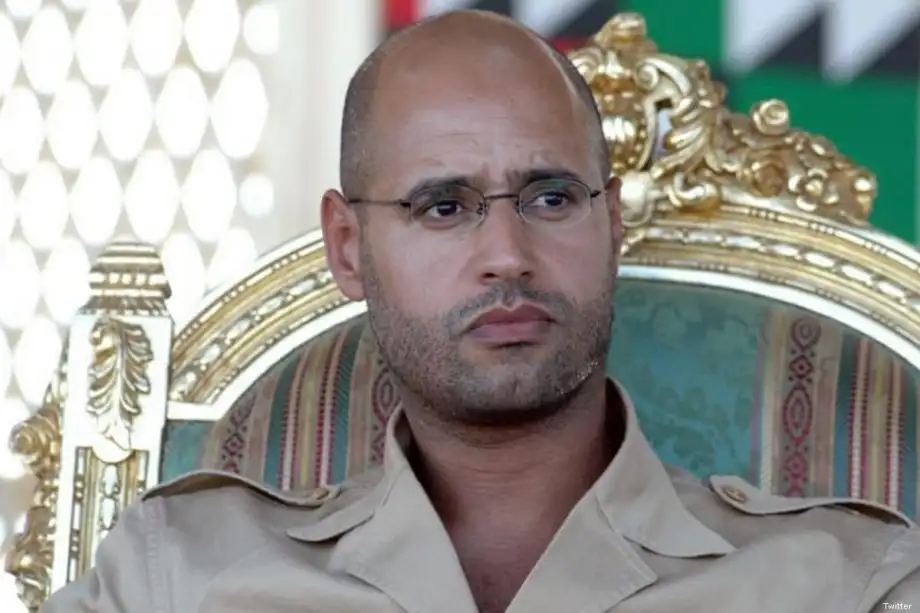
Prosecutor General Al-Sour faces an impossible calculus where pursuing identified suspects risks inter-tribal conflagration. The calculated public silence reflects state prioritization of fragile social cohesion over courtroom transparency. Concurrently, exiled Gaddafi family ambivalence leaves the substantial Green constituency politically orphaned and structurally vulnerable.
Exactly 72 days have passed since the assassination of Saif Al-Islam Gaddafi. On 3 February 2026, in Zintan, a four-man hit squad eliminated the last “wild card” in Libya’s stagnant power play. The brazenness of the broad-daylight attack signalled a terrifying confidence, suggesting that the killers knew they had nothing to fear from the law.
While initial headlines focused on “masked gunmen” and “disabled cameras”, the subsequent silence is more telling. In a country where every skirmish is live-streamed, the investigation into Saif’s murder has become a black hole. Despite the Prosecutor General’s Office identifying three suspects in March, the trail has since gone cold with clinical precision.
The Prosecutor General claims the killers’ identities and route are known, yet 72 days later, no names or photos have been released. While social media is rife with theories linking the hit to internal factions or foreign intelligence, official silence remains absolute. This lack of transparency suggests that the perpetrators were not “unidentified gunmen”, but professionals acting with a mandate, shielded by the political environment they helped to stabilise.
Two major questions dominate the aftermath: one legal and the other political. Even if the Prosecutor General arrests the suspects, a public trial is unlikely. Under Libyan law, premeditated murder carries the death penalty, specifically by firing squad. Sceptics doubt that any suspect would reach the stand alive to confess. If the perpetrators were paid millions, as rumoured, the real question is not who pulled the trigger, but whose coffers funded the hit.
In Libya’s notorious landscape of fractured law and order, legal convictions and procedures are never straightforward. Once suspects are definitively identified by the Prosecutor General, the question of their tribal affiliations immediately takes centre stage.
The victim’s status is critical here; the fact that it is Saif Al-Islam makes this case a political and tribal “hot potato”. Because of his lineage and his standing as a symbol for millions, his murder is not a private grievance but a national crisis. In the current context, the Prosecutor General is not just navigating a legal case, but a minefield where revealing the killers could spark inter-tribal warfare or leave a permanent stain on the perpetrators’ kin that no amount of political manoeuvring could wash away.
This is a predicament that cannot be solved through a courtroom alone. In the Libyan context, the legal process is inextricably linked to careful tribal networking. For the Prosecutor General to move from identification to arrest, a delicate consensus must be reached behind closed doors. Without a “tribal green light”, any attempt at a forced arrest risks igniting a broader vendetta that could destabilise the very regions the state is trying to bring under its wing.
Consequently, the silence in Tripoli may not just be about protecting political masters, but about the profound difficulty of navigating a tribal landscape where justice is often weighed against the heavy cost of social cohesion. Unlike many other figures in the fractured state, the Prosecutor General, Al-Siddiq Al-Sour, continues to command a rare level of respect across the political spectrum, even from the Gaddafi family and their Gaddafa tribe. They largely believe in his integrity and his desire to see justice served; however, they also recognise the impossible constraints of his position.
They do not believe that Al-Sour is shielding high-ranking officials in the echelons of power but rather see this as a reflection of the paralysing tribal reality. In a nation still reeling from more than a decade of conflict, the Prosecutor General likely understands that a “legal win” achieved without tribal backing could inadvertently spark a new cycle of violence. This creates a tragic paradox: the very transparency needed to restore faith in the law is the one thing the state fears will tear the social fabric apart.
Politically speaking, and beyond the tribal and legal deadlock, the assassination has left the “Green” constituencies, Saif’s substantial support base, politically decapitated. Despite their significant numbers, his supporters have yet to coalesce into a formal umbrella entity that could bring them, legally speaking, into the political fray. This is particularly critical as the United Nations mission continues to mediate a fragile process in hopes of organising national elections later this year or in early 2027.
This crisis of leadership extends into the exiled Gaddafi family, who now face an existential choice. With the recent release of Hannibal from his decade-long Lebanese detention, and now reportedly residing in South Africa, and Al-Saadi in Turkey, the family’s remaining men must decide if they possess the will to continue Saif’s work. Along with Mohamed and their sister Ayesha, the siblings represent the last vestiges of Gaddafi family legitimacy that many Greens still crave.
However, after years of imprisonment and exile, the family may have already had enough. If they choose to excuse themselves from politics altogether, it will deprive the Green movement of its historical anchor. This leaves the Greens not only headless but potentially homeless in a new Libyan roadmap, stripped of the legitimacy and symbolism that first the father, and later Saif, provided. For a movement that many believed could be the “Third Way” for Libya, the choice now is stark: find a new, non-dynastic path to legal inclusion, or fade into a fragmented collection of associations operating from the margins of a country they once ruled.
No single scenario is currently being discussed among the Greens. Instead, most are waiting for the family to decide its preferred course of action. While many within the base are content to wait out of respect for the legacy, others fear that the political window is closing and argue that the movement should move forward with or without the family’s direct involvement.
The consensus within the movement is that, if the family decides to carry on, at least by serving as a symbolic reference point, they would be welcomed at any time. However, if the siblings choose to remain in the shadows, the Greens face a historic turning point: they must transform from a loyalist base into a formal political party. Their goal would be to capitalise on the enduring symbolism of the Gaddafi era and translate their sheer numbers into actual votes.
Whether they can achieve this transition without a Gaddafi at the helm remains the most significant question for Libya’s political future, as they risk being marginalised permanently if they fail to organise before the next electoral cycle.