
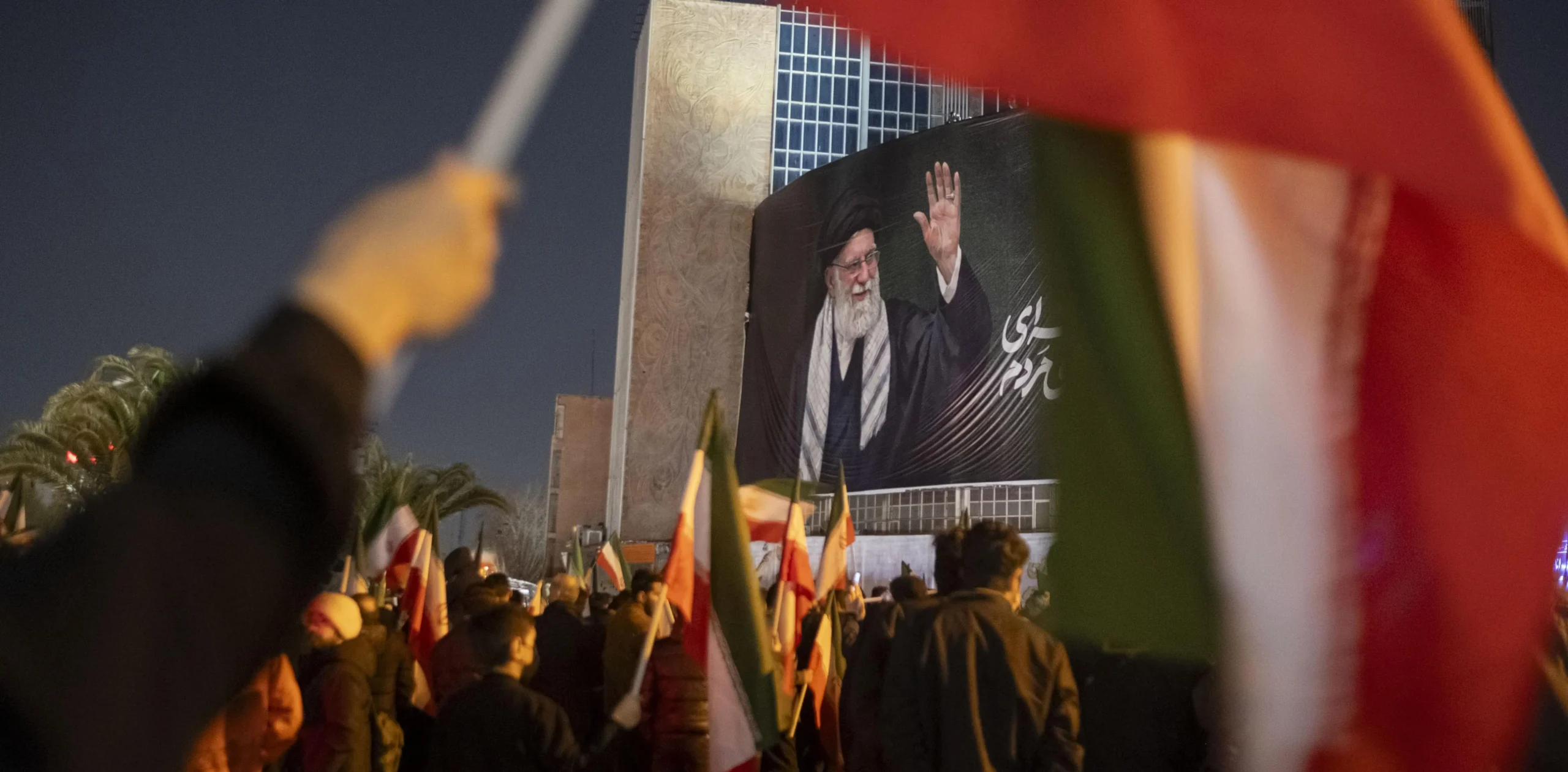
Experts warn Khamenei’s assassination won’t collapse Iran—succession is planned, IRGC retains control. Public celebration lacks mobilization. Region faces instability, diplomatic credibility damaged. No organized opposition exists. War escalates with uncertain outcomes.
The US and Israel took out Ayatollah Khamenei this weekend — the first direct state assassination of a world leader in recent history. We asked experts what happens next.
During joint operations with the U.S. on Saturday, Israel targeted and killed supreme leader Ayatollah Ali Khamenei, who at 86-years-old had been Iran’s longest serving head of state, leading the Islamic Republic since 1989.
It was the first open, direct assassination of a world leader by a state government in more than a century. For decades, as laid out by President Donald Trump in his Saturday morning video announcing the strikes, Iran had been regarded as an enemy of the United States, with the ayatollah the enduring symbol of this generational threat. After his death was announced, Trump called him the “one of the most evil people in history.”
We asked several scholars with experience in Iranian history, and domestic and Middle East politics, to talk about what they foresee as the fall out of the regime’s “decapitation” this weekend. Khamenei’s killing wasn’t the only one. Several top officials in the Iranian defense ministry and others were also taken out in the airstrikes. A three-person council has been temporarily put in charge and has vowed to fight, saying Khamenei’s assassination was a declared war on the world’s Muslims, particularly of the Shi’a faith.
Trump announced, on the other hand, that the people of Iran now had their chance to take the reins. He has also reportedly signaled a willingness to negotiate a ceasefire. Our experts consider that possibility and others much more fraught and uncertain for the Iranians, the region, and the U.S.
Sanam Anderlini, founder and CEO of the International Civil Society Action Network
The war on Iran is illegal and devastating. We warned for years of the consequences and yet here we are, watching them unfold, with every day a new travesty. Saturday they bombed a school-yard killing 108 little girls. Today they bombed Gandhi hospital with neonatal babies. They killed Khamenei to crack the regime. Instead, they turned him into a martyr. His assassination has already unleashed protests and mass crowds from Pakistan and Kashmir to Iraq. Given his age and ailments, he would have died an ignominious death, but now he’s elevated into “Imam-hood.”
The risk of escalation and unfathomable outcomes grows with each day. Israel wants fragmentation or a weakened Iran like Syria — under its control. That’s bad for the U.S., the region, and Iran. The best outcome would be for de-escalation, and for Iran to move towards a referendum on the future of the state, which internal opposition figures like Mir Hossain Mousavi — whom Israel tried to kill — are calling for.
For 47 years Khamenei shaped the Iranian regime around his world view. To many external observers, his outsized existence signaled the regime’s stability. His assassination has proven otherwise. Khamenei is gone, but the regime remains. They knew about succession planning. Within hours, a three-man council was formed and an interim figurehead, Ayatollah Alireza Arafi, appointed.
President Trump could even claim delivery on his goal of “regime change” — or at least changing of the guard. But be careful what you wish for. Arafi is reportedly more religiously conservative and more likely to delegate social crack downs to other hardline regime officials. If in life Khamenei was unsuccessful in exporting the revolution, in death his name is becoming a rallying call for muslims in Pakistan, Iraq and Kashmir.
Sina Azodi, Assistant Professor of Middle East Politics, George Washington University’s Elliott School of International Affairs
Khamenei’s removal from the political scene is a major blow to the Islamic Republic. A close disciple of Ayatollah Khomeini, the founder of the Iranian revolution of 1979, Khamenei was one of the last remaining “original” revolutionaries who participated in the 1979 revolution, the Iran-Iraq war and was ideologically very close to him. However, his removal will not bring the end of the Islamic Republic as the succession process is well underway — and there are no uprisings in Iranian streets. The system will try to quickly fill the vacuum to ensure its continuity. Internationally, his removal may open some opportunities and further flexibility in dealing with the West. Ayatollah Khamenei was a strong promoter of the culture of “resistance” — he viewed threats, sanctions, and confrontation as different stages of the path to resistance. Indeed, many in Iran believed that Khamenei was the major obstacle to Iran’s growing problems.
However, his removal can eliminate this major obstacle. A more amenable leader who is less intransigent could create diplomatic opportunities for the country.
Daniel Brumberg, non-resident senior fellow at Arab Center Washington DC, and Director of Democracy and Governance Studies at Georgetown University
Following the U.S.-Israeli assault on Iran and Israel’s assassination of Supreme Leader Khamenei, the two most likely outcomes for Iran are the imposition of an even more ruthless regime controlled by the security apparatus and its new collective leadership or a fragmentation of the country, perhaps precipitated by tension between the military and the Islamic Revolutionary Guard (IRGC). Both could also ensue at once. Much will depend on whether the military concludes it cannot continue to lose more of its assets. But if the military and the IRGC can score some real hits on U.S. military targets without inviting further regional escalation, the regime will probably hold. For now, there is no “Venezuela option” that would allow remnants of Iran’s ruling regime to survive — a prospect that Trump seemed to hint at when he insisted that Iranian leaders “are ready to talk and even walk to talk.”
Other potential candidates include former President Hassan Rouhani, and Hassan Khomeini, the grandson of Ayatollah Ruhollah Khomeini, both moderate. Thus, the next Supreme Leader will be indicative of the direction along which Iran and its foreign policy will be moving.
Shireen Hunter, honorary fellow, Prince Alwaleed Bin Talal Center for Muslim-Christian Understanding, Georgetown University
The main question is what kind of regime the U.S., but more pertinently Israel, has in mind for Iran. Slogans such as “freedom for Iranians” and “Make Iran Great Again” are meaningless. Do they want Iran to remain as a unified country? I have my doubts.
For some time now many prominent Israeli politicians and academics, notably, Brenda Schafer, have supported the separation of Iranian Azerbaijan from Iran. Some European countries have hosted Iran’s so-called Arab dissidents. The U.S. and some of its regional allies have also supported the Baluch dissidents. Saddam Hussein once said that five small Irans are better than one big Iran. Netanyahu agrees with that. What neither the U.S. nor Israel wants is a strong nationalist government in Iran.
Meanwhile, there is no obvious leader with the necessary qualifications to shape the nature of the new regime in Iran. Reza Pahlavi has neither the knowledge nor the character to lead Iran. Maryam Rajavi, the MeK leader, is even worse. Others are a motley group of Republican and leftist groups. Moreover, any leader who comes to power by foreign intervention soon loses his or her legitimacy.
If the conflict continues, the risk of civil or even regional war is high as is the risk of Iran’s disintegration with unforeseeable consequences for regional countries.
John Limbert, retired US Foreign Service Officer. He was among the last American diplomats to serve in Iran
Events of the last two days have shown the appeal of instant gratification. The Trump administration has interest in diplomacy and negotiation: only triumphalism and posturing. By all accounts, President Trump could have reached a nuclear agreement with Iran that he (as “the world’s greatest negotiator”) could present as a better deal than Obama’s. But he lacked the patience or skill to do even that. Instead he listened to the chant of “regime change” in Iran that apparently originated with Netanyahu and his allies.
Few people, Iranian or non-Iranian, will mourn the downfall of the Islamic Republic. Most will welcome an Iranian government that treats all its citizens decently and which does not threaten other countries, near and far. Bombing Iran’s military sites and eliminating top officials, however, will not bring such a happy outcome. The Islamic Republic, in its dismal 47-year history, has shown unexpected resilience. It has survived assassinations, sanctions, war, and incompetence. It has a cadre of supporters among some Iranians who are willing to slaughter their compatriots rather than give up their privileges and face retribution for 47 years of abuse.
Urging Iranians to “overthrow their government” is not helpful. Does the president expect them to go unarmed into the streets to be slaughtered? Furthermore, what will replace the current ruling theocracy? There is no guarantee it will be better. In 1979, Ayatollah Khomeini, for better or worse, could gather left, right, religious and secular under his banner, and the result was change from bad to worse. Today, however, there is no organized opposition that can offer a coherent program and make the compromises necessary to unite contentious and abused Iranians against a common enemy.
Trita Parsi, executive vice president, Quincy Institute
After the assassination of Ayatollah Khamenei, Iran says it has no red lines left and will go all out in seeking the destruction of U.S. regional bases and high American casualties.
Tehran understands that many in the American security establishment had been convinced that Iran’s past restraint reflected weakness and an inability or unwillingness to face the U.S. in a direct war. Tehran is now doing everything it can to demonstrate the opposite — despite the massive cost it itself will pay. Ironically, the assassination of Khamenei facilitated this shift.
One aspect of this is that Iran has now also struck bases in Cyprus, which have been used for attacks against Iran. Iran is well aware that this is an attack on an EU state. But that seems to be the point. Tehran appears intent on not only expanding the war into Persian Gulf states but also into Europe. Note the attack on the French base in the UAE. For the war to be able to end, Europe too has to pay a cost, the reasoning appears to be.
There appears to be only limited concern about the internal situation. The announcement of Khamenei’s death opened a window for people to pour onto the streets and seek to overthrow the regime. Though expressions of joy were widespread, no real mobilization was seen. That window is now closing, as the theocratic system closes ranks and establishes new formal leadership.
Paul Pillar, non resident fellow, Georgetown University and senior non-resident fellow, Quincy Institute
The results inside Iran of the U.S.-Israeli air attack likely will fall short of true regime change. There is no opposition movement sufficiently organized to take power the way Ruhollah Khomeini’s movement did in deposing the shah in 1979. Supreme Leader Ali Khamenei was old and infirm and could have died from natural causes at any time. Elements of the regime undoubtedly had already planned for his demise. Although the attack has killed other people and disrupted plans, those holding levers of power when dust from the attack has settled are most likely to be found in the existing regime.
Outside Iran, the chief consequences flow less from Khamenei’s death than from the United States abandoning negotiations and launching a barely rationalized war of aggression against a country that was posing no immediate threat to the U.S. Suddenly increased instability in the Persian Gulf will reverse what had been a promising trend toward détente in that region. Regimes thinking of acquiring nuclear weapons will have another example of countries not having such weapons (Iran, Ukraine) getting attacked while those that have them (North Korea) do not. And any U.S. reputation as a good faith negotiator has been severely damaged.
Muhammad Sahimi, professor, University of Southern California
To understand the prospects for change in Iran and its foreign policy regarding the Middle East, we need to consider a few important points. One is that the power structure in the Islamic Republic is firm enough to quickly elect the next Supreme Leader. Second, before his death, Ayatollah Ali Khamenei had approved a plan of succession for key military and political posts, according to which if any senior official was assassinated, his immediate successor had been named. Third, the IRGC plays a key role in electing the next Supreme Leader, unless the most senior clerics in Qom intervene and express their views publicly and loudly. Fourth, the Interim Leadership Council includes President Masoud Pezeshkian, the judiciary chief Gholam-Hossein Mohseni Eje’i, a hardline cleric, and Ayatollah Alireza Arafi who manages all seminaries in Iran, and is a member of the Guardian Council and second deputy to the head of the Assembly of Experts, the constitutional body that will elect the next Supreme Leader.
Politically, Arafi’s views are close to those of Khamenei, and over the past few years he has emerged as a leading candidate to succeed Khamenei, but he has had no experience running any large-scale organ of the state, which is a requirement of the Constitution.
Barbara Slavin, distinguished fellow at the Stimson Center and lecturer in international affairs at George Washington University.
Israel has long embraced assassination as a tool of statecraft, employing it to devastating effect, in particular since the Hamas attacks of Oct. 7, 2023. Israel has now added Iran’s Supreme Leader Ayatollah Ali Khamenei to its list of adversarial scalps, along with Hassan Nasrallah of Hezbollah and Yahya Sinwar and Ismail Haniyeh of Hamas. Killing the leaders of your enemies undoubtedly provides psychological satisfaction and satisfies the desire for vengeance. But without addressing the root causes for conflicts, these victories are likely to be short-lived.
In Iran, it remains unclear what sort of regime will emerge from the U.S. and Israeli strikes and whether Tehran will abandon its rejection of the Jewish state. Meanwhile, both Hezbollah in Lebanon and Hamas in Gaza — while severely battered by Israeli strikes — retain grassroots support. Palestinian fury at Israel has only grown during the past two years of brutal Israeli attacks. Without durable political solutions, killing only buys time and lays the groundwork for more tit-for-tat violence.