
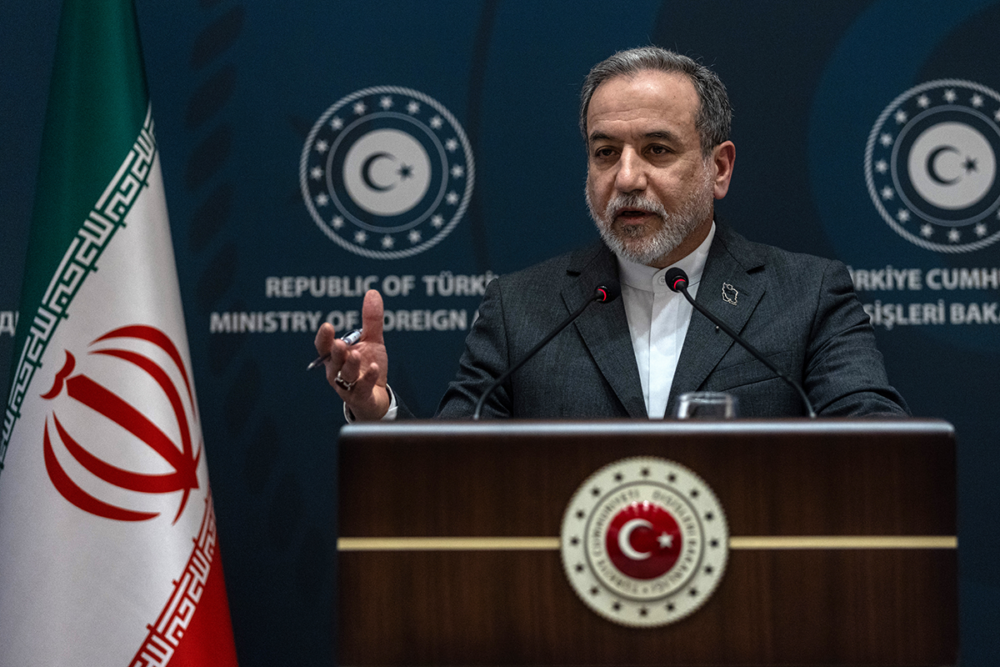
Alex Vatanka
The decision by Washington and Tehran to shift their long-anticipated meeting, set for February 6, from Istanbul to Muscat is not merely a logistical detail. It is the latest reminder that when US-Iran diplomacy is on the verge of breaking down completely, Oman is the regional player the Iranian regime trusts most to step in and mediate.
What has changed in 2026 is not the nature of Oman’s involvement but the stakes: The risk of miscalculation is rising, Iran and the United States might be reading the moment in opposite ways, and quiet facilitation is no longer enough. Oman must now take on a more assertive mediating role — not against Iran, but for Iran’s own strategic survival and for the stability of the entire Persian Gulf region.
Heightened US-Iran tensions
Over the past week, multiple regional and Western outlets confirmed that Iran pressed for the venue change. Tehran wants the talks to be held in Muscat because the latter could be trusted to narrow the agenda strictly to the nuclear file and maintain the insulated bilateral format of earlier Oman rounds, excluding Arab, Turkish, and Pakistani observers.
The US agreed to the move — a rare gesture of accommodation in President Donald Trump’s second term. Axios, Reuters, and several Arab officials all indicated that the talks will now occur in Oman, with Foreign Minister Abbas Araghchi representing Iran and White House envoy Steve Witkoff (possibly joined by Trump’s son-in-law Jared Kushner) leading the American team. Iran has made clear that ballistic missiles, regional proxies, and domestic politics are off the table. Washington has made equally clear that those same long-standing issues remain central to its strategic view. Oman now sits in the middle of that gap.
The venue shift tells us something else as well: Iran’s leadership, despite its hard public line, still prefers to negotiate when escalation threatens to spin out of control. Moving the talks to Oman also reflects Muscat’s enduring status as Iran’s most trusted Gulf counterpart — a status that it has maintained despite years of regional polarization, the war in Yemen, and the shadow of broader skepticism from the other Gulf Cooperation Council (GCC) members toward Oman’s neutrality. But the shift also exposes a deeper problem that Muscat will have to confront directly: the widening misperception between Washington and Tehran.
In Tehran, especially across the hardline media and security apparatus, America’s willingness to return to talks is advertised as evidence of US weakness or lack of options. The Tasnim News Agency, linked to the Islamic Revolutionary Guard Corps (IRGC), framed it bluntly: Trump’s military pressure failed, the “quasi-coup” failed (a reference to the January 2026 mass protest movement in Iran), the snapback of sanctions by the Europeans in September 2025 also failed, as did other Israeli pressure tactics, and thus Washington had no choice but to negotiate. In this narrative, America blinked, which ostensibly validates Iran’s strategy of defiance.
Washington reads the situation almost exactly the opposite way. US officials and regional diplomats repeatedly tell reporters that Iran is under severe internal strain, fearful of another round of nationwide protests, and uncertain about the durability of its own internal control. The US naval buildup in the Persian Gulf region, the February 3 shoot-down of an Iranian drone approaching the aircraft carrier USS Abraham Lincoln, and the near-seizure of a US-flagged tanker in the Strait of Hormuz all unfolded in the same 72-hour window that Trump publicly warned “bad things” would happen if no deal is reached. From the American point of view, negotiating is not a concession; it is an opportunity to lock in symbolic and substantive gains before events spiral further.
Enter Oman
This gap in perception is the most dangerous feature of the current crisis — and precisely why Oman’s role has become indispensable. When one side believes the other is retreating, and the other believes it is negotiating from a position of strength, diplomacy can break down in an instant. Iran’s insistence on nuclear-only talks and refusal to include regional observers reflects confidence. America’s insistence on discussing broader issues reflects pressure. That asymmetry is how wars can begin by accident.
The GCC states now recognize this as well. For years, Oman’s quiet mediation elicited suspicion among its neighbors — particularly Saudi Arabia and the United Arab Emirates — which feared Muscat’s independent line weakened the collective pressure on Iran. But the 12-day war with Israel in 2025 and the unrest in Iran in early 2026 changed that calculus. The Israeli attacks on Iranian targets, Iran’s retaliatory strike on al-Udeid Air Base in Qatar, and the subsequent American drawdown at key Gulf bases all underscored that any US-Iran conflict would spill onto Gulf soil first. The memory of the 2019 Saudi oil-facility strikes remains fresh; the 2025-26 escalatory cycle made it even clearer that no Gulf country can afford unilateral crisis management.
Thus, by mid-January, Gulf capitals were no longer questioning whether Oman should mediate — but whether Oman could prevent a conflict neither side may intend but both are dangerously capable of triggering. Doha, Riyadh, and Muscat jointly pressured Washington to pause a military strike. What was once viewed as Muscat’s inconvenient neutrality is now understood as the region’s last line of preventive diplomacy.
Yet Oman’s traditional approach — discreet, patient, process-driven — may not be sufficient this time. In earlier years, Muscat’s role was to pass messages, host secret channels, and preserve space for dialogue when others disengaged. That was enough when both Iran and the US believed time was on their side. But the current environment is less forgiving. Iran is signaling confidence that America has no military option. America believes Iran is vulnerable and will eventually bend. Israel is lobbying hard to expand US demands and to prevent any agreement unless Tehran basically capitulates to all of them, including a vastly reduced Iranian missile program and the withdrawal of support for its regional proxy allies, such as Hizballah in Lebanon and the Houthis in Yemen. There are also reports that that the Israeli government is now pressing Trump to strike ballistic missile factories and blockade Iran. Meanwhile, the Gulf — in this case, unusually unified — is terrified that one misread move by either Washington or Tehran will consume the entire region.
In this landscape, Oman has a different kind of responsibility: not merely to facilitate, but to correct the misapprehensions that make escalation more likely. Muscat is uniquely positioned to tell Tehran what no other capital can: that interpreting US engagement as capitulation is a dangerous illusion; that Trump’s unpredictability is not a sign of weakness but a negotiating tactic; and that refusing to broaden the agenda, while understandable, risks confirming Washington’s belief that Iran is stalling for time. At the same time, Oman can deliver to the US the message that maximalist demands — zero enrichment, dismantlement of its missile program, and abandonment of regional allies — will produce no deal at all and may corner Iran into counter-escalation.
This is not about choosing sides. It is about preventing both sides from misunderstanding the other’s intentions and capabilities. Oman does not need to push Iran to capitulate. It needs to compel Iran to recognize that the window for a face-saving compromise is shrinking and that overconfidence has derailed Iranian diplomacy with Trump before. Tehran knows how 2019-20 ended (with the US assassination of General Qassem Soleimani, head of the IRGC Quds Force); it also knows that Trump prizes visible victories over technical nuance. Understanding that psychology is essential, and Oman may be the only actor able to convey it credibly.
There is still a path to de-escalation. Iran can step back from high-level enrichment without surrendering its nuclear program. Washington can ease sanctions without abandoning its concerns. Regional actors can play constructive roles without crowding the negotiating table. These are exactly the kinds of narrow, interest-based arrangements Oman has brokered before.
But no such deal will materialize if Oman limits itself to quiet message passing. This moment calls for something harder: candid persuasion. Muscat has the trust of Tehran, the respect of Washington, and the backing of the Gulf — a rare alignment. It should use that leverage to urge Iran toward strategic restraint, not out of deference to the United States but because Iran’s stability, the Gulf’s security, and the region’s peace now depend on how Tehran interprets this moment.
Oman has always been the Gulf’s quiet mediator. Today, it must also be its clearest voice of caution. The region has entered a phase where miscalculation, not malice, is the greater danger. Helping Tehran recognize that difference — firmly, privately, and persistently — may be the most important diplomatic service Muscat has ever performed.
https://mei.edu/publication/with_us_iran_on_knife-edge_can_oman_mediate/