
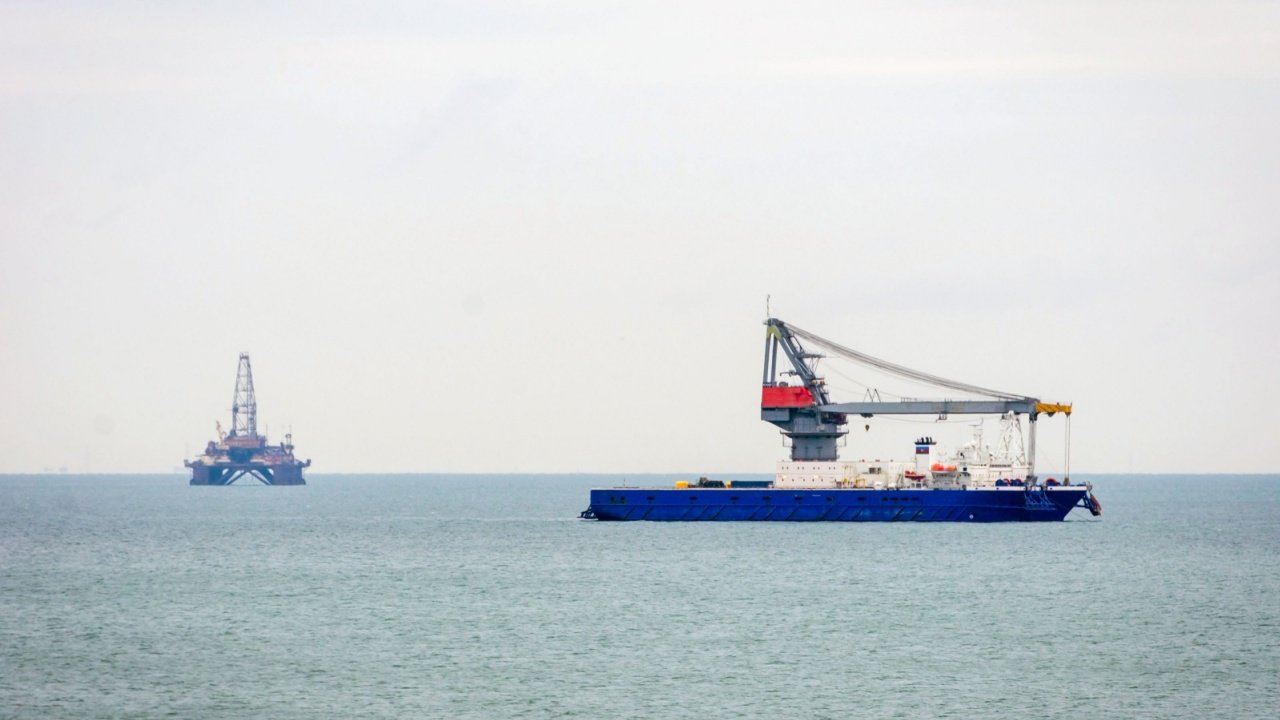
Caspian Sea Trade has emerged as the definitive lifeline for Tehran as traditional maritime routes collapse under heavy bombardment. With the Persian Gulf paralyzed, regional powers are now forced to accelerate all Caspian Sea Trade.
The Strategic Importance of Caspian Sea Trade
With the Strait of Hormuz blocked, Iran must rely on the sea to its north for its essential trade. Since the outbreak of the Iran War, most international attention has focused on the Persian Gulf, specifically the Strait of Hormuz, through which, in normal times, nearly 25 percent of the world’s oil and 20 percent of the world’s natural gas flow. The double Iranian and US naval blockade has choked maritime traffic and precipitated a global energy crisis.
Yet, the gulf and its strait are not the only bodies of water that war has placed in jeopardy. On its northern edge, Iran borders the Caspian Sea, the world’s largest inland body of water. At 143,000 square miles, it’s as large as the Black Sea in Europe, and along its coast, it hosts the regional powers of Russia, Azerbaijan, and Kazakhstan. Maritime trade and oil pipelines have, for years, crossed the Caspian between Europe and Asia, making it a prime venue for commerce.
Military Strikes Disrupting Caspian Sea Trade
As an energy-rich basin at the crossroads of the three flashpoint regions—the Middle East, Eastern Europe, and Central Asia—the Caspian Sea has seen conflict come right to its coast. The US and Israeli bombardment of Tehran has brought military activity near the Caspian’s airspace, just 67 miles away. Airstrikes have also targeted Iranian seaports along the Caspian. On March 19, Israeli forces executed strikes on Bandar Anzali, a seaside town and major Caspian port for Iran’s conventional (ie, “Artesh”) navy, destroying a substantial portion of Iran’s Caspian fleet. Another series of airstrikes, on April 1, targeted Bandar Anzali’s port infrastructure.
Port Infrastructure and Survival
Bandar Anzali is the largest port on the Caspian Sea, and a principal conduit for commerce between Iran and Central Asia. Under normal circumstances, 90 percent of Iranian trade ran through the Persian Gulf. However, warfare has closed off 95 percent of its maritime traffic. For Iranian goods to reach markets, its non-Arab and non-Gulf transport links—eg, through the Caspian—are now essential to global commerce. Attacking Bandar Anzali dents Iran’s alternative routes.
Russia’s Role in Caspian Sea Trade
The most important trade affected is between Iran and Russia. Their trans-Caspian relationship predates the war but has since grown. Bilateral trade, while modest at $4.8 billion in 2024, has nonetheless grown by 16 percent in the last year, driven by Russian machinery and industrial goods that Iran needs due to Western sanctions. In 2026, it is estimated that the Russia-Iran cargo trade will exceed 10 million tons.
Russia has pledged its support to Iran during the ongoing war. Principally, this support has involved the shipment of one-way Shahed-style attack drones, which Tehran has used effectively as missiles to attack Israel, Arab countries, and US military assets. The drones have been Iran’s most effective asset in the war.
Russia manufactures drones in the north at Yelabuga and sails them from its Volga riverport, Astrakhan, to Iran, where ships dock at Bandar Anzali. The use of unregistered vessels and false cargo manifests, known as a “shadow fleet,” helps these weapons transit the Caspian to reach Iranian forces, which also ferry other arms and ammunition.
Azerbaijan’s Influence on Caspian Sea Trade
The attacks at Bandar Anzali sent a message to Russia to stop supporting Iran. However, it is unclear whether Moscow has received the message. Russia’s Foreign Minister Sergey Lavrov denounced the strikes: “The Caspian Sea must remain a zone of peace and cooperation.” “Russia would view it extremely negatively,” Kremlin spokesperson Dimitry Peskov remarked, discussing the prospect of future military action in the Caspian Sea.
Azerbaijan’s Stake in the Caspian Sea The other major power in the Caspian is Azerbaijan, which has a 400-mile land border with Iran. Both countries are Shia-majority, and a large number of ethnic Azeris, some 20 million, live in northwestern Iran. Moreover, for Azerbaijan, Iran is the only land route to its landlocked Nakhchivan exclave, which is separated from the mainland by its rival, Armenia.
This exclave became a flashpoint during the ongoing war on March 5, when Iranian drones struck an airport and a school in Nakhchivan. Azerbaijan responded by withdrawing its diplomats from Iran and preparing retaliatory measures. President Ilham Aliyev also made verbal overtures to ethnic Azeris in Iran, raising a sensitive subject for Tehran, which fears Azerbaijani revanchism and loss of territory. Iran denied involvement, and the two countries quickly resumed normal relations.
Shifting Alliances in the North
Despite its Iranian ties, Azerbaijan has a close relationship with Israel, which the latter calls a “strong partnership.” Amid oil sales boycotts from its neighbors, Israel imports up to 40 percent of its oil from Azerbaijan. In exchange, it supplies most weapons used by the Azerbaijani Armed Forces. Through this partnership, Azerbaijan has cultivated stronger ties with the United States, which has been courting Azerbaijan’s membership in the Abraham Accords.
The awkwardness of this relationship for Azerbaijan cannot be understated. Iran has long criticized it, especially military ties, which it fears undermine the security of its northwest. During the war, Azerbaijan sent humanitarian aid to Iran, which Baku must carefully manage to avoid supporting the Iranian armed forces, to Israel’s ire.
Formally, Azerbaijan is neutral in the war and refuses to let either side use its territory for military operations. However, Azerbaijani territory has been essential to absorbing people fleeing violence.
Importantly, Azerbaijan has used its leverage with Israel to demand no strikes on Iran’s northwest to protect its ethnic Azeri populations in 2025. The demand came after Israel attacked Tabriz, the largest Iranian city in the region, just 28 miles from the Azerbaijani border.
Financial Windfalls from Caspian Sea Trade
For Azerbaijan’s part, its Caspian position has allowed it to reap financial windfalls during the war, as an oil producer and trade conduit. Oil price increases may net the country an additional $200 million in revenue, per estimates, while Trans-Caspian trade has increased by 500 percent. The Port of Baku, Azerbaijan’s biggest seaport, stands to gain greatly as a logistics hub, from customs and transit fees as trade volume circumvents Iran through the Caucasus, en route to other markets like Europe.
Indeed, Baku’s port may be the only safe way for general commerce to reach Iran, as its northern ports like Bandar Anzali face Israeli targeting; Iran and Azerbaijan continue to trade over their land border. Moreover, due to its good relations with the United States, Israel, and Iran, Azerbaijan is among the rare few countries of the world that maintains robust ties to all belligerents. Consequently, Baku may use its leverage to shape the outcome of the war or, at the very least, the Caspian Sea’s security.