
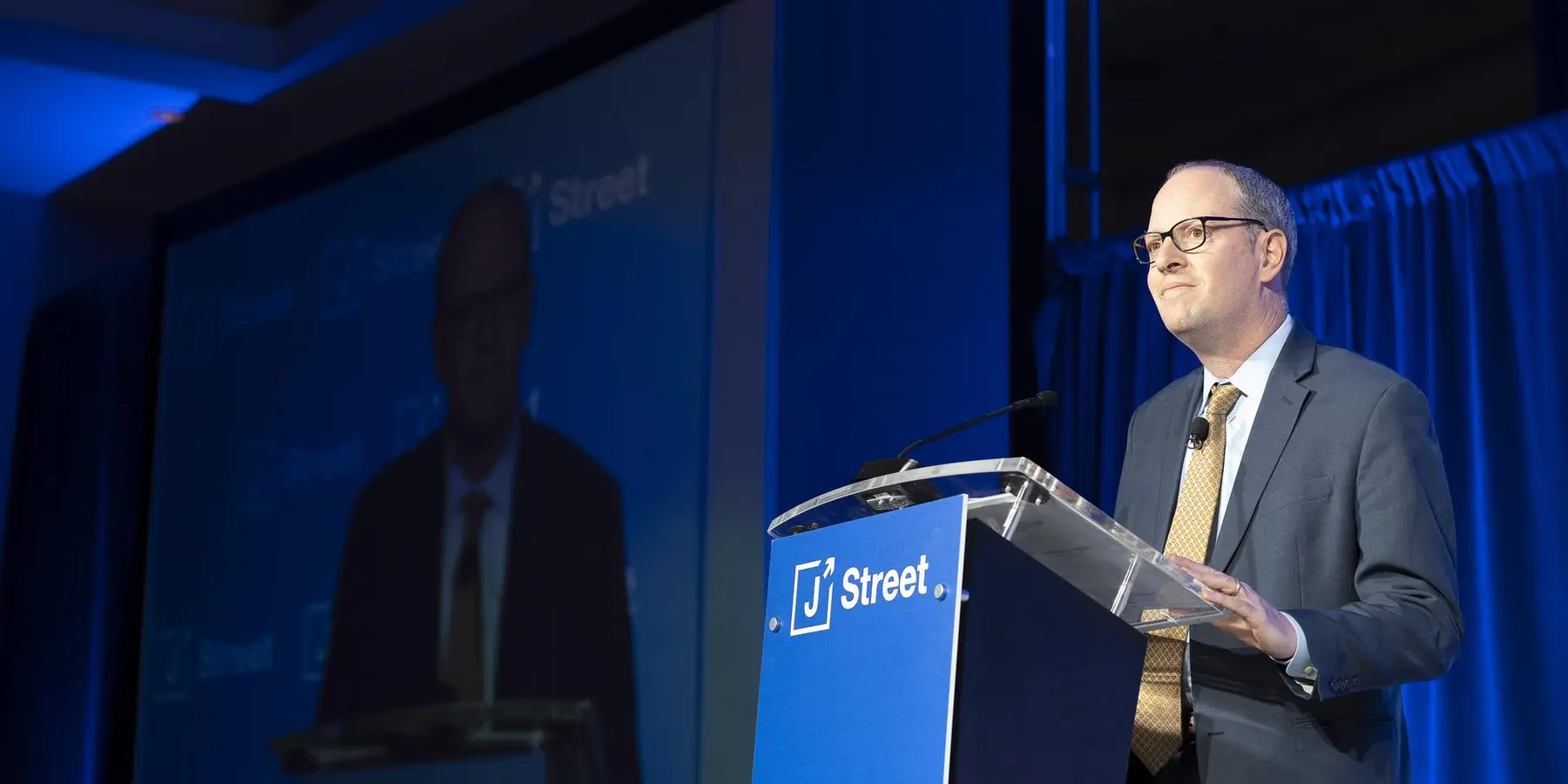
Goldenberg, a former Harris adviser, now advocates conditioning arms sales and sanctioning settlers, diverging from Biden’s war policy. Progressives criticize his Ceasefire Compliance Act as a weaker alternative to blanket weapons bans, shaping the 2028 primary foreign policy debate.
No one knows better where Biden and Harris went wrong than Ilan Goldenberg. Now, he’s using his perch at J Street to end the ‘blank check’.
A Palestinian family was waiting for Israeli officials to return their son’s body. Inside a mourning tent, a group of American foreign policy leaders sat with them.
It was August 2025, and Ilan Goldenberg — a former adviser to Vice President Kamala Harris — was leading a trip to the West Bank with his former Biden administration colleagues. When Goldenberg heard about the killing, he decided to make a detour to this village on the outskirts of Hebron.
The family was grieving 31-year-old Awdah al-Hathaleen, a local activist who helped film the Oscar-winning documentary No Other Land. Days earlier, Awdah had recorded a confrontation with an Israeli settler, Yinon Levi, until the moment Levi pulled the trigger.
From the tent, Goldenberg looked at a circle of rocks surrounding a dried pool of Awdah’s blood on the cement nearby. “It was as tough of a thing as I had seen in many of my trips into Israel, to the West Bank,” Goldenberg told RS.
In the White House, he had helped develop an executive order under which Levi himself had been sanctioned. President Donald Trump later reversed it. Goldenberg, who was born nearby in Jerusalem, had decided it was time for the U.S. to adopt a new approach to Israel and Palestine. The trip was his opportunity to show his former colleagues where the Democratic Party could go from here.
Ilan Goldenberg has spent more than two decades trying to shape U.S. Middle East policy from the inside, at the Pentagon, on Capitol Hill, in the Biden White House. Now, as the chief policy officer and senior vice president of J Street, a progressive pro-Israel advocacy group, he is focused on forging a new Democratic Party consensus — one that seeks to end America’s “blank check” for Israel.
In practice, this means pushing for policies that would have been unthinkable just a few years ago, like ending military aid, conditioning weapons sales, and cracking down hard on Israel’s settler movement, which has killed more than 1,000 Palestinians in the past two and a half years.
This mission is an odd fit for the bespectacled, suit-sporting bureaucrat, who once helped implement the soft-touch approach to Israel that has left the Middle East in flames. Known across foreign policy circles as an eminently likeable wonk, he stands in stark contrast to the activists who have driven the Democratic party away from pro-Israel politics in recent years. In this group’s reckoning, Goldenberg is at best trying to catch up with the shifting political winds, and at worst trying to slow down momentum toward policies like a full arms embargo.
“There’s a predetermined zone of comfort for policy,” said a progressive foreign policy researcher who’s known Goldenberg for more than a decade. “Regardless of what the facts are, the policy prescriptions are going to finish in that zone of comfort.”
But Goldenberg is undeterred. Drawing on deep connections in both policy and politics, he is betting that he can drive the party toward a consensus that reins in Israel without completely abandoning it. As he wrote in a blog post last year, “The key now is to elevate voices, which support these values and ideas, but are being drowned out by the extremes.”
The road from Jerusalem
When Goldenberg was four years old, his family friend came home from Lebanon in a bodybag. The Israel Defense Forces had invaded the country in 1982 to force out the Palestine Liberation Organization, and casualties were mounting. After sitting shiva for his fallen friend, Goldenberg told his parents, “I didn’t want to die when I was 23. I wanted to die when I was 90.”
Goldenberg lived in Jerusalem for eight years before his family returned to the United States and settled in New Jersey. He grew up a staunch Zionist. Then, in the summer after he finished high school, an intensive Arabic program at Middlebury College challenged his perspective. “I start hearing all these things that are just very different than the world I grew up with,” he said.The ensuing ideological tumult played out like a “grieving process.”
“First it’s denial, and then you move to anger,” he recalled. “I felt very angry at Jewish community, felt like my Judaism was really wrapped up in a one-sided version of the story of how Israel was created.” In the end, he reached acceptance. “I actually understand both worlds,” he recalled thinking. “Maybe I can do stuff to help.”
When Goldenberg arrived in Washington in 2004, he cut his teeth working for the National Security Network, a progressive advocacy group that sought to create a credible Democratic alternative to the George W. Bush administration’s militaristic foreign policy. After Obama took office, Goldenberg went into government as a Middle East adviser at the Pentagon.
In 2013, he got his first opportunity to work on the conflict directly, joining the American team for what would be the last serious round of Israel-Palestine peace talks. The talks ultimately collapsed, in no small part because of Israeli Prime Minister Benjamin Netanyahu’s refusal to freeze settlement expansion in the West Bank, which Palestinian leadership interpreted as a rejection of a two-state solution.
Matt Duss, who would go on to work as a foreign policy adviser to Sen. Bernie Sanders (I-Vt.), recalled discussions with Goldenberg at the time. “We had some differences about when and how the U.S. should apply pressure,” Duss said, noting that Goldenberg was more reticent about pushing Israel. (Goldenberg confirmed this in a 2015 report, saying that American officials were “more sensitive to Israeli concerns.”)
After leaving government in 2014, Goldenberg joined the Center for a New American Security, where he stayed throughout the first Trump administration. There, he created a working group on Gaza that he led with Hady Amr, another former Obama administration official.
Despite an escalating series of wars between Israel and Hamas, Gaza had largely fallen off the radar in Washington. Goldenberg and Amr hoped the task force would force the foreign policy establishment to pay attention. Their conclusion, as Goldenberg told RS, was simple: “If we keep going as it is, this whole thing is going to implode.”
The turning point
When Hamas attacked Israel on October 7, 2023, Goldenberg had recently joined the Vice President’s office as a special adviser on the Middle East. As President Joe Biden debuted his “bear-hug” strategy, premised on shaping Israeli policy through emphatic public and private support for the war, Goldenberg turned his attention to a particularly thorny question: what would a post-war Gaza look like?
Goldenberg took an unconventional approach to this planning. The dominant assumption in the Biden administration was that Israel would succeed in its goal of destroying Hamas. But “one of Ilan’s scenarios, and I dare say his core scenario, was Hamas surviving,” said Philip Gordon, who was Harris’ national security adviser and Goldenberg’s boss at the White House.
“That’s not a traditional government reflex,” Gordon explained. “If the goal is to eradicate Hamas, then people often do their planning based on that goal.”
In mid-November 2023, Goldenberg met with Israeli officials to pitch various options for a post-war Gaza, including ones in which Israel and the U.S. would support the creation of a technocratic Palestinian government that could replace Hamas. The Israelis refused to engage. “Their response was, ‘we want to talk to you about this, but we can’t, because the politicals won’t let us,’” he said.
Goldenberg had supported Biden’s embrace of Israel during the first month of the war, but this rejection changed his mind. Israel had little hope of eradicating Hamas through war, and it had no interest in replacing the organization with a more moderate Palestinian government, like the Palestinian Authority. “Whatever war they launched in Gaza, Hamas would still be there at the end,” Goldenberg told RS. “And therefore, none of this was worth it.”
By early December of that year, a growing number of senior U.S. officials had joined Goldenberg in concluding it was time to end the war. A divide formed within the administration, with only a few influential figures — like National Security Council stalwart Brett McGurk and Secretary of State Antony Blinken — hewing to Biden’s emphatic support for Israel’s war. Because of this split, the policy process “got controlled ultimately by a very small group of people in the White House,” Goldenberg said.
The Biden administration often pushed in vain for Israel to allow more humanitarian aid into Gaza, Goldenberg argued. But U.S. officials rarely pressed their Israeli counterparts on the civilian impact of their bombing campaign despite the widespread understanding in the Pentagon that Israel’s rules of engagement were “not up to our standards,” Goldenberg said.
“We shouldn’t have been, in retrospect, giving them those weapons,” he told RS, pointing to U.S. laws that limit arms sales to human rights violators.
As the death toll mounted in Gaza as well as in the West Bank, a dozen career officials across the government resigned in protest. Goldenberg decided to stay in his role and attempt to influence policy from the inside. He remained convinced that Biden and Harris “wanted this war to end,” he said. “That’s why I did not resign.”
But the war didn’t end. As Israel’s campaign dragged on, Goldenberg began looking for a way out of government. Then, when Biden bowed out of the presidential election, Gordon asked if Goldenberg would lead Jewish outreach for Harris’ campaign. He said yes and plunged into politics for the first time since the Bush administration.
The job bolstered his credentials as one of the most prominent Democratic voices on Israel. Working alongside the campaign’s liaison to Arab and Muslim voters, he saw just how divided Americans had become on the issue. “I’d spent all my time focused on what was going on over there, without really understanding how bad things were domestically,” he said.
Despite his overall support for the campaign’s approach to Israel, Goldenberg has some regrets — most notably, the party’s decision to prevent a Palestinian from speaking at the Democratic National Convention. “That was the one thing I wish we’d done differently,” he said.
Still, Goldenberg doesn’t believe that Harris lost the election because of Gaza, even if it “surely didn’t help.” In his view, the real reasons for the campaign’s failure were a poorly performing economy and Harris’ inability to reach younger voters.
For many progressives, this argument is splitting hairs. Harris’ weakness among young people was a direct result of her unwillingness to break with Biden on Gaza, argued a Democratic strategist at a pro-Palestine organization. “The polling was clearly showing that they were losing votes on this issue.”
The long game
After Harris lost to Trump, Goldenberg wrestled with the destruction that more than a year of brutal war had wrought. He thought that Biden had missed an opportunity to end the fighting by publicly calling for a ceasefire in late 2023, when he was still at his most popular within Israel. “[W]e could have taken a different approach that may have put the war on an entirely different trajectory,” Goldenberg wrote on his Substack. “We will never know how things might have gone.”
Goldenberg couldn’t persuade the president he had served to change course when he was in office. So he set out to ensure that the next Democratic president would embrace a new perspective that adjusted to realities on the ground and accepted the changing views of American voters.
Goldenberg became the inaugural chief policy officer at J Street, where he leads a mini-think tank that advises the organization and guides its policy prescriptions. J Street already had a well-connected lobbying shop and an increasingly influential political action committee. Goldenberg became its wonk-in-chief — someone who can get the ear of leading foreign policy figures one day and provide persuasive advice to a member of Congress the next. “He brings a level of credibility,” Jeremy Ben Ami, the founding president of J Street, said.
Since joining J Street, Goldenberg has defended the Harris campaign for probing Pennsylvania Governor Josh Shapiro, a 2028 presidential contender, over his ties to Israel, and he has declared his opposition to U.S. funding for Israeli weapons. He’s even thrown his support behind blocking some arms sales to Israel — something he “was never comfortable supporting” until last year.
Goldenberg has also been one of the only Biden White House officials to publicly come out against America’s policy toward Gaza, aligning himself with the overwhelming majority of Democratic voters and endearing himself with the progressive wing of the party. Duss said he hopes Democratic leaders will “draw a line” in future administrations and keep their distance from officials who have continued following Biden’s lead. The progressive, pro-Palestine strategist went further, advocating for the “complete blacklisting of anyone who is involved in supporting the Biden administration’s policy of funding Israel throughout the Gaza genocide.”
Goldenberg doesn’t condemn his former colleagues. But he’s already working hard to shape the views of the candidates who will vie for the Democratic nomination in 2028 — and the wonks who will advise them.
For last year’s trip to Israel and the West Bank, he mainly recruited people who are “younger and might go back in” to government, he said. The trip included former officials who had worked as assistant secretaries and National Security Council senior directors, in addition to some more senior former officials like Gordon. Traveling through the segregated West Bank city of Hebron, Goldenberg showed them the “worst of the worst of the occupation.”
Back in Washington, Goldenberg has helped sell legislation that would impose sanctions on Israeli settlers and condition U.S. arms sales to Israel. In his view, these increasingly popular proposals are shifting the Democratic Party’s center of gravity and creating room to pursue a “normal” relationship with Israel.
Progressives are less enthused. A former U.S. official who has worked with Goldenberg worried that, rather than pulling the party to the left, Goldenberg and J Street’s influence could prevent moderate members from continuing to move in a pro-Palestinian direction.
The Ceasefire Compliance Act, which Goldenberg helped craft, is particularly controversial. The bill would create a framework for conditioning U.S. weapons transfers to Israel. But progressives worry that it will draw attention away from the Block the Bombs Act, which would place blanket bans on transferring many of the weapons Israel used in Gaza and Lebanon.
“What this is essentially saying is, ‘don’t hold Israel accountable to existing law. That’s too complicated and too controversial. So we’re going to create a whole new set of requirements for Israel,’” the progressive foreign policy researcher said. “Israel always gets its own set of rules.”
Goldenberg shrugs off these arguments. “There’s been a bunch of members who signed on to this, who are not on Block the Bombs,” he said. “Now we’re expanding the coalition of people who are saying, ‘let’s end the blank check.'”
As the 2028 presidential primaries draw closer, the stakes of this debate have come into focus. Settlers are still killing Palestinians like Hathaleen every week, and the Israeli military is still waging brutal campaigns in both Lebanon and Gaza. Critics say Goldenberg isn’t going far enough to break with this legacy. But Goldenberg believes that building a better future requires creating a new consensus that the entire Democratic Party can embrace.
“My job is to make sure that whoever walks into that door in 2029 has a fundamentally different set of experiences they’re coming with,” he told RS. “Because by the time you’re in that little bubble in the Oval, it’s too late.