
The Iran war did not push Gulf states toward China as a US replacement. Instead, it accelerated diversification: Gulf states seek domestic defense, Chinese drones, and BRI infrastructure. Beijing can facilitate Gulf-Iran dialogue, shaping a layered, multi-aligned security order.
China Gulf Strategy is reshaping post-war calculations across the Middle East as governments reassess deterrence, diplomacy, procurement, and investment. China Gulf Strategy now influences policy debates, alliance design, and regional hedging. China Gulf Strategy frames emerging realities, while long-term stability may ultimately depend on China Gulf Strategy.
China Gulf Strategy and the War’s Immediate Strategic Impact
The war in Iran has made China’s future posture in the Gulf more uncertain. Some analysts have rushed to conclude that the war has revealed China’s absence and proved that the US is the only reliable security partner for the Gulf states. Others claim that the war has pushed Gulf states closer to China as US predominance has declined.
This binary outlook overlooks a key factor in Beijing’s Middle East policies: they are not built on a balancer or security provider model. In fact, China lacks a clear direction for navigating geopolitical shifts in the region. But it could reap political, normative, and reputational wins where dissatisfaction with Washington, and reorganized priorities across the Gulf, allow it to intervene at the expense of the US.
The war’s main effect has not, therefore, been to set China on a path to replace the US as the region’s security provider. But it may have created the conditions for Beijing to play a role in shaping a new regional order.
China Gulf Strategy and New Gulf Security Dynamics
New Gulf security dynamics
The war in Iran revealed three key dynamics for Gulf security and future alignment.
First, US military power has limits, and escalation is not necessarily a substitute for deterrence. For the Gulf, US military bases may have become a liability, not a source of security. And Gulf states did not choose this war. Indeed, the US ignored their calls to avoid it. The country that was supposed to ensure Gulf security, therefore, imperilled it – even if largely US-made defences deployed by Gulf States were critical in shielding their populations from missile and drone attack.
Second, Iran has shown that its missile and drone capabilities, coupled with its use of the Strait of Hormuz as leverage, can create a balance of deterrence with the US and Israel – one that allows Tehran to extract valuable concessions in tactical and political terms.
Third, the US and China don’t compete over matters of war and peace in the Gulf. In fact, their interests have been shown to align.
China Gulf Strategy and Hormuz Diplomacy
China’s position on ending the blockade has been eye-catching for its clarity. In a phone call with Saudi Crown Prince Mohamed bin Salman, President Xi Jinping called for Hormuz ‘to remain open to normal passage, as this serves the common interests of regional countries and the international community’.
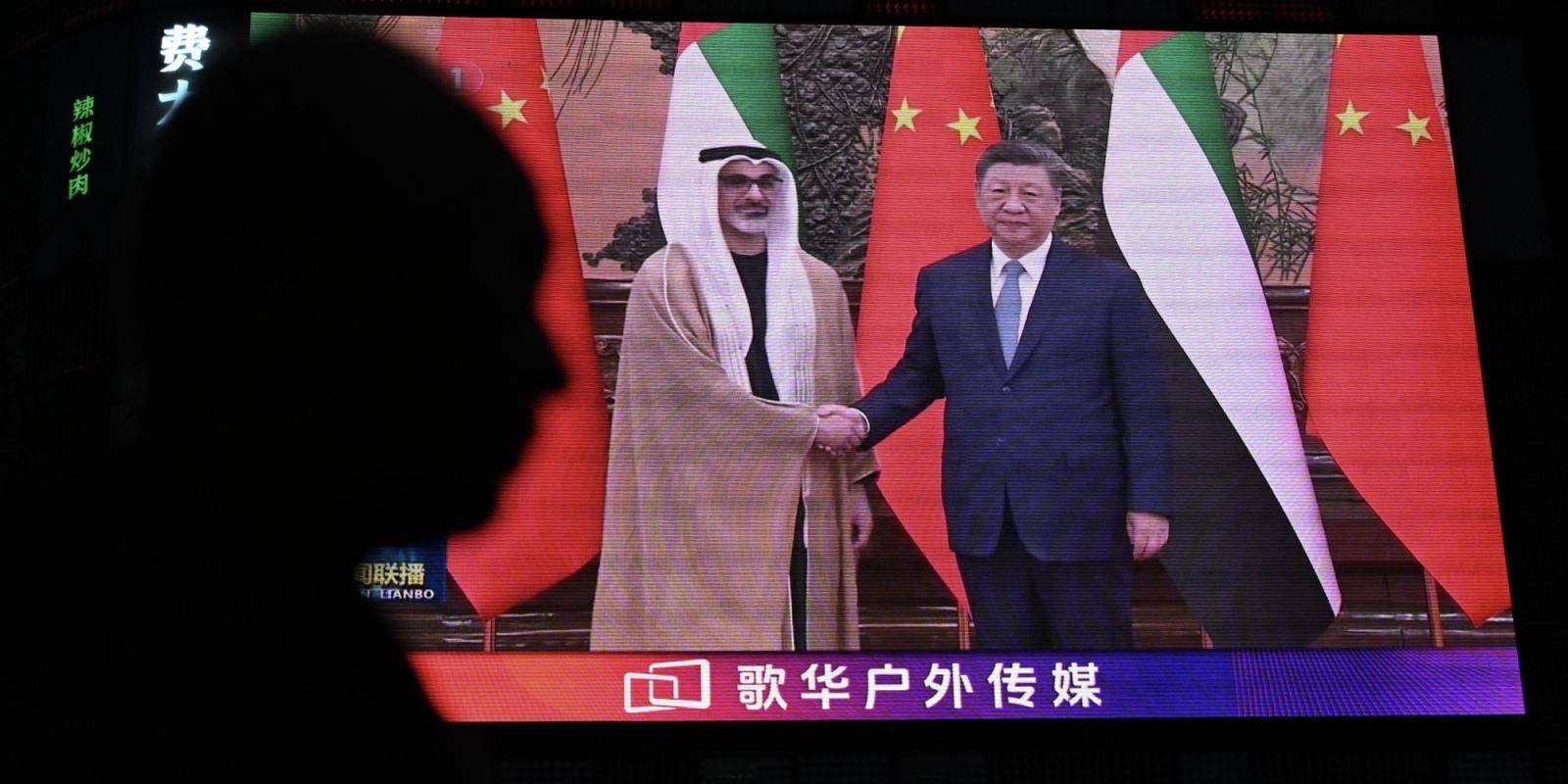
The call came days after Xi met with Abu Dhabi Crown Prince Sheikh Khaled Bin Mohamed bin Zayed in Beijing. Xi has made no such direct contact with Iran’s leadership, although Iranian Foreign Minister Abbas Araghchi met his Chinese counterpart, Wang Yi, in Beijing this week to discuss the war. After the meeting the Chinese called on both Iran and the US to open the Strait.
China has been sending a subtle message of discontent to Iran for its closing of the strait – and to the US for its blockade of Iranian shipping – while signalling convergence with Gulf priorities. But its desire to open the Strait does reflect Trump’s stated priority – laying the groundwork ahead of the forthcoming Xi–Trump summit.
China Gulf Strategy and Defence Realignment
These dynamics have accelerated shifts in Gulf strategic thinking. One immediate effect has been a push by Gulf states to reduce reliance on US protection by creating domestic, cutting-edge defence technology capabilities. Deals reportedly signed with Ukraine, providing fuel in exchange for drone defence expertise, are likely part of that effort.
That reflects a move in the long term towards a more diversified procurement model based on industrial and technological multi-alignment with partners including the US – but also the UK, Ukraine, Pakistan, Turkey and South Korea.
Previous doctrine, based on acquiring expensive US defence platforms to purchase leverage in Washington, will likely shift towards addressing the threat of Iran’s missiles and drones by procuring relatively cheap platforms produced at scale.
China can play a part in that effort. True, Chinese dual-use material exports and satellite access has reportedly helped support the Iranian war effort.
But Saudi Arabia and the United Arab Emirates are already among the biggest buyers of Chinese drones and other defence technologies – and they may calculate that enhancing defence cooperation with China in areas that are not perceived as a security threat in Washington might be a prudent post-war strategy, to boost influence in Beijing and counter Iranian diplomacy.
China Gulf Strategy and Regional Dialogue
But diversifying security cooperation can’t guarantee sustained peace across the Gulf. Regardless of any peace deal between the US and Iran, the Gulf states and Iran will, at some point, have to reckon with uncomfortable realities by agreeing to establish an inclusive regional security framework. As UAE official Reem Al Hashimy said on 3 May, ‘geography prevails… we’re going to have to live with each other, the Gulf states and Iran’.
Here, China can play a crucial role. Along with Pakistan, Turkey, and some European powers (including the UK), Beijing is well positioned to facilitate dialogue between the Gulf and Iran and foster a working relationship in the medium term.
China may use the second China-Gulf Summit in June to promote its normative model for a Gulf security framework, built on the Global Security Initiative’s principles, which align with these new dynamics.
China Gulf Strategy and the Emerging Regional Order
During his meeting with Sheikh Khaled, Xi affirmed Chinese principles for creating stability in the Middle East – saying Beijing is ready to ‘support Gulf states in improving their ties, work to build a common, comprehensive, cooperative and sustainable security architecture’ in the Gulf. While not new, these principles may look more realistic and appealing to countries in the region in the absence of absolute security commitments from the US.
Buying into China’s ideas for regional security complements a shift in Saudi officials’ thinking. Riyadh is now prioritizing an effort to become the central node for mitigating Hormuz risks, creating infrastructure that can bypass the strait and link the Gulf with the Red Sea.
Developing that infrastructure could be an attractive enterprise for ‘Belt and Road’ (BRI) investors – as could opportunities to rebuild what the damage done by the war.
That could help make Renminbi-dominated transactions expand in the long term, making infrastructure and trade with the region more attractive for Beijing.
Meanwhile, economic corridors designed for regional integration with Israel, such as IMEC, may be put on the back burner, as Riyadh and other Gulf countries dismiss normalization with Israel, and calls for de-escalation and coexistence with Iran rise.
The war has not therefore ‘pushed’ the Gulf towards China or removed Beijing from the Gulf calculus. It has rather changed the Gulf’s perception of the benefits of hedging at a time of increased Chinese diplomatic involvement in a region that is transforming towards a layered, issue-based, and diversified security landscape.
The US will remain the principal security provider. But it will do so in the context of managed de-escalation across the Gulf – in which the appetite for Chinese investment, products and diplomacy is much increased.