
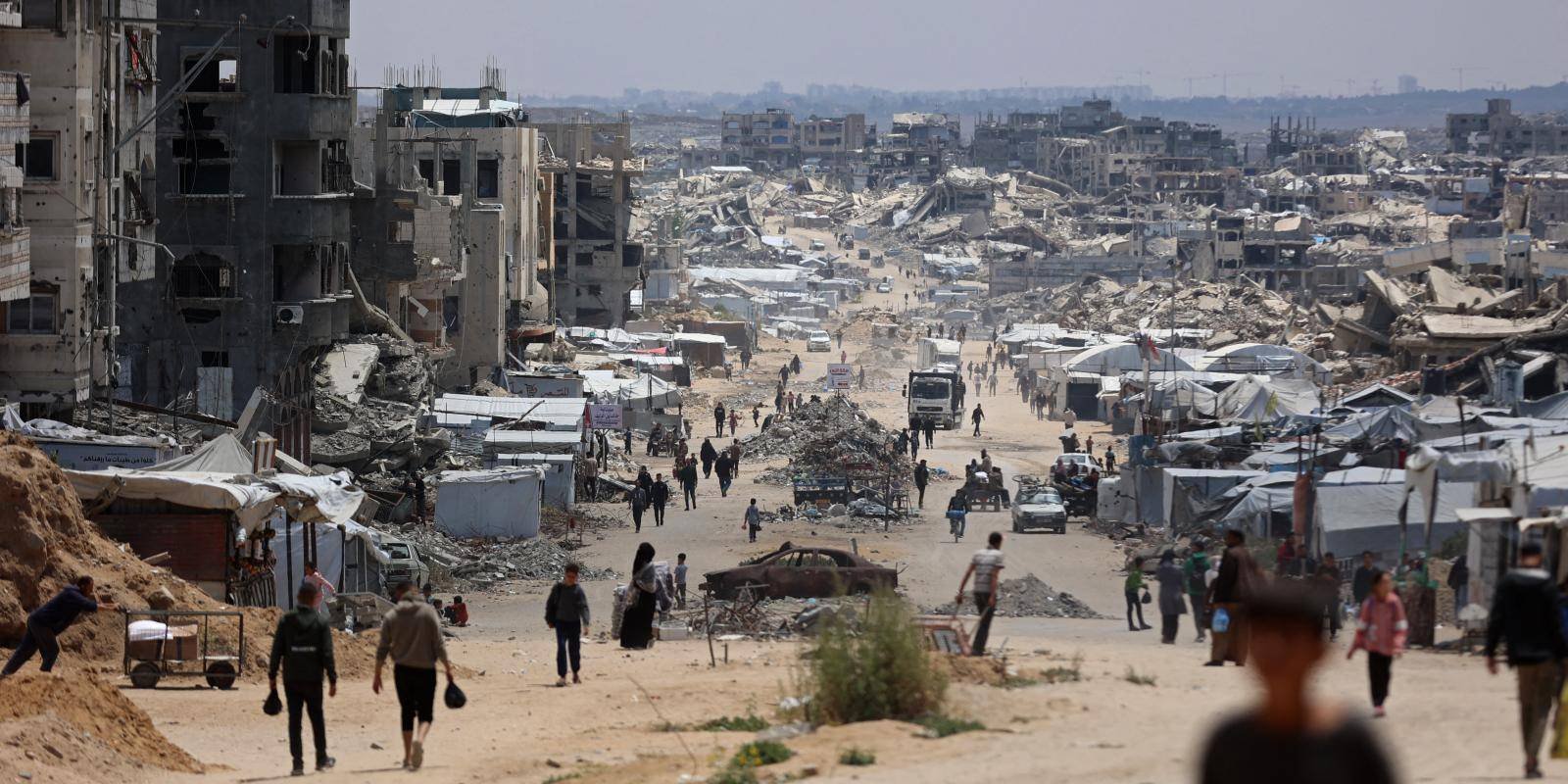
The Iran war has frozen Gaza’s ceasefire. Hamas refuses disarmament without a state; Israel entrenches buffer zones. The NCAG remains blocked, worsening humanitarian conditions as international attention shifts elsewhere.
The ongoing instability surrounding the Gaza ceasefire has reached a critical juncture as regional tensions escalate. International actors must recognize that a stable Gaza ceasefire is the only viable pathway to preventing a total collapse of humanitarian conditions and regional security.
The Opportunity to Secure the Gaza Ceasefire
In the shadow of the Iran war, the Gaza ceasefire has ceased to be a priority for international or regional actors, even while Palestine remains inextricably linked to other conflicts in the region. Meanwhile, with the world looking elsewhere, humanitarian conditions in Gaza are deteriorating,
the room for political pathways is narrowing and supposedly temporary borders and security measures are at risk of becoming entrenched. It was always likely to be difficult to move from the initial ceasefire to the second phase of US president Donald Trump’s 20-point plan, given that it contains two of the biggest sticking points: the disarmament of Hamas and the withdrawal of the Israeli army.
But the Iran war, and the subsequent lack of external pressure on either Hamas or Israel, has given both parties time to double-down on their positions and cement the status quo, with dangerous consequences.
Strategic Obstacles to the Gaza ceasefire
Hamas refuses to disarm In April, Hamas rejected a disarmament plan from Nickolay Mladenov, the high representative for Gaza on the US-led ‘Board of Peace’, which linked the decommissioning of weapons to reconstruction efforts.
Hamas officials asserted that they would not negotiate on the second phase of the ceasefire until Israel fully implemented the first phase, including allowing humanitarian aid to enter Gaza at the levels stipulated in the ceasefire agreement.
Moreover, Hamas sees no incentive to disarm without a framework for establishing a Palestinian state. Unlike Northern Ireland or South Africa (historical cases to which the Israel-Palestine conflict is often compared) there is no peace process on the horizon, nor is there a political pathway available to Hamas if the group lays down its arms.
Navigating Internal Palestinian Political Pressures
Many Palestinians I’ve spoken with, including non-Hamas supporters, support a pathway in which Hamas could potentially maintain a political role in Palestinian governance. But this is a non-starter for Israel and ruled out in the 20-point plan. While the plan offers individual Hamas members amnesty if they disarm and ‘commit to peaceful co-existence’, they may well doubt this offer is sincere or worry about reprisals.
If there were few incentives for disarmament before, Israel has introduced additional disincentives by reportedly backing other Palestinian armed groups to carry out attacks against Hamas. Groups like the Popular Forces near Rafah, the Counterterrorism Strike Force near Khan Younis, and the Ashraf al-Mansi group near Gaza City are based in the Israeli-controlled area of Gaza. These groups conduct operations in Hamas-controlled territory where nearly all of Gaza’s approximately 2.2 million civilians are living.
Risks Facing the Long Term Gaza ceasefire
The militias provide Hamas with another reason to reject disarming, adding another armed threat on top of Israel’s continued air strikes. Furthermore, because the militias are reportedly viewed as collaborators by many in Gaza, they may be inadvertently boosting Hamas’s support, while making
it more difficult for any alternative anti-Hamas voices to emerge. No pressure on Israel to withdraw Just as Hamas leaders see little incentive to disarm, Israeli leaders see little incentive to withdraw from Gaza. According to Trump’s 20-point plan, the Israeli army’s withdrawal was meant to coincide with the deployment of an International Stabilization Force (ISF). However, uptake for the ISF has been slow, with few countries expressing interest.
While the American commander of the ISF has announced that five countries will be joining the force, there remains a lack of clarity over its mission and doubts about whether it will actually be deployed if that entails direct confrontation with Hamas in Gaza.
Security Measures and Evolving Borders
This increases the likelihood of Israel maintaining a troop presence in Gaza in the long-term. After the ceasefire, Israeli troops occupied roughly 53 per cent of the Gaza Strip, demarcated on maps by its ‘Yellow Line.’
Recent reports appeared to show maps issued by the Israeli military with an expanded restricted zone of control in Gaza that added an estimated extra 11 per cent of Gaza’s territory beyond the ‘Yellow Line’. While the exact line of control may yet shift, these new lines of control are now at risk of becoming de facto long-term borders. This would be in line with Israel’s embrace of so-called ‘buffer zones’ as a central strategy in both Syria and Lebanon in the regional realignment that followed Hamas’s 7 October attacks.
This tactic is not new – Israel occupied parts of southern Lebanon from 1982 to 2000, and maintained a buffer zone of about 300 metres around Gaza’s perimeter even before 2023.
Impacts of Regional Conflict on Stability
It seems highly unlikely that Israeli prime minister Benjamin Netanyahu will reduce Israel’s area of control in Gaza, especially in an election year, even if Hamas were to make concessions. While this ‘buffer zone’ tactic may yield some short-term security gains for Israel, it could also play into Hamas and Hezbollah’s calls of resistance against the continued Israeli army presence.
NCAG unable to enter Other key ceasefire measures also remain stalled. These include governance steps that could help stabilize the territory, like admitting the entry of the National Committee for the Administration of Gaza (NCAG), a transitional Palestinian governing body established by the Board of Peace. Since its launch in January, the 15-member NCAG has been based in Cairo, with members reportedly blocked from entering Gaza. There were questions from critics from the outset about NCAG’s legitimacy, autonomy and remit. Nevertheless, many Gazans expressed hope that NCAG could bring at least some Palestinian-led improvements.
Now, however, that cautious optimism has shifted to frustration as NCAG’s physical absence from Gaza has reinforced its perceived impotence. By not admitting NCAG to Gaza while continuing to reject any meaningful role for the Palestinian Authority (PA) in the territory, Israel is contributing to conditions that make the territory appear lawless and ungovernable.
This also strengthens Hamas by preventing the emergence of any alternatives. Positions hardened The wars in both Iran and Lebanon have only further entrenched these positions. For Hamas, the ability of the Iranian regime and Hezbollah to (thus far) survive multiple rounds of military operations will likely embolden their own position of defiance.
For Israel, the lack of a knock-out blow in either Iran or Lebanon will likely harden its position on Gaza and further postpone any meaningful negotiations involving Palestinian self-determination, even under a new government. Meanwhile, President Trump and his top negotiators, Steve Witkoff and Jared Kushner, have sidelined Gaza while focusing on Iran. And regional actors like Qatar, the UAE and Saudi Arabia have been focused on their own finances and defences in the Gulf since the war began.
Keep Gaza on the agenda But Gaza can’t afford to be ignored. The humanitarian conditions for ordinary Gazans are worsening as rehabilitation and reconstruction efforts remain postponed. Rising costs and supply restrictions have fuelled food shortages, while untreated waste sites have led to contamination, infestation and disease. External actors like the UK have limited leverage over the stickier points of the Gaza ceasefire.
But together with European and regional partners, they can urge the US and Israel to uphold basic measures within Trump’s plan. These include admitting the NCAG to Gaza and maintaining minimum humanitarian aid quotas. These steps, though minimal, are necessary.
They will help to meet Gazans’ basic needs and provide basic services, contributing to some wider stability – which is ultimately in Israel’s interest. Moreover, any states concerned about the broader region must keep Gaza on the agenda. The alternative of neglecting Gaza will only fuel current conflicts and create conditions for new ones to emerge.