
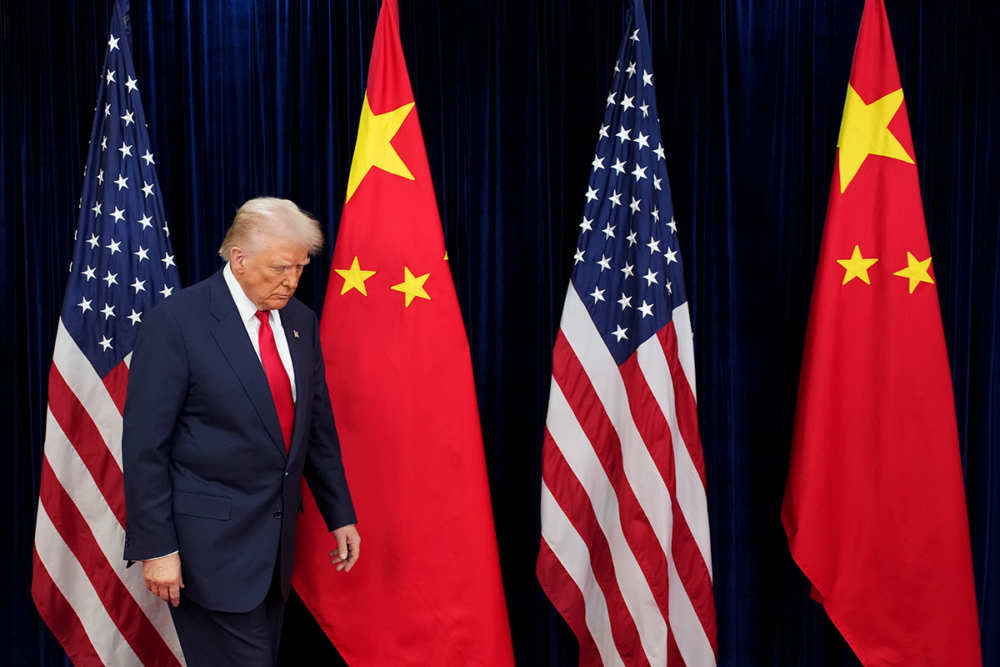
The Iran war has weakened Trump’s domestic and global standing ahead of Beijing talks. Militarily superior but economically strained, the US faces asymmetric Iranian leverage over Hormuz. Any rushed nuclear deal risks regional instability.
The shifting Iran War Strategic Balance is currently redefining the geopolitical landscape as President Trump prepares for high-stakes negotiations in Beijing. Understanding the Iran War Strategic Balance is essential for assessing how recent Middle East volatility impacts American leverage against rising global competitors like China.
Impact of the Iran War Strategic Balance
The limelight for American foreign policy shifts to Beijing this month, where US President Donald Trump and Chinese President Xi Jinping will meet on May 14-15 to address a long agenda of unresolved issues between the two global powers.
But the Iran war and still unfolding geo-economic calamity resulting from it cast a long shadow over these talks and dynamics around the world. One thing to watch for in the run-up to Beijing and in the meeting itself is whether China or the US feels like it has a stronger hand in light of recent events in the Middle East.
The crisis with Iran now stands around the 70-day mark, well past the four to six weeks the Trump administration initially anticipated. Trump’s Iran quagmire has put him in the worst political position he has seen at any point in his more than five years in office. This weakened position at home has consequences on the global stage, as we have already seen in damaged ties with close European partners, and as we may see again in China next week.
Examining the Iran War Strategic Balance
Trump’s Attempts to Declare Premature Victory in Iran Risk a More Volatile Middle East For several weeks now, the Trump administration has started to look increasingly desperate to end the conflict with Iran, even when key issues remain unresolved between Washington and Tehran. A few weeks ago, Trump falsely proclaimed that the Strait of Hormuz was open, only to see Iran continue its attacks and threats against shipping.
After a series of unhinged threats of force, including a warning that Iran’s civilization would die, Trump extended the originally two-week-long US-Iran cease-fire indefinitely last month.
Just this week, Trump launched “Project Freedom” on Sunday, an effort to reopen the Strait of Hormuz by “guiding” commercial ships through with air and naval support, only to suspend it less than 48 hours later, after a flare-up of attacks by Iran against its Arab neighbors, some of whom reportedly objected to how the Trump administration downplayed the attacks, temporarily blocking the US military’s use of their airspace and bases.
As of Thursday, the administration was reportedly considered reversing course yet again and restarting Project Freedom. One particularly weak aspect of the Trump administration’s handling of Iran is the lack of sufficient strategic coordination with America’s Arab partners on the endgame in Iran — a lasting resolution needs input from neighboring countries, or it is will not likely be sustained.
Navigating Uncertainties in Regional Conflict
Also, this week, US Secretary of State and Trump National Security Advisor Marco Rubio declared that the war effortwas over even as missiles from Iran hit the United Arab Emirates, saying, “The operation is over — Epic Fury. We are done with that stage of it.” Pentagon chief Pete Hegseth echoed this sentiment, arguing that the cease-fire was still in place despite Iran’s attacks.
These statements may be designed to buy more time for talks with Iran, or to divert attention from the fact that the US military operations and deployments passed the May 1 deadline for the Trump administration to get Congressional approval, but it is clear that Trump does not want to show up in Beijing with a major Middle East war underway.
The US president signaled optimism this week about the discussions with Iran while also keeping military options open, saying, “I think it’s got a very good chance of ending, and if it doesn’t end, we have to go back to bombing the hell out of them.” One thing to watch closely are the details of a possible deal with Iran — the publicly stated positions of Iran and the United States are still very far apart. If Trump cuts corners on key aspects of what is needed from the Islamic Republic to secure the Middle East just because of the weakened position he has put America in, then any deal reached is unlikely to last.
Assessment of the Iran War Strategic Balance
The Mixed Strategic Balance Sheet on the Iran War Thus Far At this stage in the crisis, the ledger of the war’s impact on the Iranian people, the broader Middle East, and wider world is overwhelmingly negative, but the balance of conventional power and forces remains in America’s favor.
The results since the start of the Iran war on February 28: Key Iranian leaders were taken out, but the regime is still intact. Iran’s ruling leaders were eliminated in the first hours of the war, but the main remnants of the regime remain in control, with perhaps more extremist and less predictable figures at helm in Tehran.
This is the same regime at its core that threatened regional neighbors, invested in global terror networks, and brutalized its own people for decades, including in the recent mass killings in January.
Iran’s nuclear ambitions were set back but the program remains unresolved. Iran suffered significant losses to its nuclear program, but just like in the 12-day war in June 2025, major questions remain about the status of key components, including hundreds of kilograms of highly enriched uranium. The regional dangers posed by Iran’s military capabilities were diminished but not eliminated.
A weeks-long aerial campaign by America and Israel did considerable damage to Iran’s military infrastructure, but Iran was already conventionally weaker than America and its partners before the war, and the main threat it posed was asymmetric. Iran’s attacks against America and its regional partners, particularly the United Arab Emirates, have continued through this past week. New uncertainties about the Strait of Hormuz have been created.
The regime in Iran gained control and leverage over this key global chokepoint for energy and trade, and the mix of military maneuvers and diplomatic discussions have not yet eroded this control. The fast-moving events with Iran and the Middle East, along with President Trump’s near-daily zigzags on policy and controversial statements, make it difficult to offer a clinical and holistic understanding of where things stand with the regional and global crisis that has unfolded as a consequence of the war.
Throughout the crisis, the Middle East Institute has hosted several events, including two webinars with former senior US officials who served in the Trump, Biden, and Obama administrations: namely, former Biden Deputy National Security Advisor Jon Finer, former Trump Deputy National Security Advisor Victoria Coates, as well as senior Biden Pentagon official Mara Karlin and Trump’s top Middle East diplomat in the first term, David Schenker.
These conversations offered a diverse set of perspectives, and in the exchange of these views some key points emerged about the Iran war’s effect on the overall balance sheet for US foreign policy.
Conventional Military Strength and Asymmetric Challenges
First, the United States and its regional partners maintain a strong conventional military advantage over Iran and dealt serious losses to its naval, air force, and missile launch capabilities.
Moreover, the war showed the effectiveness and functionality of America’s military partnerships across the region, particularly with Israel. Nevertheless, Iran’s use of asymmetric warfare — including its use of less expensive weapons like drones — has enabled it to punch above its weight and inflict damage against the United States and its regional partners.
The Iranian regime’s bar for success in the military conflict is much lower: it just seeks to survive. Even though America remains much stronger militarily, it has depleted some key weapons arsenals in fighting the war, which is already having ripple effects in other theaters, like Europe and Asia, and adding to pre-existing strains in America’s defense industrial base.
A second key arena in this war is the economy — and like Iran’s conventional military forces, the country is much weaker economically and has suffered great damage from the war and the US blockade of its ports. One long-standing aspect of Trump’s Iran policy since his first term as president has been to inflict as much economic pain on Iran’s regime and people as possible in order to drain the resources Iran has to challenge America and its partners in the region.
But decades of sanctions have produced a “resistance economy” and hardened Iran’s ability to withstand pain. But in this economic arena, Iran has responded by looking to impose high economic and political costs in America and around the world through its control of the Strait of Hormuz and repeated attacks against the Gulf’s energy infrastructure. These growing economic costs are hurting President Trump at home, and the Iranian regime has known for years how to use its leverage in exploiting America’s internal political divides to its advantage.
Economic Warfare and Information Dominance Strategies
Last but not least, a third arena that shapes the competition for power and influence is the information and narrative wars, something President Trump engages in on a daily basis in domestic and foreign policy with his unique version of troll power.
But as yet with Iran, Trump has been unable to seize the high ground in part because of his administration’s ever-shifting and often confusing public statements about the war and what is at stake. The Iranian regime and its supporters and propagandists have also deployed slickly produced videos using Legos and humor sometimes laced with anti-Semitism in their own form of cognitive warfare.
At Stake: America’s New Position in the World It will take some time to determine what impact the 2026 Iran war will have on America’s position in the world. Some voices argue that the Iran war, combined with Trump’s operation in Venezuela at the start of the year, will ultimately place America in a stronger position vis-à-vis strategic rivals like China by giving Washington greater control over key resources Beijing needs for its economic growth and increasing presence on the global scene: oil and natural gas.
Another argument is that the Iran war will extend the dominance of the petrodollar; and at a time when America is adding more to its national debt, the strategic advantage of the US dollar over the global economic system is all the more crucial. Furthermore, the long-term ripple effects of China’s relationship with Iran will accrue benefits to America in the Middle East, because more countries will lean away from Beijing due to its support for Iran and its Axis of Resistance, this side of the argument maintains.
Global Implications for American Foreign Policy
On the other side of the argument about the Iran war’s impact on US foreign policy are those who say that the Trump administration has expended considerable time, money, and precious military assets to essentially achieve a net negative in the loss of freedom of navigation in the Strait of Hormuz with little to show for it on Iran’s nuclear program and continued ability to sow instability across the region and terrorize its own people.
In addition, some of America’s competitors like Russia have gained additional resources from the spike in energy prices and Trump’s loosening of sanctions on Moscow, along with its passive and unclear approach on Ukraine. Furthermore, the impact of the conflict on the US economy, as well as the sharper divisions inside of its politics, all add to America’s strategic vulnerabilities made worse by the Iran war.
The upcoming summit between Trump and Xi in China will offer some important initial signals about where America stands in the world as a result of the Iran war. The summit will also serve as a reminder of the limitations of trying to pivot or rebalance America’s strategic focus from one region of the world to another, when what is really needed is to toggle more effectively between multiple strategic issues at the same time.