
The UAE’s OPEC+ exit over quota grievances reduces cartel control over global supply. OPEC+ may expand membership or boost capacity among existing members like Iraq and Venezuela, but faces steep political and logistical hurdles.
The recent shift in the global oil landscape has forced a total reevaluation of the OPEC plus market stability strategy. Analysts suggest that maintaining an effective OPEC plus market stability strategy requires balancing the production quotas of remaining members against the rising output of non-aligned producers.
Developing a Resilient OPEC plus market stability strategy
On May 1, the United Arab Emirates ended almost 60 years as a core member of the Organization of Petroleum Exporting Countries (OPEC) and a decade as a key player in the broader OPEC+ grouping, resolving long-running speculation about its future in the producer alliance.
As the third-largest producer in OPEC+, Abu Dhabi’s departure will require a long-term recalibration of the group’s strategy. OPEC+ may pursue a range of options for this, which could include expanding its membership, more actively seeking to boost production among existing member states that have the potential to do so, or some combination of the two. While the challenges to either of these strategies are immense, the obituary of OPEC+ is one that has been written prematurely before. The inevitable complications that will arise from the loss of a major member should not be treated as a sign of the group’s near-term decline.
Evolving Dynamics of Global Energy Alliances
The UAE’s misgivings with the group were well established since 2021. At the root of Abu Dhabi’s dissatisfaction was that its production quota, which determines how much oil each member produces in a given month, had continuously lagged state-owned Abu Dhabi National Oil Company’s (ADNOC) growing capacity. At the time of the UAE’s exit from the group, ADNOC stated that its maximum sustainable production capacity was 4.85 million barrels per day (bpd).
Despite incremental increases since 2021, the UAE’s tentative May quota of just under 3.5 million bpd would continue to leave a gap of at least 1.35 million fewer bpd than it could actually produce. On average, the UAE’s capacity utilization rate in 2025 was just 66%, whereas regional peers Saudi Arabia and Kuwait averaged 77% and 84%, respectively.
The Emirati utilization rate has dropped as its capacity has grown faster than its production; in 2021, its average utilization rate was 73%. Thus, the UAE’s exit was not motivated solely by its inability to produce as much as it liked but also by the fact that it was obliged to keep a greater share of its available capacity unused than any other OPEC+ member.
On May 3, just two days after the UAE’s formal departure, the seven remaining OPEC and OPEC+ members participating in an ongoing round of voluntary production cuts met to discuss market dynamics.
The seven countries, including Saudi Arabia, Russia, Iraq, Kuwait, Kazakhstan, Algeria, and Oman, are most able to increase or cut production to support the group’s efforts to balance crude oil supply with demand. T
he meeting resulted in participants agreeing on a plan to add 188,000 bpd in new supply as of June, which will remain symbolic for now — as will their further plan to add 206,000 bpd, announced at their previous meeting on April 5. The three Gulf countries set to contribute the most new supply — Saudi Arabia, Iraq, and Kuwait — cannot yet do so, because the closure of the Strait of Hormuz makes it impossible for them to export it. Russia, the other major OPEC+ supplier, is dealing with an oil-sector crisis of its own.
A Setback, but Not Totally Without Precedent
The ongoing closure of the strait represents the group’s most pressing near-term challenge. It is unprecedented in nature, unlike the departure of a member. OPEC has gained and lost members throughout its history, including both before and after the 2016 Declaration of Cooperation (DoC) that created OPEC+. The cornerstone of this agreement, which established a framework for cooperation with a grouping of major non-OPEC oil producers, was the entry of Russia into the producer alliance. Its addition meant that two of the world’s top three oil producers — the US, Saudi Arabia, and Russia — were now in the group, bolstering its ability to modulate the oil supply in support of a collective market strategy.
Navigating the OPEC plus market stability strategy
During its decade-long history, OPEC+ has adapted to a host of events whose impacts on oil markets were difficult to predict, including the US shale boom, the COVID-19 pandemic, and Russia’s full-scale invasion of Ukraine. The question the group faces now is how to continue to evolve to adapt to changing circumstances, with the UAE’s withdrawal representing the newest challenge.
Of course, in this case, part of the challenge is that the Emirati exit not only reduces the amount of oil production OPEC+ controls but also simultaneously increases the amount of competing oil production outside OPEC+ output. The amount of oil produced by non-OPEC+ members is a critical data point that the group watches closely when considering the wider factors that influence its decision making.
Prior to last week, the new sources of oil production that OPEC+ was expecting to have to confront were primarily represented by the “up-and-coming” producers found in places like Guyana and Namibia, in addition to more established producers with a strong outlook for growth, such as the US and Brazil. None of these countries adhere to output quotas in the same manner as OPEC+ members, but a host of other factors governs how much more (or less) they may produce in any given year.
Fortunately for OPEC+, the trajectory for near-term UAE supply growth is fairly clear, given that Abu Dhabi is widely expected to meet its capacity growth target of 5 million bpd for 2027. While this does not mean the UAE will automatically ramp up output to its full capacity once able to do so, it at least helps guide projections around non-OPEC+ growth into next year. What is less certain is whether the UAE may look to act on a future capacity target of 6 million bpd further down the road, although this would not likely happen before 2030.
Integration of New Global Petroleum Producers
The question for OPEC+ is how it chooses to adapt its strategy to this new set of variables. The most likely response involves shoring up the amount of output capacity subject to quotas, given the obvious hit this figure has taken from the UAE’s departure. For now, there are two clear pathways the group could take to accomplish this, although neither represents a quick fix.
New Members
The first course OPEC+ might pursue would be to grow its ranks by adding new members, either to the core OPEC grouping or to OPEC+. However, it is not immediately clear what the profile of a new OPEC+ member looks like in 2026. Ascendant producers like Guyana or Namibia, both of which are highly dependent on international oil company (IOC) investments to boost their output, are unlikely to see any major benefit from agreeing to production limits.
Both countries are late arrivals to the unofficial club of oil producers, considering the future trajectory of most oil demand forecasts. They are keen to monetize their relatively newfound resources while the rewards for doing so are still high, and they are unlikely to adopt a strategy to keep their output “lower for longer” to help the mature producers of OPEC+ hedge against price instability. Additionally, their dependence on international investment is a key factor here, since output constraints are widely viewed as a barrier to more investment.
Still, there may be some mature non-OPEC+ producers that are concerned with the erosion of the undeniable benefits that the group’s market-balancing efforts have brought in times of volatility.
Mexico, which produces about 1.4 million bpd, is not bound by quotas but is a DoC signatory that maintains a higher level of cooperation with OPEC+ than most, and could theoretically represent one such candidate. Perhaps some of these producers could see greater cooperation with OPEC+ as beneficial in the long term, even if it means output constraints in the near term. The drawback for OPEC+ is that any attempt to offset the market share lost by the UAE’s departure would involve bringing on multiple new members, since there are no likely candidates with capacity comparable to Abu Dhabi.
Expanding Capacity Among Existing Member Nations
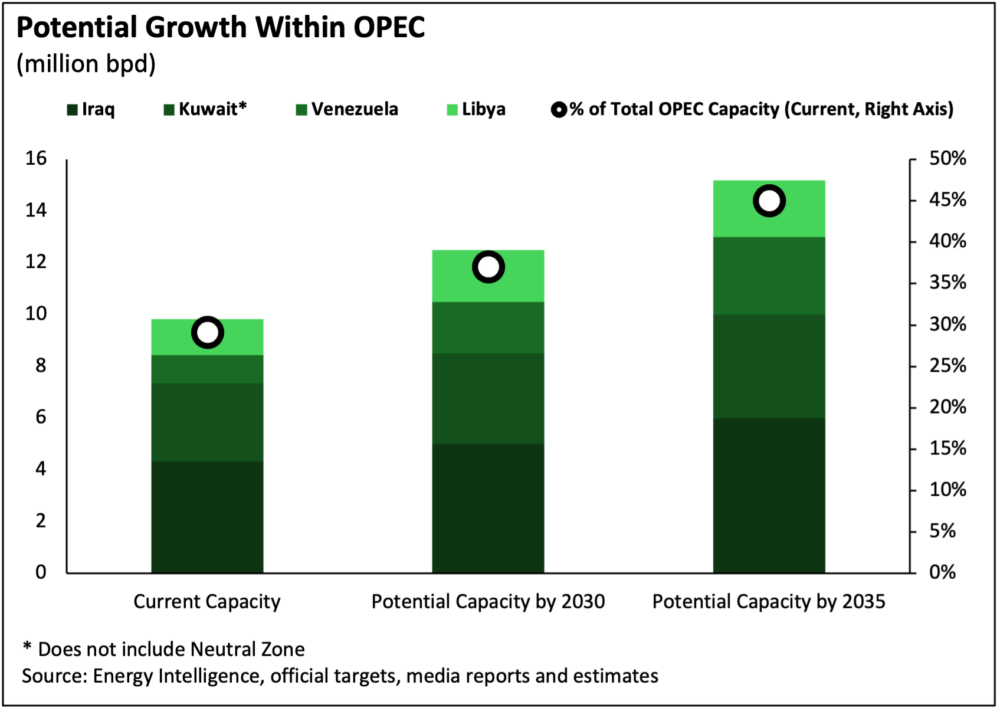
An alternate approach, or perhaps a complementary one, could be for the group to boost crude capacity growth among existing members. A number of them are actively pursuing capacity increases; and until the current Iran war started, there were positive signs that these goals could be achieved. Iraq, Libya, Kuwait, and Venezuela are all longstanding, core OPEC members seeking to grow production. Before its October 2025 elections, Baghdad inked major deals with IOCs looking to expand their presence in its upstream.
Libya has seen a similar flurry of activity; and despite somewhat underwhelming bid round awards earlier this year, it has already announced a new upcoming round. Kuwait has made progress reversing years of crude capacity losses, and it even began showing signs of greater openness to IOCs after largely closing its oil sector to foreign investors for decades. Following the ouster of President Nicolás Maduro just three days into 2026, the outlook for Venezuela’s decrepit oil sector was also improving after years of underinvestment.
According to figures from Energy Intelligence, the four producers listed above currently have just over 9.8 million bpd in output capacity. Based on reporting around official targets, they could add close to 2.7 million bpd in new capacity by the end of the decade. Longer term, this figure could double by 2035, adding nearly 5.4 million bpd and more than offsetting the loss of the UAE.
All of this is far easier said than done, though. The assumptions above view all potential growth as net supply additions, which do not take account of losses due to factors like natural output declines and lack of upstream investment. More granularly, the Iran war is likely to affect Iraq’s and Kuwait’s upstream investment propositions.
New risk factors, in addition to the lack of existing, major alternate export routes, will make them a harder sell for IOC investors; Kuwait did not export a single barrel of oil in April — a first in more than 30 years. Although Libya represents a large source of potential growth for OPEC+, and IOCs are not totally deterred by the challenges of its domestic political and security landscape, the same aboveground risk factors — particularly, the danger of renewed civil war — that have stymied investment for years will remain.
Assessing the OPEC plus market stability strategy
Venezuela also faces an uncertain outlook. IOCs have seemingly warmed to the idea of investing there in recent months, likely due in part to risks stemming from the war in the Middle East that have made Venezuela seem safe by comparison. However, US President Donald Trump hailed the UAE’s exit from OPEC as a positive development, and there is no guarantee that Washington will not pressure Caracas to eventually follow suit, which could represent another loss of promising supply growth for the group. Still, there are no strong indicators that an imminent Venezuelan departure from OPEC is likely.
Further, a key impediment to truly harnessing prospective supply growth in all of these member states is the very factor that was at the core of the UAE’s decision to leave: production quotas. Kuwait has been the most compliant of those listed above, while Iraq has been a chronic offender for a number of years. Even more di
fficult is the fact that both Libya and Venezuela have been exempt from quotas since 2017 and 2019, respectively. Both countries will doubtless resist the reimposition of quotas as they work to boost output growth, complicating efforts to capture more market share that the group can mobilize to ramp production up or down in support of its market strategy. A third variable could enter this dynamic if the ongoing conflict in the Gulf is brought to a close in a manner that results in sanctions relief for Iran, which has also been exempt from quotas since 2016 and would almost certainly refuse to abide by one in the near term.
Despite assertions that Tehran would remain committed to its membership in the group after the UAE’s departure, Iranian officials have previously stated that Tehran will not consider accepting new quotas until its exports regain the market share they lost as a result of the impact of sanctions.
Yet while such a way forward would be complicated, it is not impossible. OPEC+ is currently carrying out third-party assessments of each of its member’s production capacity, a process that is expected to wrap up this year and inform quota allocation for 2027, assuming the war does not delay the process.
What the group will need to do looking ahead is to ensure that quotas grow commensurately with members’ ability to produce. In the past there were well-founded concerns that the sensitivities surrounding this process would damage group cohesion, but the loss of a major member may now do more to inform views going forward.
Resilience and Future Influence of Oil Producers
Strategy Subject to Circumstances
Few if any of the OPEC+ members are likely to oppose growing their oil production as well as the group’s market share, but the former requires policy support, investment, and time, which often work against one other. Convincing new members to join will present plenty of its own unique challenges as well. To adapt to its newfound circumstances, OPEC+ may opt to pursue some combination of the two above options or perhaps find some other, entirely different, means of maintaining its influence in global oil markets.
US policymakers interested in the group’s influence should not view the UAE’s exit as a reason to write off OPEC+ in the long term. Where US policy aims to promote a stable environment for exporters of American energy, it should not seek to actively diminish the influence of OPEC+. As other analysts have rightly noted, however the organization may be perceived by much of the American public, its efforts to balance markets have indirectly benefited US oil producers over the years.
Efforts to limit or add oil supplied to markets as OPEC+ does is not a framework that can eliminate volatility altogether, but it does serve as a set of guardrails against what would likely otherwise be a near constant “boom and bust” cycle. Price stability would be almost impossible to achieve in this kind of environment, which would be detrimental both to US oil producers and consumers as well as the overall economy.
The challenges OPEC+ faces going forward are evident, but this alone is a key reason that observers ignore the group at their own peril; the implications of the major paradigm shifts it has faced in the past were anything but clear, and it has managed to retain its influence nonetheless.