
Turkey’s Somali hydrocarbon geostrategy secures energy independence and expands military influence across the Red Sea. Drilling deals, a planned Laas Qoray base, and deepening rivalry with the UAE and Israel reshape Horn of Africa geopolitics.
The Turkish Somali hydrocarbon geostrategy has become a focal point for foreign policy, significantly altering the power balance in the Horn of Africa. Through the Turkish Somali hydrocarbon geostrategy, Ankara seeks to secure its energy future while expanding its military footprint across the Red Sea.
Turkish Somali hydrocarbon geostrategy and regional interests
The abundance of oil deposits in Somalia has lured interest from Turkey, deepening the Mogadishu-Ankara relationship.
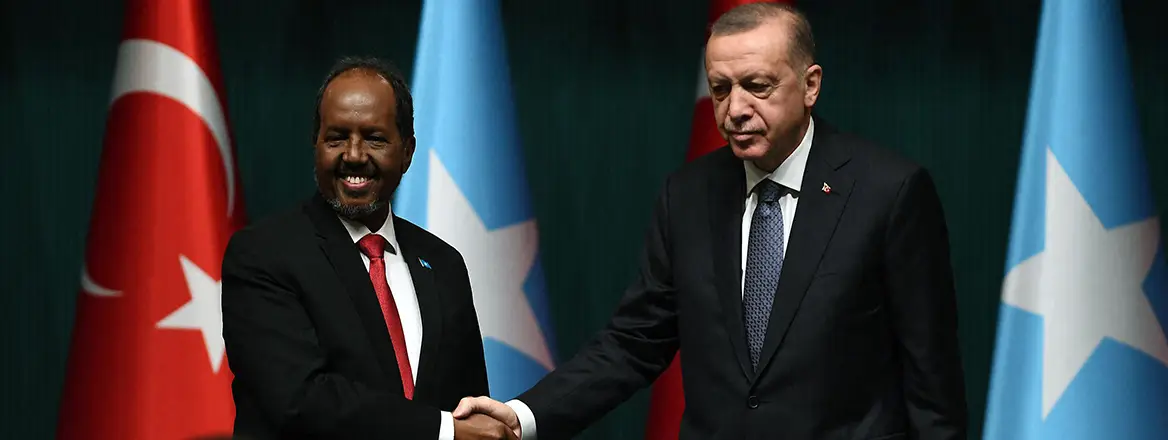
In August 2011, Turkish President Recep Tayyip Erdoğan and his family travelled to Mogadishu amidst a gruelling famine, becoming the first non-African head of state to visit Somalia in almost two decades.
Evolution of the Turkish Somali hydrocarbon geostrategy
Rallying humanitarian support, Erdoğan’s visit spurred an outpouring of affection for Turkey, with the white crescent and star on red subsequently adorning much of the country. Some Somali children were even named after the Turkish leader. Flash forward nearly fifteen years, and much of the regional and global political landscape has changed almost beyond recognition – as have Turkish geostrategic stakes in Somalia.
What followed has been a transformation in kind and scale, spanning military bases and now deepwater drillships, and situated in a broader geopolitical contest for the Gulf of Aden and Red Sea.
Ankara’s engagement has passed through several distinct phases over the years, shifting from soft power and humanitarian diplomacy through infrastructure management to becoming Mogadishu’s foremost foreign allytoday. Since Erdoğan’s visit, Turkish soft power has proliferated, with thousands of Somali students in Istanbul or Ankara, the Mogadishu elite holidaying in Turkey, and Turkish brands such as Enza Home becoming markers of middle-class aspiration in the capital. At the same time,
Turkish companies have assumed control of the management of the Mogadishu port and airport, whilst Camp TURKSOM – Ankara’s largest overseas military base – has facilitated the training of thousands of Gorgor special forces since 2017.
Regional rivalries and the Horn of Africa
Throughout, Turkey has channelled its support exclusively through the federal government in Mogadishu, a posture that distinguishes it from the UAE – a geostrategic rival of Ankara’s in the Horn of Africa – and Ethiopia, which both have cultivated ties with Somalia’s semi-autonomous regional administrations of Puntland and Jubaland, as well as Somaliland.
Today, it is Riyadh and Abu Dhabi that are grappling for ascendancy over the Red Sea, but in 2017, simmering tensions within the Gulf Cooperation Council erupted into the open, with a Saudi-Emirati-led coalition seeking to blockade Qatar, aligned with Turkey, due to its alleged ties with Iran and various Islamist movements. Though publicly neutral, Mogadishu allied itself with Qatar and Turkey in the fallout– infuriating the UAE, which subsequently broadly steered its considerable financial and military support away from Mogadishu. In this period, however, Ankara was broadly considered the ‘junior partner’ in Somalia for Doha, helping to steer patronage and aid on Qatar’s behalf.
Drill, Baby, Drill During Hassan Sheikh Mohamud’s second administration, though, it is Turkey that has stepped into the fore, with the more recent prospect of hydrocarbon extraction marking the most significant expansion of the Somali-Turkish relationship to date. Though a NATO member, Turkey has simultaneously taken an increasingly assertive posture across the Middle East, North Africa, and, more recently, the Horn. And as part of this independent foreign policy, Ankara has similarly sought to diversify its reliance on hydrocarbon imports from Azerbaijan, Iraq, Kazakhstan and Russia, significantly expanding its domestic extraction capacity in recent years.
Hydrocarbon potential under Turkish Somali hydrocarbon geostrategy
In turn, the decades-old promise of oil and gas – onshore and offshore – in Somalia has proven particularly enticing to Ankara, with the two countries striking a rapid deal in early 2024 for Turkey to exploit Somalia’s latent resources. For its proponents in Somalia, it offers the realisation of a long-awaited dream, with seeps of oil first formally identified by British and Italian geologists in the colonial era.
Agreements with Chevron and Shell in the 1950s never translated into formal extraction, and the collapse of the Somali state in the early 1990s – leading to decades of persistent instability and conflict – has left the reserves untapped. And they are believed to be substantial, with more recent seismic studies suggesting around 30 billion barrels, around a quarter of the UAE’s current proven crude oil reserves.
Such a Turkish rationale is likely to grow only further amid the conflagration in the Middle East, with the Gulf energy architecture set ablaze in the US-Israeli assault on Iran. The repercussions of this war – and the selective blockade of the Strait of Hormuz – will reverberate through globalised energy and trade networks for years to come, placing fresh urgency on Ankara’s search for self-sufficiency.
Economic implications and bilateral agreements
However, a number of criticisms from Somali parties have been levied at the lopsided deal, not least that it was rushed through Somalia’s parliament without scrutiny. The agreement came as Mogadishu sought to rally its foreign allies against a promised deal between Ethiopia and Somaliland, for sovereign recognition in exchange for sea access.
Though Addis eventually backed away from its pact with Somaliland following Turkish-mediated negotiations with Mogadishu, Ankara is still permitted to recover up to 90% of the cost of Somali oil or gas produced before any sharing of profits, and its state-owned petroleum company is exempt from production bonuses.
Somalia’s royalties, on the other hand, are capped at just 5%. In a country as impoverished as Somalia, there is discernible excitement about the prospect of a transformative injection of oil money, but the nature of Ankara’s bilateral – often clandestine – dealings with Villa Somalia is causing growing concern as well. Furthermore, Somalia’s federal government has been repeatedly accused of monopolising and politicising funds, withholding support for Jubaland and Puntland after they severed relations over its electoral agenda.
Infrastructure development and maritime security
But the hydrocarbon deal is moving ahead and, in April, Turkey’s latest deepwater drillship, the Çağrı Bey – the first deployed outside Turkish territorial waters – arrived at Mogadishu Port amidst much pomp and fanfare. Exploratory drilling is expected to begin in the coming weeks at the Curad-1 well-site, 370 km from Mogadishu, at a depth of 7,500 m. Substantial infrastructure will still need to be constructed, but Ankara is making headway.
Turkey’s Growing Military Stakes In the past two years, the military dimensions of the Somali-Turkish relationship have grown in lockstep, with some considering them a guarantor of Ankara’s commercial stakes. Jets, drones, helicopters, warships and more have appeared in Mogadishu in recent months, showcasing Turkey’s impressive homegrown military technology. Such aerial support, too, has played a role in operations against Al-Shabaab, the jihadist insurgency and Al-Qaeda affiliate that has waged a grinding war against the Somali state for two decades.
Geopolitical competition in the Red Sea
The political will of the Somali government, though, is more questionable. Emboldened by its foreign allies’ support, Villa Somalia has monopolistically sought to consolidate power at home, overriding historic guardrails to rewrite much of the Provisional Constitution earlier in 2026 under the guise of restoring direct democracy. Simultaneously, the gradual penetration of Turkish interests and advisors into parts of the Somali state has become considerable, epitomised by the government’s new Islamist-flavoured ruling Justice and Development Party in Mogadishu, having been modelled on Erdoğan’s own movement.
Moreover, the drawing down of a wearied diplomatic corps – particularly the United States and the UN – from Somalia has opened space for such consolidation. In March, during the violent ousting of a regional leader in southern Somalia after he broke ranks with the government’s electoral agenda, Ankara was accused of facilitating his removal with military and fiscal support.
Such an assertive role in Somalia’s fraught domestic politics represents precisely the kind of internal deployment that its critics had long cautioned against, and may yet signal Ankara’s willingness to underwrite Villa Somalia’s own controversial adventurism at home.
In the Regional Contest But Somalia is far from the limit of Ankara’s ambitions in the region, rather a broader platform for them.
It was no coincidence that President Hassan Sheikh’s first visit following Israel’s unilateral recognition of Somaliland in late December 2025 – a bombshell development facilitated by the UAE – was to Ankara. Agreed during his trip and now coming into sharper focus are plans for a Turkish military base in Laas Qoray, located in a contested region on the Gulf of Aden, the strategic, narrow waterway that connects the Red Sea to the Indian Ocean and through which roughly 12% of global trade passes.
The Laas Qoray base would serve as a direct riposte to the growing Israeli and Emirati presence in Somaliland, further along the coast. Though a direct armed conflict between Ankara and Tel Aviv remains unlikely, the theatres in which their geostrategic interests diverge – from Somalia to Syria to the eastern Mediterranean – are multiplying.
That rivalry is part of a broader and accelerating reconfiguration of influence across both sides of the Red Sea; a vast, interlocking theatre, in which the fates of littoral states are being shaped by competition between Israel, Qatar, Saudi Arabia, Turkey and the UAE.
Each state has pursued interests along the Horn’s coastlines and hinterlands, driven by a combination of imperatives, including securing ports and waterways, hedging against hydrocarbon dependence, and divergent views on the role of political Islam.
To date, such external transactional and militarised politics have wrought immense damage on the Horn, deepening pre-existing fissures and fractures from the Somali peninsula to divergences between Egypt and Ethiopia over the Nile water basin, as well as eroding the region’s fragile multilateral peace and security architecture.
Since 2023, the epicentre has been the war in Sudan, effectively a proxy conflict pitting the UAE, principally backing the Rapid Support Forces, against Saudi Arabia and Egypt, supporting the Sudanese army, with an array of African and Arab states behind either party. Within a divided Somalia itself, the Puntland government has been accused of allowing Abu Dhabi to smuggle weapons through Bosaaso airport, whilst the Sudanese military intelligence has facilitated militia support for Mogadishu.
Even before the continuing US/Israel-Iranian war, the western Indian Ocean and Gulf of Aden were bristling with competing navies and interests, ranging from the Iranian-backed Houthis in Yemen to Operation ATALANTA, the EU mission designed to combat piracy.
And a Turkish installation at Laas Qoray would join facilities operated by China, France, Italy, Japan, and the US in neighbouring Djibouti, further deepening the concentration of foreign military power near the Bab al-Mandab, the critical chokepoint between the Gulf of Aden and the Red Sea, whose strategic significance the Iran conflict has thrown into savage relief. Alongside oil, the real estate value of control over these aortic straits has soared in the past weeks.
Turkish interests in Somalia are an expression of a longer history; the blending of commercial and security interests through these arterial waterways is centuries old, be it through Royal Navy frigates or American aircraft carriers. What has changed, though, is the collapse of the multilateral framework that once provided a degree of structure, however imperfect, to the post-Cold War competition and the dying era of the ‘liberal peace.’ In its place, a bluntly transactional geo-kleptocratic logic has stepped forward, in which the scramble for energy is reshaping politics across the globe.
More than most countries in the Horn of Africa, the Somali peninsula’s geographic position has drawn trade, religion, and cultural exchange for millennia with the Middle East and beyond. It is impossible to divorce Somalia’s politics or culture from the broader region, not least with many Somali clans regarding themselves as ‘Arab’ rather than ‘African.’
Instead, the question for Somalia and the Horn writ large remains whether its governments can convert the rivalries from across the Red Sea from a source of instability into positive leverage for their own countries. Whether Turkey’s rising geostrategic investments in Somalia offer a transformative model of engagement or simply more of the same externalised insecurity will have to be seen, but the augurs are hardly positive.