
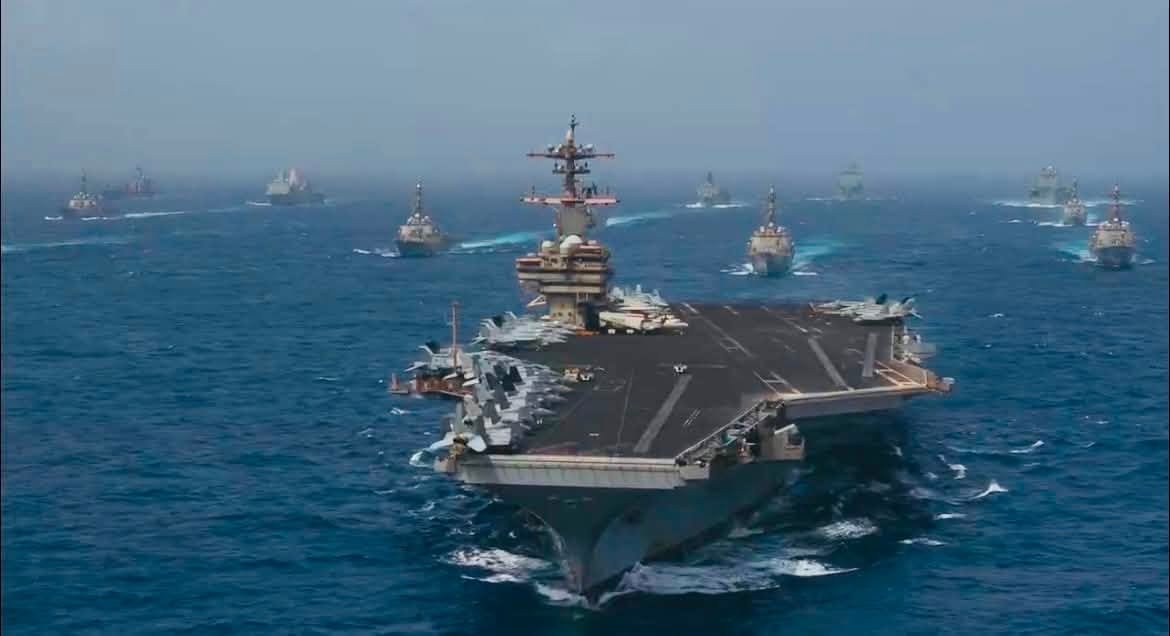
Repeated naval attacks in the Strait of Hormuz have triggered direct American military strikes on military installations and targeted sanctions on the Shamkhani energy smuggling cartel. Definitively halting Tehran’s nuclear and regional plans requires Washington to formally tear up the residual MOU.
Tehran’s persistent naval strikes in the Middle East demand an immediate, structural policy correction from Washington to safeguard global energy corridors. Restoring regional deterrence requires the White House to officially mobilize its dormant maximum pressure campaign. By dismantling the financial and physical channels that route capital directly to the Islamic Revolutionary Guard Corps, a formal maximum pressure campaign offers the only realistic path to neutralizing state-sponsored disruption.
Maximum Pressure Campaign Revived Now
Iran’s repeated attacks on commercial shipping may ultimately force the United States to take a more aggressive posture by reviving its maximum pressure campaign against the Tehran regime.
Following a wave of attacks on ships in the Strait of Hormuz, as well as strikes on U.S. military forces in the region, the United States, on July 15, sanctioned a multinational network supporting the Islamic Revolutionary Guard Corps’ (IRGC) efforts to procure weapons. This measure came days after President Donald Trump declared “in no uncertain terms” that the ceasefire with Iran was over and launched a new military campaign against the regime.
The Treasury Department sanctioned a key Iranian financier, a network of opaque exchange houses and shell companies, and a separate web of shipping firms facilitating sanctions evasion in two separate designations on July 10 and July 14. The United States also reimposed its naval blockade on Iranian ports and revoked a previous sanctions waiver authorizing Tehran to repatriate oil revenue.
Although Washington’s memorandum of understanding (MOU) with Tehran is effectively a dead letter, the Trump administration has yet to declare its commitment to a new maximum pressure campaign and the tougher measures it would entail.
Degrading Threats To Maximum Pressure Campaign Infrastructure
Treasury’s July 15 action targeted seven entities in Iran, Nigeria, Italy, and Russia that used aviation and transport companies, and procurement agents to support IRGC weapons acquisition, including through drone industry suppliers.
On the military front, U.S. Central Command carried out six consecutive days of strikes between July 7 and 15, hitting over one hundred Iranian targets, including anti-ship missile batteries, defense systems, command and control nodes, launch sites, ammunition silos and naval assets. Most strikes have been concentrated in Iran’s southern coast adjacent to the Strait of Hormuz.
Curbing Oil Exports Via Maximum Pressure Campaign
The targets of the July 14 sanctions include a shipping network controlled by Mohammad Hossein Shamkhani that the United States sanctioned in July 2025. Shamkhani’s father, Ali, was the Secretary of Iran’s Supreme Defense Council, whom Washington had sanctioned in 2020 and eliminated on the first day of the combined U.S. and Israeli strikes in February.
The Shamkhani network relies heavily on companies based in Hong Kong and the United Arab Emirates (UAE), which are notorious jurisdictions for Iranian sanctions evasion. Washington has sanctioned over 200 Shamkhani-related entities, including a fleet of oil and cargo vessels that transport Iranian and Russian petroleum. These front companies have also procured new ships, disguising ownership through shell companies and foreign flags.
The naval blockade reimposed on July 14 has already intercepted two Iran-bound vessels. The initial blockade prior to the MOU redirected over 140 vessels while allowing humanitarian shipments, driving Iran’s crude oil exports to zero in May and its total seaborne petroleum exports to just 64,000 barrels per day, down from 2.1 million in February.
Maximum Pressure Campaign Targeting Evaders
Although Washington has revoked key components of the sanctions waiver that enabled Tehran to repatriate oil revenue, a waiver technically remains in place. Formally ending the MOU would remove that constraint and give Washington greater latitude to rebuild leverage against Tehran by officially reimposing the maximum pressure campaign.
Halting Bank Laundering With Maximum Pressure Campaign Strategy
The Treasury Department’s Financial Crimes Enforcement Network (FinCEN) should propose a Section 311 action pursuant to the USA PATRIOT Act which designates international funds transfers involving Hong Kong or United Arab Emirate (UAE) shell companies tied to Iranian shadow banking as a class of transactions of primary money laundering concern. These include transactions involving large round dollar payments, rapid movement of funds, an unclear commercial purpose, unusual use of exchange houses, or inconsistencies between payments and underlying trade records.
FinCEN should additionally propose recordkeeping requirements for such transactions. It should require covered institutions to obtain information concerning the parties’ beneficial ownership, source of funds, commercial purpose, and operating history. Final implementation of these measures should be delayed, giving Hong Kong and UAE regulators an opportunity to act.