
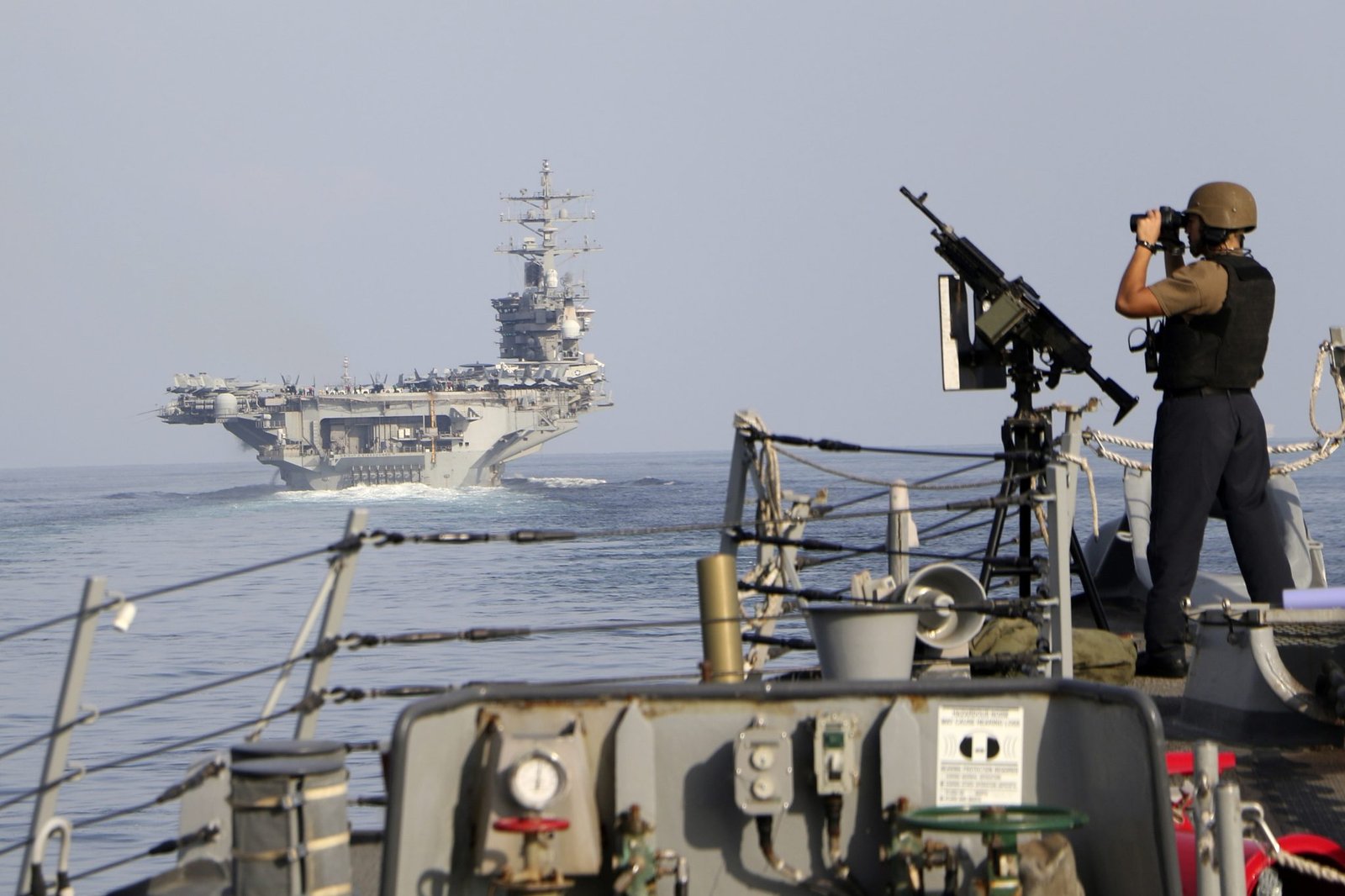
The US Naval Blockade of Iran halted maritime traffic, diverted 142 vessels, and disabled nine ships. Despite a temporary ceasefire, the blockade resumed, revealing the limits of maritime coercion absent a political settlement.
The imposition of a US naval blockade of Iran in April 2026 marked a calibrated coercive strategy intended to choke maritime commerce and compel Tehran’s compliance without triggering full-scale war. Over two months, U.S. Central Command diverted 142 vessels and disabled nine ships attempting to breach the cordon, demonstrating both the reach and restraint of American sea power.
The US Naval Blockade of Iran temporarily froze Iranian oil exports and generated negotiating leverage, yet the subsequent collapse of the ceasefire and the reimposition of the same measures in July expose a deeper strategic frailty. Naval coercion can reshape adversary behavior in the short term, but it cannot resolve the fundamental geopolitical disputes that drive conflict. The Hormuz crisis remains entangled with nuclear brinkmanship, regional military posturing, and the unresolved security architecture of the Gulf.
Military operations bought time, but they did not buy peace. The cycle of tit-for-tat strikes, shadow fleet evasions, and diplomatic breakdowns illustrates that the US Naval Blockade of Iran served as a tactical instrument rather than a strategic solution. Without a coherent political endgame, maritime pressure risks becoming a recurring episode in an open-ended confrontation rather than a bridge to a durable settlement.
How the US Naval Blockade of Iran Was Built
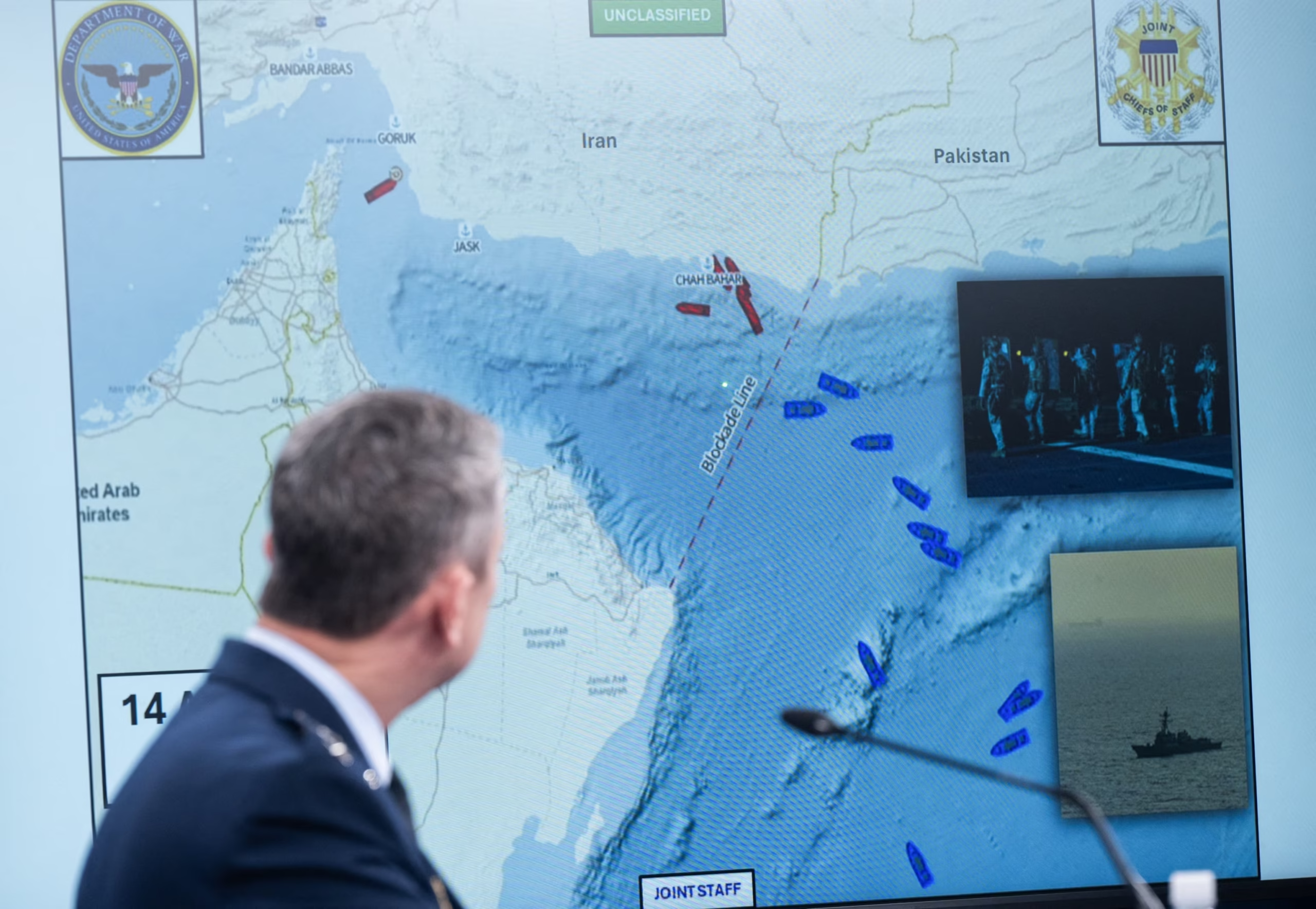
On April 13, the U.S. Central Command (CENTCOM) launched a naval blockade preventing inbound and outbound maritime traffic from all Iranian ports, including those in the Gulf of Oman, such as Chabahar and Bandar-e Jask. Two months later, the United States lifted the blockade as part of the temporary ceasefire agreement with Iran, highlighting how calibrated maritime pressure can generate leverage and contain escalation. However, mutual retaliatory strikes, resulting in the reimposition of the U.S. blockade on July 13, underscore that naval power can temporarily shape adversary behavior, but eliminating volatility ultimately depends on translating military leverage into a viable political outcome.
The U.S. blockade operated through a deliberate approach intended to compel compliance while minimizing the need for direct confrontation. U.S. forces initially established radio contact with merchant vessels suspected of attempting to breach the blockade while the ships were still operating in international waters. Captains were informed that their cargoes and routes had raised concerns and were instructed either to reverse course or return to their last port of call. Compliance at this stage avoided further action.
In a limited number of cases, such as for the M/V Blue Star III and the M/T Celestial Sea, U.S. Marines conducted boarding-and-search operations. After verification showed that neither vessel included Iranian port calls, U.S. authorities released both ships without incident.
When crews ignored repeated warnings, a process that could extend anywhere from 6 to 24 hours, surface combatants and embarked helicopters carried out interdiction duties by compelling compliance through warning shots from small arms. These limited demonstrations of force were intended to signal that escalation remained avoidable.
When a vessel continued to disregard instructions, CENTCOM forces proceeded to a second and more coercive phase: disablement. Naval and air assets employed carefully calibrated strikes designed to deprive vessels of propulsion. Weapons employed ranged from the five-inch Mk 45 gun of guided-missile destroyers to the 20 mm cannon of U.S. Navy F/A-18 Super Hornets and AGM-114 Hellfire missiles. Over roughly two months of operations, CENTCOM forces disabled nine ships attempting to force the blockade.
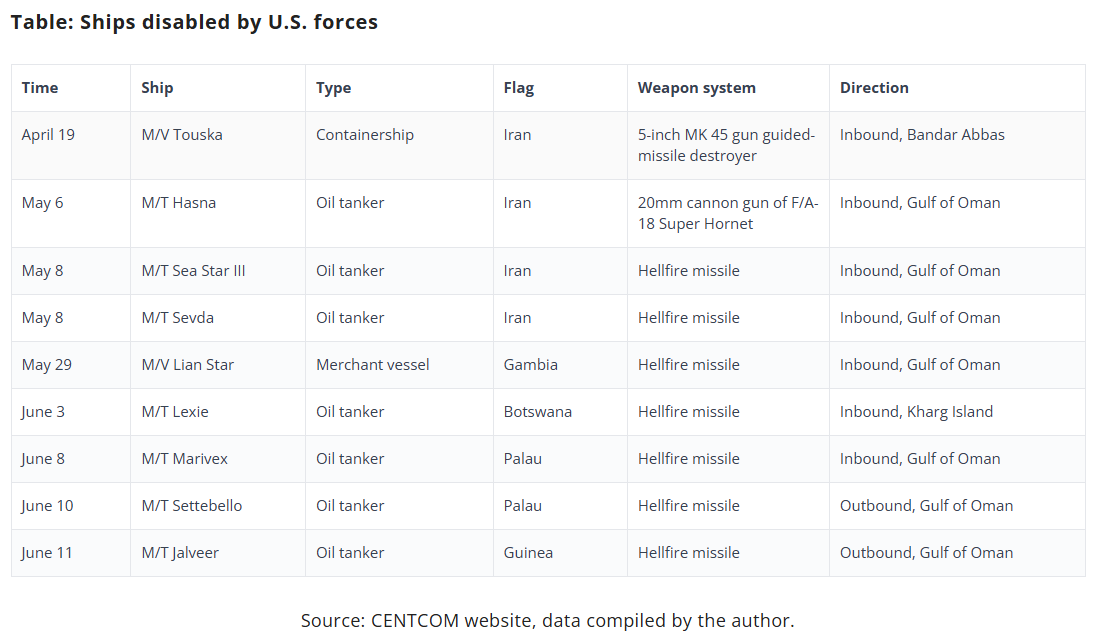
The M/V Touska, the first merchant vessel disabled during the blockade, was the only case in which personnel from the 31st MEU boarded a ship after kinetic action had been employed. In subsequent incidents, however, CENTCOM refrained from conducting follow-on boarding operations. Instead, operations were limited to surgical strikes targeting the engine room or smokestacks, forcing vessels off their intended routes without exposing boarding teams to unnecessary risk. This pattern reflected an operational preference for calibrated coercion and risk management rather than outright seizure of suspect shipping.
US Naval Blockade of Iran by the Numbers
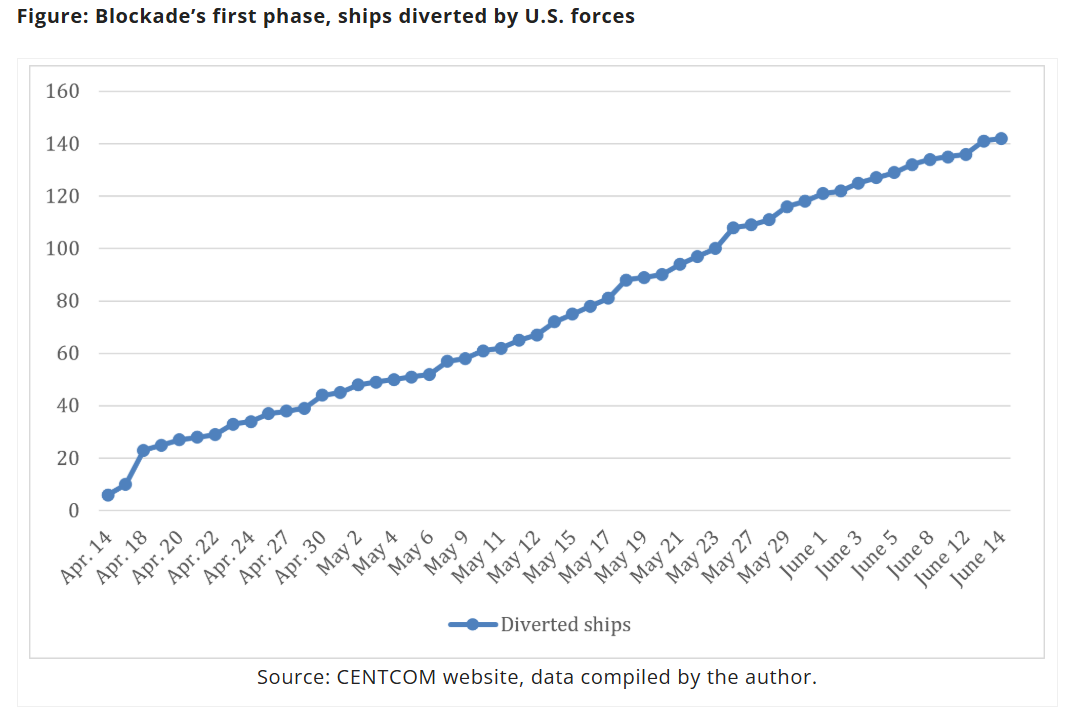
On June 18, the United States lifted the blockade, permitting the resumption of maritime traffic to and from Iranian ports. Throughout the blockade, CENTCOM forces diverted 142 vessels while allowing 42 humanitarian shipments to proceed.
The pace of interdictions rose steadily as CENTCOM forces accumulated operational experience and expanded their maritime awareness picture, suggesting that the effectiveness of the blockade improved over time despite persistent efforts by Iranian-linked vessels to evade detection.
Despite positive results, some ships succeeded in slipping through the blockade. Dozens of “shadow fleet” tankers employed a wide range of grey-zone techniques, from disabled tracking signals to fake flags and unspecified port calls, to evade detection by CENTCOM forces.
With the chokepoint spanning nearly 60 miles at its widest point, these vessels exploited gaps in CENTCOM’s surveillance architecture and the practical limits of continuous maritime monitoring to evade interdiction. Even with overwhelming naval and air superiority, enforcing persistent control over a congested and commercially vital maritime corridor proved challenging.
Tit-for-Tat Under the US Naval Blockade of Iran
According to CENTCOM, during the blockade, Iran mounted six attacks against merchant shipping transiting the Strait of Hormuz, relying on volleys of ballistic missiles and one-way attack drones. CENTCOM forces responded by intercepting incoming projectiles and striking hostile threats before they could be employed. This combination of active defense and preemptive counterfire prevented individual incidents from disrupting commercial traffic for prolonged periods.
U.S. forces deliberately confined their responses to a narrow set of military targets. Iranian attacks were met with self-defense strikes directed against air defense batteries, drone ground-control stations, and surveillance radar facilities. Most of these targets were concentrated within the coastal triangle bounded by Qeshm Island, Bandar Abbas, and Goruk, an area from which Tehran projects military power over the Strait of Hormuz.
CENTCOM effectively adopted a tit-for-tat approach, whereby Iranian hostile actions elicited proportionate military responses. This strategy afforded sufficient operational flexibility to maintain the broader framework of the ceasefire while demonstrating that attacks on commercial shipping would carry immediate costs for Tehran. The resulting exchanges remained limited and highly circumscribed, restoring deterrence without generating a self-reinforcing cycle of escalation.
Iran initially applied the same logic to address the disabling of Iranian-flagged vessels. On April 22, three days after CENTCOM disabled the M/V Touska, commandos from the Islamic Revolutionary Guard Corps (IRGC) Navy boarded and seized two container ships, redirecting both vessels to Bandar Abbas. The episode, however, proved to be an isolated incident rather than the beginning of a sustained campaign of reciprocal seizures.
Several tactical considerations may explain Tehran’s decision not to repeat such operations. The April 22 seizures likely heightened CENTCOM’s alert levels and prompted closer surveillance of Iranian naval activity. Under these conditions, both IRGC Navy fast-attack craft and helicopter-borne boarding teams would have become increasingly vulnerable to U.S. patrols and rapid-reaction forces. Restricting calibrated confrontation primarily to the air domain offered Tehran greater flexibility, allowing tensions to be raised or lowered without committing maritime assets to operations carrying comparatively higher risks. Missile and drone attacks also provided Iranian decision-makers with a wider range of escalation options, while reducing the likelihood of direct encounters with CENTCOM forces in the confined waters of Hormuz.
Unintended Consequences of the US Naval Blockade of Iran
With thousands of U.S. personnel deployed on, above, and below the sea, CENTCOM conducted blockade operations with limited losses and without suffering combat fatalities. On June 1, Iranian forces shot down an MQ-1 Predator over international waters. A week later, a U.S. Apache helicopter crashed off the coast of Oman during a routine patrol mission after it was struck by an Iranian drone, but both crew members were recovered by a U.S. Navy Corsair unmanned surface vessel. The rescue marked the first known instance of an unmanned vessel conducting the recovery of personnel in an active combat theater, illustrating the growing utility of autonomous systems in performing missions traditionally reserved for crewed platforms.
Although U.S. forces incurred no fatalities, the blockade was not without human cost. Civilian mariners accounted for the only confirmed casualties directly associated with interdiction operations. Three Indian sailors aboard the M/T Settebello were killed when a CENTCOM strike hit the engine compartment. The incident highlighted the inherent difficulty of employing calibrated force against commercial shipping and underscored the persistent risk that even carefully executed disablement operations can produce unintended consequences.
Restoring Freedom Amid the US Naval Blockade of Iran
Seeking to restore a minimum degree of confidence in maritime traffic while negotiations with Iran were still underway, the U.S. launched Project Freedom on May 4. Conceived as a defensive mission, the initiative aimed to provide direct support to merchant vessels transiting the chokepoint. Its results, however, proved mixed.
The operation registered some early successes, with two U.S.-flagged merchant vessels and a Dutch-flagged vehicle carrier successfully exiting the Hormuz. However, Project Freedom was paused the following day. The initiative appeared less like an attempt to establish a permanent convoy system than a means of strengthening Washington’s negotiating position. By demonstrating both the capability and willingness to reopen the Strait under military protection, Washington sought to gain additional leverage should conditions at sea improve enough to make escorted transit feasible.
Yet those conditions failed to materialize. Even though the frequency and intensity of Iranian attacks had declined, Tehran retained the ability to strike commercial routes, indicating that the operational environment remained too volatile for a sustainable escort mechanism.
Diplomatic Test of the US Naval Blockade of Iran
The signing of the U.S.–Iran memorandum of understanding (MOU) marked the beginning of a new phase in the crisis. The resulting 60-day implementation period established a framework for de-escalation and confidence-building measures, but the situation remained fragile.
U.S. President Donald Trump repeatedly stressed that Washington retained the option of abandoning the arrangement should Tehran fail to honor its commitments. Initially, the administration invested considerable political capital in preserving the agreement, but it maintained the possibility of resuming more coercive policy options.
For Tehran, the 60-day extension provided much-needed breathing space after months of intense fighting. Iranian leaders used the pause strategically, seeking to rebuild military capabilities, restore depleted stocks, and provide relief to an economy batter by conflict and sanctions. The resumption of oil exports offered Tehran an opportunity to stabilize domestic conditions while reassessing its strategic options.
Despite these uncertainties, the blockade initially achieved its principal objective of creating the conditions for diplomacy while avoiding a broader military confrontation. Compared with more ambitious military options periodically discussed, including the seizure of Kharg Island and larger amphibious operations against Iranian territory, the blockade ultimately represented a calibrated form of coercion. It imposed costs on Iran while preserving sufficient political space for negotiations.
However, the period of relative restraint proved temporary. Even after the blockade was lifted, escalation cycles persisted. Tehran continued targeting merchant vessels crossing the Strait through the southern corridor, while Washington responded with retaliatory strikes against Iranian military facilities. Both sides initially maintained a calibrated tit-for-tat approach, avoiding actions that could derail negotiations and trigger a return to full-scale hostilities. Yet, exchanges eventually exceeded the limits of controlled escalation following Iranian attacks against U.S. bases in Bahrain and Kuwait.
The collapse of the ceasefire framework and the resumption of U.S. strikes against Iranian military targets, alongside the reimposition of the maritime blockade on July 13, demonstrated that the leverage generated by the initial operation was insufficient to resolve the broader confrontation.
The Uncertain Endgame of the US Naval Blockade of Iran
The renewed blockade also highlights the enduring challenge of using maritime coercion as a diplomatic instrument. While the first phase demonstrated that naval pressure could constrain Iranian activity and create negotiating space, it did not eliminate the strategic competition driving the crisis. The Hormuz dispute has never been solely about freedom of navigation. It remains inseparable from the broader nuclear talks, regional military competition, and the unresolved security confrontation between Washington and Tehran.
Ultimately, the blockade remains a means rather than an end in itself. Its strategic value depends on the broader strategic objective it is intended to achieve, yet Washington’s long-term vision for the Strait remains unclear. President Trump initially proposed placing Hormuz under U.S. control and establishing a fee-based security arrangement, before shifting toward a reported plan centered on major Gulf investments in the U.S. economy to offset the costs associated with Washington’s security commitments. The former would represent a significant departure from previous U.S. policy, which emphasized freedom of navigation and opposed Iranian efforts to impose transit tolls. The latter reflects a more transactional approach to burden-sharing, linking economic partnerships with continued U.S. security involvements in the Gulf.
Both approaches, however, face substantial operational and political constraints. Any attempt to impose a permanent U.S.-managed security regime over Hormuz would encounter sustained Iranian opposition and require a long-term military commitment. At the same time, Gulf states, which oppose Iran’s efforts to dominate the Strait, may support a ship-escort mechanism, but are likely to remain cautious about arrangements that expand dependence on uncertain external guarantees or transform Hormuz into a contested geopolitical instrument. The future of the blockade, therefore, will depend less on the ability of U.S. forces to temporarily control maritime traffic than on whether Washington can define a sustainable regional security framework capable of outlasting the immediate shipping crisis.