
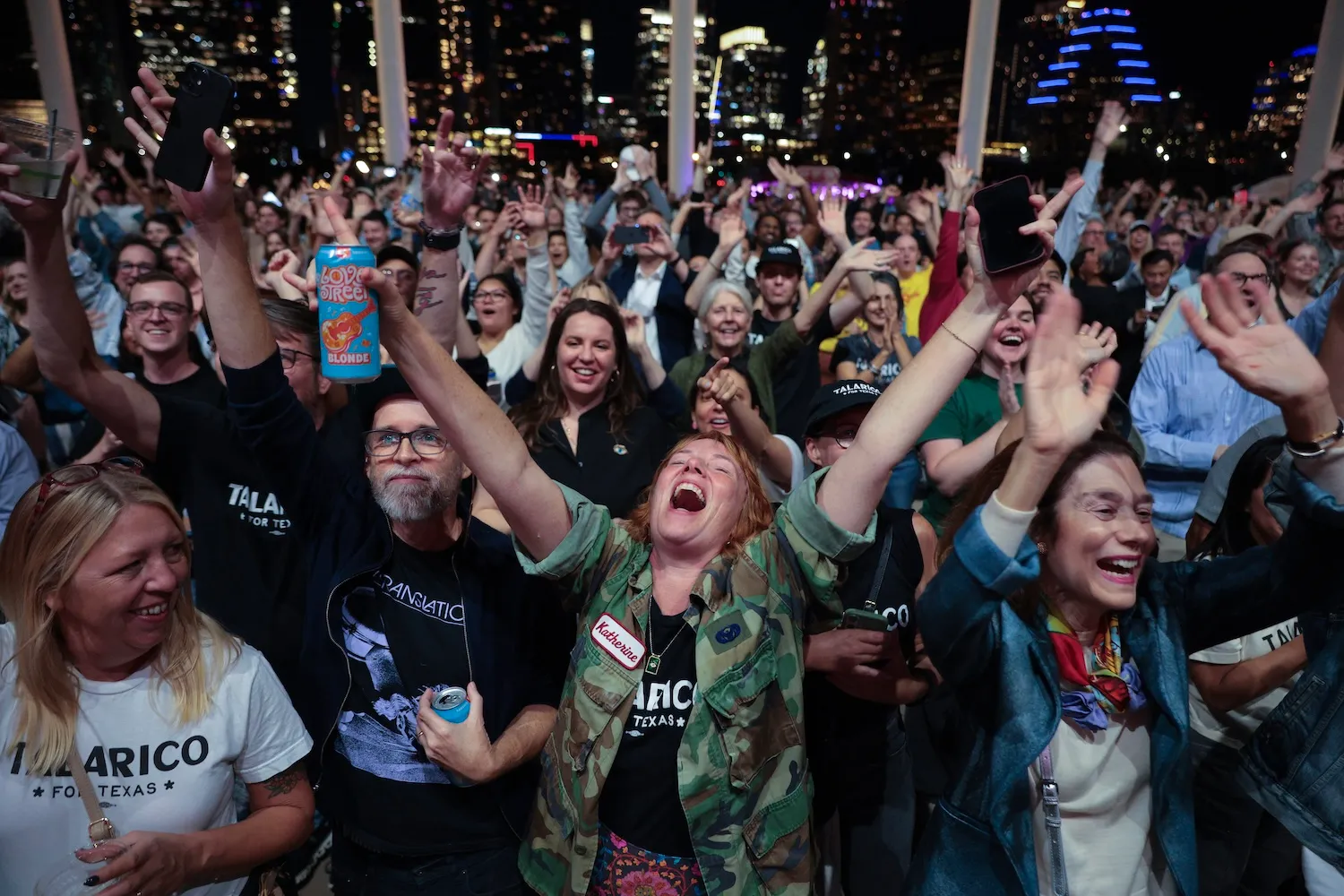
Democrats won the House and Senate in a historic midterm rebuke, yet the party lacks a leader and a program. Vetoes, depleted munitions, court losses, and a global counter-backlash now constrain Trump more than Congress does, leaving the outcome unresolved.
End of Trumpism begins with a rebuke
Americans have now delivered on what they’ve been telling pollsters all year: They’re mad as hell and they’re not going to take it anymore. In a stunning rebuke to U.S. President Donald Trump and his Republican Party, voters have entrusted Democrats with both the House and the Senate, flipping their control simultaneously for only the fourth time in a midterm election since World War II. The reverses for the GOP include defeats in usually deep-red states such as Kansas, South Carolina, and Texas.
Trump is already distancing himself from the results—after encouraging voters to pretend he was on the ballot. “I wasn’t on the Ballot and if I was, we would have won IN A LANDSLIDE!” he wrote on Truth Social, his social media platform, as he cast blame on the right-wing network Fox News for platforming Democratic party voices. But polls show that voters across the country were concerned about rising costs and government corruption as they cast their ballots on Tuesday. They also show that Americans were linking their dissatisfaction over those matters directly to Trump’s policies, including the Iran war and tariffs.
Democrats should, of course, take credit for running successful campaigns in states as different as Maine, Michigan, Nevada, and North Carolina. And they ran a diverse slate of candidates, from centrists such as Adam Hamilton, a pastor who has become the first Democrat to win a Senate seat in Kansas since the Great Depression, to Darializa Avila Chevalier in New York, one of several new House representatives associated with the Democratic Socialists of America. But that broad tent—without a clear party leader or direction—suggests that the midterm vote was more a repudiation of the present than a roadmap for the future.

Vetoes will limit Democratic investigations
It would be wise to not expect too much change immediately. “LAWYER UP,” wrote Rep. Robert Garcia, a Democrat from California who is expected to chair the House Oversight Committee and launch enquiries into the Trump administration’s actions. But Democrats will remember their failed attempts to convict and remove an already impeached Trump in his first term.
Without a two-thirds majority in the House and Senate, Democrats will find that their hands remain somewhat tied in the face of a powerful executive. In case they needed a reminder, Trump already posted on Tuesday night an image of his signature red cap on Truth Social with the word “VETO” embroidered on the front in white.
Yet the president will now contend with greater hurdles than he has been used to. Even if Trump restarts the Iran war or launches a new one in Cuba without congressional approval, he will face more enquires, increased public resistance, and a reduced ability to fund his pet projects.

Stockpiles restrain Trump more than Congress
Until Democrats coalesce around a new leader and a unifying vision, the greater checks on Trump may turn out to be systemic rather than from the Democratic Party or Congress. When it comes to waging foreign wars, whether old ones or new, the White House’s greatest restraint comes from the diminished capabilities of its defense industrial base.
As is now well documented in Foreign Policy and elsewhere, the United States has expended two-thirds of its Patriot missile interceptors and one-third of its Tomahawk cruise missiles since the Iran war began. Replenishing those stockpiles could take years.
Trump’s trade policies have hit repeated roadblocks in court. The president’s hold on the media—including his once-beloved Fox News, and influential right-wing commentators—has begun to slip. As I have previously written, companies and countries will see these signs of resistance and adjust how they approach Trumpworld. Entities around the world will begin to reach out to policymakers they expect to take power in two years—and this week’s results indicate they might not be Republicans.
As Florida’s Republican Gov. Ron DeSantis wrote on X on Wednesday morning, the Democrats’ massive margin will take a long while to overturn. “It is very unlikely Republicans will recapture Congress in 2028,” he wrote. “Might not have a shot at Senate control until 2032.”
Beyond the partisan tug-of-war, what is clear is that the democratic system itself is holding in the face of incredible pressure. Election workers have this week ensured the integrity of democracy in the United States. Unsung state officials—both Democrats and Republicans—have fended off the Justice Department’s attempts to seize confidential voter data. Most of all, ordinary Americans, tens of millions of them buried under bills and worries, have taken the time to show that their vote counts. That is the sign of a system that is resisting historic attempts to write it off.
It is often said that the world follows the United States’ lead. Perhaps it will. It’s worth noting, however, that the U.S. midterms come amid a global mood of protest, from France to India. Countries such as Serbia and Hungary have recently booted out their leaders.

End of Trumpism faces its real test
And in that sense, the bigger takeaway could be that we are in a moment of historic tumult. If Trumpism was the most recognizable brand of our global moment of backlash, then perhaps we are now in the throes of a counter backlash.
Voters are realizing that the people who wanted to blow up the system—the Trumpists, if you will—don’t have the answers to our problems. Now it’s time for a sober debate about the actual solutions.