
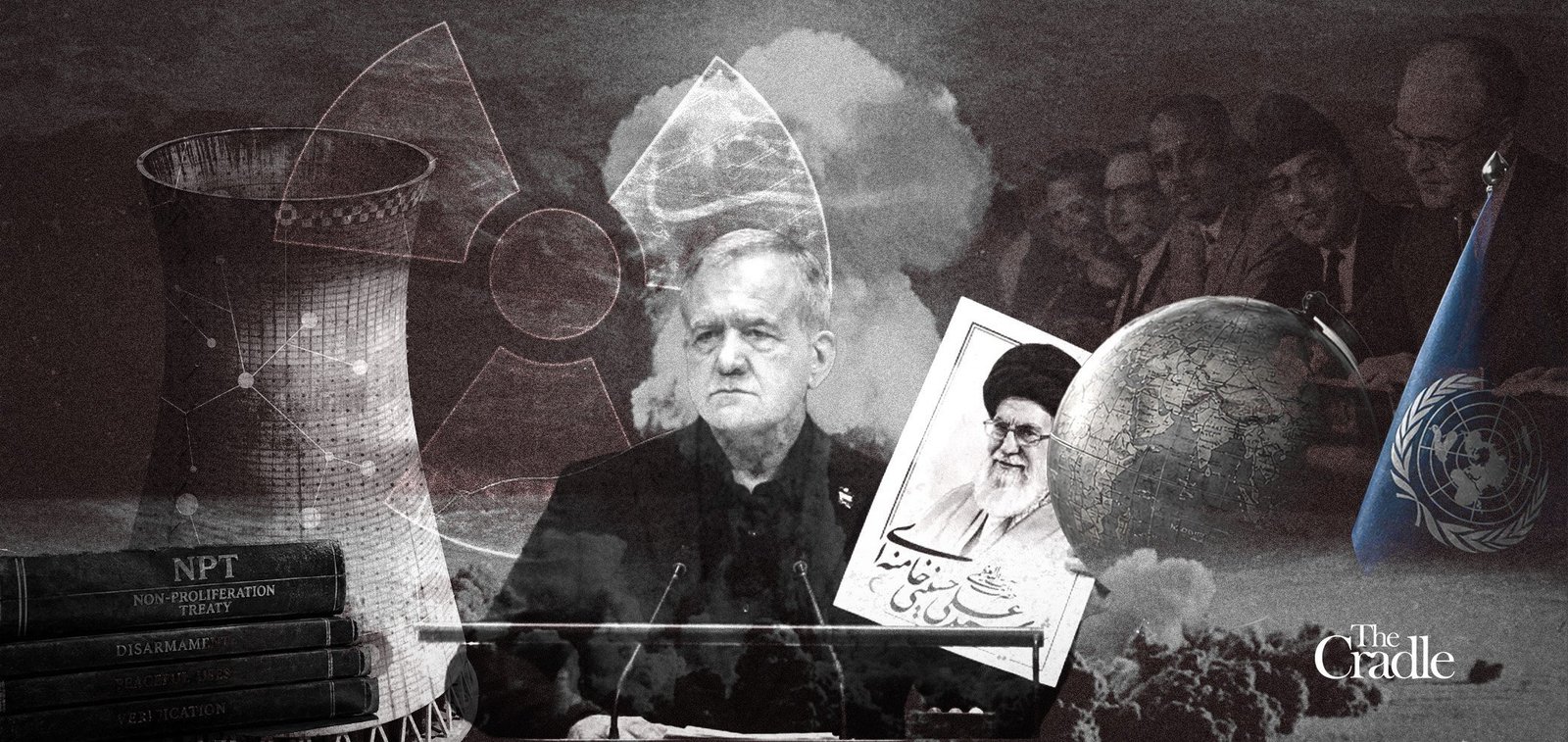
Iran’s parliament weighs leaving the Nuclear Non-Proliferation Treaty after US–Israeli strikes. Lawmakers demand withdrawal, while President Pezeshkian and security officials debate timing, deterrence, and risks of alienating China and Russia.
After two US–Israeli attacks within a year, Iran’s political and security elites are debating whether continued membership in the Nuclear Non-Proliferation Treaty still serves the state’s interests. A parliamentary motion demanding Iran NPT Withdrawal has sat with the presidium for months, while lawmakers press the Supreme National Security Council and Foreign Ministry to begin formal procedures.
Advocates argue the treaty and the International Atomic Energy Agency failed to protect Iran’s civilian nuclear program, scientists, and facilities from inspection leaks and military strikes. Opponents warn that Iran NPT Withdrawal would hand Washington and Tel Aviv a pretext for another assault, alienate China and Russia, and impose costs without delivering a credible deterrent.
President Masoud Pezeshkian defends remaining in the treaty and denies any bomb ambition, yet Mohsen Rezaei of the Supreme National Security Council openly ties withdrawal to American behavior. The argument now extends beyond the Majlis to the highest levels of the Islamic Republic, where a formal vote may only ratify a course already chosen elsewhere. The dispute is no longer whether Iran might leave, but when it would act and what strategic price it would pay.
Iran NPT Withdrawal Debate Intensifies
After two rounds of US–Israeli attacks in the space of a year, pressure is mounting on Iran’s leadership to withdraw from the Nuclear Non-Proliferation Treaty (NPT). Advocates say the treaty has failed to protect Iran’s civilian nuclear program or its scientists. Their opponents warn that withdrawal could provide Washington and Tel Aviv with a pretext for another assault. The argument now reaches well beyond the Majlis.
“A big decision in the offing” is one way to describe a motion that has sat with the Iranian parliament’s presidium for months. A group of lawmakers has now issued an open statement demanding that the Supreme National Security Council and Foreign Ministry begin the formal process of withdrawal from the NPT. They also want Tehran to end voluntary nuclear commitments beyond its treaty obligations.
The lawmakers argue that the NPT and the International Atomic Energy Agency (IAEA) have failed to safeguard Iran’s right to peaceful nuclear technology. They accuse the agency of allowing information obtained through inspections to reach Iran’s enemies, exposing nuclear facilities and scientists to attack.
Their statement follows years of dispute over the agency’s access to Iranian sites and the use of its findings by western governments. They invoke Article X of the treaty, which permits withdrawal when a state decides that extraordinary events have jeopardized its supreme interests. A withdrawal would require three months’ notice to other parties and the UN Security Council.
A motion awaiting debate
In the wake of that open statement, Isfahan lawmaker Hussein-Ali Haji-Deligani revealed he and his colleagues submitted legislation on Iran’s withdrawal from the NPT months ago, and it is up to parliament Speaker Mohammad Bagher Ghalibaf to put it to debate on the parliament floor. Heji-Delogani reiterated:
“Considering enemies’ wars against Iran on two occasions, the continuation of Iran’s membership in the NPT has no use, especially after the IAEA’s Board of Governors sent Iran’s dossier to the UN Security Council. Therefore, Iran should exit from the treaty to prevent further damage.”
Other lawmakers have turned their criticism on the parliamentary leadership. Tehran representative Kamran Ghazanfari blamed the presidium for keeping the motion off the floor, an accusation aimed principally at Ghalibaf.
Ghalibaf has aligned himself with Iranian President Masoud Pezeshkian on several questions of state policy, drawing fire from former allies among the Principlists. The NPT dispute has become another point of contention between them.
Another parliamentarian, Mohammad-Reza Sabaghian, stated:
“We must use the courage that was shown and the right strategy to close the Strait of Hormuz in the discussion of withdrawing from the NPT. This is the second step that will lead to the failure of America’s plans.”
Mohsen Sani, a member of parliament’s national security commission, went further:
“In our opinion, the NPT no longer has any meaning or significance, whether we want to stay in it or leave it. When one of the NPT member states attacks another member (Iran), it means withdrawing from all these commitments and treaties that have existed in this regard. Recent pressures suggest that we should reconsider enrichment.”
The case for staying
The call for withdrawal has met resistance within Iran’s political establishment. Tehran lawmaker Mohammad Seraj sees no benefit in leaving. Unless Iran intends to build a bomb, he argues, the step would only damage its relations with friendly states.
Khorasan, a newspaper close to Ghalibaf, has criticized lawmakers for “radicalizing the political ambiance of the country and forcing the Islamic Republic to make such a sensitive decision,” describing it as “a gift to Trump.”
The outlet maintains that “any moves towards leaving the NPT give enough justification to Trump and Netanyahu for their future strikes against Iran while it alienates friends such as China and Russia who have always supported Iran’s legitimate right to a non-military nuclear program.”
Rouydad24, a news site with strong ties with the Reformist camp, lambasted lawmakers as “radicals” who “have returned with a controversial and costly prescription.”
The Reformist news site charges that “Pezeshkian’s critics have turned withdrawing from the NPT into a political slogan without considering it is a complicated matter economically, militarily and internationally.”
Where the decision rests
The debate has become a challenge for Pezeshkian, whose government has defended Iran’s continued place in the treaty. But the president is not the only voice in the room. Mohsen Rezaei, secretary of the Supreme National Security Council, has openly raised the possibility of withdrawal.
Rezaei said, “After the United States abandoned the post-war Islamabad Memorandum of Understanding, we reached the conclusion that we must change course. We have yet to take a decision on withdrawing from the treaty, because our withdrawal totally depends on Washington’s behavior.”
The senior general admits that the Islamic Republic is still committed to the late supreme leader Ali Khamenei’s religious prohibition on the use of nuclear weapons and has not changed its nuclear doctrine; however, “nobody can guarantee the future,” he elaborates.
Is Iran seeking a nuclear weapon?
In an exclusive interview with the Republican Party’s mouthpiece, Fox News, Pezeshkian flatly denied Iran is seeking an atomic bomb, adding that his country is even willing to dilute the 440-kilogram uranium stockpile purified at 60 percent and allow the IAEA’s nuclear inspectors to supervise Iran’s nuclear program.
Pezeshkian made those claims while the Islamic Republic does not allow international inspectors to visit its nuclear facilities, which were destroyed by the US and Israel during two wars in June 2025 and February-March 2026.
Pezeshkian’s assurance contrasts with Rezaei’s warning that the country’s future course cannot be guaranteed. Reports in Tehran that Supreme Leader Mojtaba Khamenei has ruled out nuclear talks with Washington remain unconfirmed; they offer no basis for treating such a ban as settled policy.
A decision above the Majlis
Iran’s NPT membership has moved from a technical and legal question into a wider argument over deterrence after the attacks on its nuclear facilities. The parliamentary bill gives that argument a public stage, but lawmakers alone will not settle it.
The final decision would be made at the highest levels of the Islamic Republic’s political and security establishment. A vote in the Majlis could put a formal stamp on a course set elsewhere, as earlier nuclear legislation did.
The 2020 Strategic Action Law to Lift Sanctions, for example, obliged the government to expand nuclear activity and restrict inspections if sanctions relief did not materialize. It sharply constrained the Rouhani administration’s room for maneuver over the 2015 Joint Comprehensive Plan of Action (JCPOA) nuclear agreement. The precedent is relevant because a bill presented as a parliamentary initiative can become a lever for policy agreed across the state’s security institutions.
Iran NPT Withdrawal Timing Remains Unsettled
For now, proposals to leave the NPT and calls to build a bomb circulate side by side. That does not establish that either has been adopted. It does show how far positions once kept at the edges of public debate have entered the argument over Iran’s security.
Lawmaker Ahmad Bakhshayesh Ardestani has advocated building a nuclear weapon first and withdrawing from the NPT afterward, “because only in that case, it can guarantee deterrence against a renewed US-Israeli aggression.”
Even Khorasan, which warns against leaving the NPT now, does not rule out an exit. Its argument is that Iran should first build and test a nuclear weapon. Until then, it says, Tehran would bear the costs of a nuclear-armed state without possessing a nuclear deterrent.
The disagreement in Iran is no longer confined to whether the country should leave the treaty. It is also about when.