
Between 1980 and 2026, 381 public forecasts anticipated Iranian Regime Collapse. The brief shows how these expectations led Washington to abandon diplomacy, expand demands, and discount the costs of coercion before the February 2026 war, even as the Islamic Republic survived.
Washington Bet on Iranian Regime Collapse
Executive Summary
On Feb. 11, 2026, Israeli Prime Minister Benjamin Netanyahu briefed President Donald Trump in the White House Situation Room. He argued that Iran was ripe for regime change and that a joint military campaign could quickly lead to the Iranian regime’s collapse. Seventeen days later, the United States and Israel went to war; nearly nine months later, a hardened Islamic Republic remains in power.
Predictions of Iranian regime collapse long predate 2026. As this study documents, political figures, analysts, journalists, and Iranian opposition leaders repeatedly anticipated the Islamic Republic’s demise between 1980 and February 2026. At several consequential moments, expectations of impending collapse were also present among US decisionmakers and contributed to their policy choices. These expectations made negotiations seem less worthwhile, encouraged more expansive demands, and led policymakers to underestimate the costs of coercion.
In 2003, officials in the George W. Bush administration who expected upheaval in Tehran argued against talks that might lend the Iranian government legitimacy. The United States walked away from a working diplomatic channel that had grown out of cooperation in Afghanistan.
Fifteen years later, Trump’s conviction that sanctions and protests were wearing Iran down helped drive the US exit from the Iran nuclear deal, officially called the Joint Comprehensive Plan of Action. Secretary of State Mike Pompeo followed with 12 demands that went far beyond the nuclear program.
In the run-up to this year’s war, the same expectation let Trump brush aside his own advisers’ warnings about the Strait of Hormuz and dwindling US munitions, because he assumed Tehran would give in first. Each time, confidence that the regime was on its way out made it easier to skip diplomacy and harder to see the costs of pressure.
Whether and when Iran will undergo fundamental political change remains an open question, but Washington still has to manage its relations with the government that exists today. The Trump administration should assess its Iran policy by what it achieves for US interests and pursue realistic demands that leave room for compromise. Above all, US policymakers must stop letting predictions of the Islamic Republic’s imminent collapse stand in for strategy.
A Six-Month Forecast From 1979
“The regime won’t last six months.”
The prediction sounds as though it could have been made after Iran’s January 2026 uprising, when mass protests and a severe economic crisis once again produced confident assessments that the Islamic Republic was approaching its end. Or it might have come during the 2022 “Woman, Life, Freedom” uprising, when similar expectations spread among analysts, opposition figures, and journalists. It came from neither moment. The prediction was made in March 1979, only weeks after Iran’s revolution and before the country had even formally become the Islamic Republic. Three years later, the Christian Science Monitor recalled the forecast while asking how Ayatollah Ruhollah Khomeini’s government had survived despite repeated expectations of its demise and “much to the surprise of his critics.”
By then, the original six-month deadline had long passed, but the expectation had not disappeared. Iranian opposition figures interviewed for the same article were again “so certain the regime will collapse soon” that they were already preparing political and economic programs for the government they expected to follow it.
Over the next four and a half decades, expectations of the Islamic Republic’s demise appeared across remarkably different political moments and among very different observers. US and foreign officials, Iranian opposition figures, journalists, scholars, former Iranian officials, and policy analysts repeatedly interpreted new crises as possible signs that the political system had entered its final stage.
This brief traces the recurrence of predictions of the Islamic Republic’s collapse and asks how perceptions of its domestic vulnerability have shaped US foreign policy. Its central question is whether expectations of collapse have made Washington less willing to negotiate and more willing to escalate. When policymakers believe an adversary is nearing its end, negotiations can seem unnecessary, and waiting can promise better terms. Such expectations may also make coercion appear less costly if policymakers believe that additional pressure or military action will bring a confrontation to a swift conclusion.
Drawing on official statements, firsthand recollections, and reporting on internal deliberations, the brief examines the George W. Bush administration and both administrations of Donald J. Trump. The cases reveal different versions of a recurring argument. Under Bush, anticipated political change reinforced objections to negotiations that might legitimize the Islamic Republic. During Trump’s first term, expectations that economic pressure would deepen Iran’s vulnerability supported demands extending well beyond the nuclear issue. However, officials differed over whether pressure should produce concessions or regime change. In Trump’s second term, the prospect of political breakdown entered arguments that military action could achieve substantial gains at a manageable cost.
Predictions Track Repeated Political Shocks
Waves of the coming collapse
Predictions of the Islamic Republic’s collapse have reappeared around successive internal and external crises. Revolutionary instability, war, leadership succession, mass protest, economic distress, and military confrontation have each supplied a new setting for the expectation that the latest challenge might finally prove decisive. The historical pattern is therefore less one of continuous pessimism about the regime’s survival than of recurring episodes.
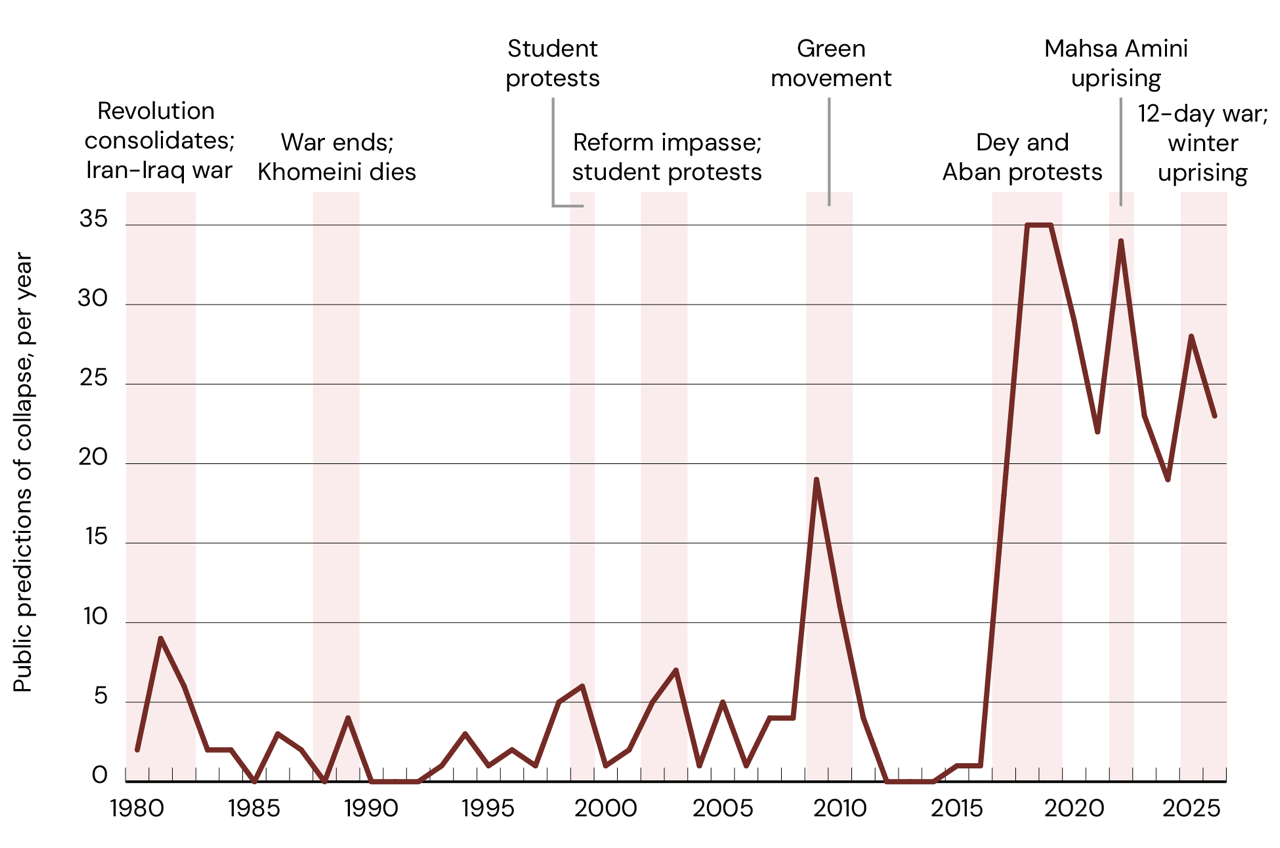
Figure 1 plots an original dataset of 381 public predictions of the Islamic Republic’s collapse, collected from news coverage, official statements, and other public sources, by year, alongside major shocks to the political system (see the appendix for sources and collection methods).
The collected predictions cluster around the instability of the early revolutionary period and the Iran–Iraq War; the end of the war and Ayatollah Ruhollah Khomeini’s death; the 1999 student protests; the reform impasse in 2002–03; the 2009 Green Movement; the protest waves of 2017–19; the uprising following Mahsa Amini’s death in 2022; and external war and domestic unrest in 2025–26. Across these episodes, observers repeatedly interpreted visible stress as a sign of impending collapse.
Although the collection contains more statements from some recent crises, differences in media attention and source availability warrant caution when interpreting the counts as evidence of changes in the frequency or prevalence of collapse predictions.
Figure 1: Public predictions of collapse, 1980–2026
The forecasts also came from a much broader range of actors than the image of Iranian opposition groups repeatedly predicting the regime’s demise might suggest. Iranian opposition figures in exile constitute the largest single category in the dataset, accounting for 138 of the 381 statements. But they represent only a little over one-third of the corpus.
Western politicians and government officials account for another 106 statements, scholars and think-tank analysts for 72, journalists and commentators for 55, and politicians and officials elsewhere in the Middle East for 10. Within the exiled opposition, predictions fall into three categories: the National Council of Resistance of Iran, or the NCRI, and the Mujahedin–e Khalq, or the MEK; other exile groups and unaffiliated opposition figures; and the monarchist/Pahlavi network.
Figure 2: Predictor categories in the collapse-prediction dataset
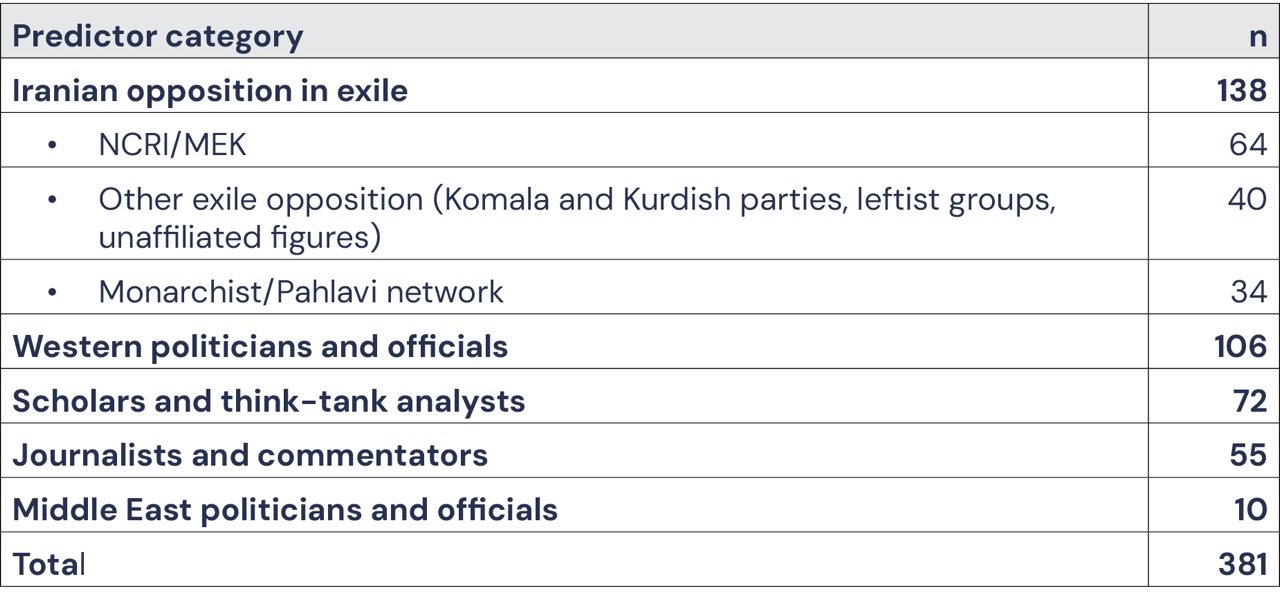
This composition is important for interpreting the historical record. Collapse prediction has certainly been part of opposition advocacy, and statements made in that context should not automatically be treated as equivalent to scholars’, journalists’, or government officials’ analytical forecasting. But the recurrence of the prediction cannot be explained as opposition rhetoric alone. Nearly two-thirds of the observations in the dataset come from outside Iranian exile opposition. The expectation that the Islamic Republic was approaching its end repeatedly traveled across political and professional boundaries.
The reasons given for expecting collapse changed substantially over time. In the early revolutionary period, the new political order confronted armed political opposition, elite conflict, economic disruption, and the Iran–Iraq War. Forecasts during these years frequently centered on whether a still-consolidating political system could survive simultaneous internal and external pressures. As the decade drew to a close, attention shifted toward succession. Khomeini’s death in 1989 raised a different question: Could a political order built around the authority of its founding leader survive his disappearance? The Islamic Republic did survive the transition, but the expectation of collapse did not disappear permanently. It receded until new vulnerabilities supplied a different reason to expect the same outcome.
From Green Movement to Maximum Pressure
By the late 1990s, the anticipated source of political transformation had increasingly shifted from war and elite succession to pressure from below. Mohammad Khatami’s presidency, the reform movement, and especially the July 1999 student protests encouraged speculation that Iran’s younger population and demands for political opening might overwhelm the Islamic Republic’s institutional constraints.
The student protests began over the closure of the reformist newspaper Salaam and spread after an attack on a Tehran University dormitory, becoming the largest protest episode of the reform era. In the early 2000s, the continuing struggle between reformists and conservatives within the government, combined with civil society activism and periodic small protests, kept alive hopes that the political system might be entering a deeper crisis. Yet the opposition lacked the strength to turn those hopes into a decisive breakthrough.
The 2009 Green Movement generated a much larger wave. The disputed presidential election brought enormous demonstrations into the streets and produced the most significant political challenge to the system in years. Some forecasts treated the protests as the beginning of a terminal one. One prominent scholar argued that the regime’s “days are numbered,” citing the enormous June 15 demonstration as evidence that popular opposition had reached a qualitatively different level.
Yet by early 2010, the state had largely suppressed visible manifestations of the movement and collapse predictions subsequently declined sharply.
The relative lull between 2012 and 2017 is equally revealing. Collapse predictions became much less frequent after the Green Movement was suppressed, and the election of Hassan Rouhani in 2013 shifted attention toward the possibility of political change through existing institutions rather than regime breakdown. Rouhani won a first-round majority on a platform emphasizing moderation, sanctions relief, and greater engagement with the outside world, in an election with turnout above 70 percent. Contemporary observers described his victory as generating the first real optimism in years about a negotiated resolution of the nuclear dispute.
The interim nuclear agreement later that year, followed by the 2015 Joint Comprehensive Plan of Action, or JCPOA, reinforced the sense that Iran might be entering a period of managed political and economic opening rather than a terminal crisis. The 2016 parliamentary elections, in which Rouhani–aligned candidates performed strongly in Tehran amid high participation, further strengthened the perception that substantial constituencies remained invested in electoral politics and gradual change within the system. The combination of renewed possibilities for engagement with the outside world and visible domestic support for electoral politics made imminent collapse appear less plausible than it had during the crisis years that preceded it.
Collapse predictions returned to prominence in the statements collected around the protests beginning in December 2017. Initially driven by economic grievances, the demonstrations quickly spread across dozens of cities and took on explicitly political demands. At the same time, the external environment was changing sharply.
Trump withdrew the United States from the JCPOA in May 2018 and restored broad economic sanctions under what became the strategy of maximum pressure. Economic deterioration, renewed sanctions, and repeated protest could now be assembled into a broader narrative of systemic vulnerability.
Some prominent American figures expressed that expectation in unusually explicit terms. Speaking to an Iranian opposition gathering in Paris in July 2017, John Bolton argued that Iran’s political system would not survive to its 40th anniversary and declared that “before 2019, we here will celebrate in Tehran.”
Similarly, Rudy Giuliani said, “We are now realistically being able to see an end to the regime in Iran,” and argued that mounting economic isolation would eventually produce collapse.
The November 2019 protests generated renewed predictions of collapse. On Nov. 30, Reza Pahlavi urged Iranians to prepare for the “inevitable downfall of the Islamic Republic” and for leadership during a transition.
Why Protest Waves Renewed Collapse Talk
The death of Mahsa Amini in September 2022 and the Woman, Life, Freedom uprising provided another setting for collapse predictions. The protests differed from earlier episodes in their geographic breadth, the central role of women and younger Iranians, and the explicit rejection of the political system itself. Many observers therefore interpreted the uprising not simply as another episode of unrest, but as evidence that the Islamic Republic had entered a terminal phase. In the New York Times, one Iran expert argued that “the question is no longer about whether this will happen but when,” adding that authoritarian collapse can move from “inconceivable to inevitable in days.”
Masih Alinejad, an opposition activist, similarly described the protests as sounding the “death knell of the Islamic Republic” and the “beginning of the end.”
The most recent wave was different in one important respect: Predictions of collapse increasingly linked domestic discontent to external military pressure. During the 12-day Israel–Iran war in June 2025, Israeli strikes killed senior Iranian military commanders and damaged nuclear facilities, exposing vulnerabilities in the country’s defenses. These setbacks became the basis for claims that military pressure could precipitate political breakdown. On June 14, Israeli Prime Minister Benjamin Netanyahu declared that Iranian leaders were “packing their bags.”
The following day, he said regime change “could certainly be the result” of Israel’s attacks because the Iranian government was “very weak.”
On June 17, Reza Pahlavi similarly declared that “the regime is on the verge of collapse.”
The January 2026 uprising intensified predictions that the Islamic Republic was approaching its end. Against the backdrop of economic distress and the June 2025 war, some commentators interpreted the confrontation as a struggle over the government’s survival. One analyst wrote that events “might just be the end of the Islamic Republic” while warning that the opposition still lacked the organization needed to replace it.
For some commentators, this interpretation also strengthened the case for military intervention. One analyst argued that the crackdown revealed “fear of collapse, not strength” and that a targeted US strike “would not trigger a regional war,” because Iran’s security forces were preoccupied with domestic unrest. Military action, he maintained, could “intensify internal fractures” and encourage political change.
Another urged the US military to “go big and then let Iranians do the rest,” arguing that attacks on government institutions would “inspire the masses of Iranians who took to the streets in December and January to do so again.”
The perception of Iran’s vulnerability functioned as a rationale for military intervention because internal unrest was presumed to both constrain the government’s retaliatory capabilities and provide an opening for external force to precipitate its downfall.
Explaining why these predictions recur requires a separate inquiry beyond the scope of this brief. Several plausible drivers, however, are consistent with the pattern. Opposition groups have clear incentives to portray the Islamic Republic as nearing its end, both to sustain morale and to attract external support. Analysts and officials may engage in motivated reasoning when forecasts of collapse align with preferred policies of pressure or nonengagement. Many predictions systematically underestimate the Islamic Republic’s institutional resilience, committed loyal constituency, and coercive capacity.
When expectations of collapse shape US policy
Repeated expectations of the Islamic Republic’s collapse have had consequences beyond the forecasts’ accuracy. At several important moments, perceptions that Iran’s political system was weakening and approaching its end have significantly shaped how US officials assessed the value of diplomacy, the demands Washington could realistically make, and the likely costs of coercion. The border between judging a government weak and predicting that it will fall is often blurry. But both push policy the same way: toward postponing compromise, expanding demands, and discounting the costs of pressure.
The underlying logic relies on three core mechanisms. First, expectations of political decline can reduce diplomacy’s appeal. Negotiating with a government believed to be approaching a crisis may appear to confer legitimacy, provide economic relief, or otherwise strengthen an adversary at precisely the moment when pressure is weakening it. Waiting can therefore look more attractive than compromise. Second, perceptions of weakness can encourage more ambitious demands.
If policymakers believe time is on their side, they have less reason to settle for limited agreements and stronger incentives to seek concessions across a wider range of issues. When Tehran rejects those demands, its resistance can reinforce the argument for even greater pressure, further narrowing the space for diplomacy.
Third, expectations of collapse can make coercion appear less costly. Sanctions or military pressure become easier to sustain if policymakers expect them to aggravate an existing political crisis and produce political change before the longer-term costs of confrontation accumulate.
US policy toward Iran has, of course, varied considerably over time. Expectations of collapse have not been present in every period. President Barack Obama’s pursuit of nuclear diplomacy provides a useful comparison. Addressing the United Nations in September 2013, Obama stated that the United States was “not seeking regime change” and would instead seek Iranian compliance with its nuclear obligations.
The 2015 JCPOA entailed nuclear restrictions without requiring agreement on the future of Iran’s political system. Its value did not depend on the Islamic Republic disappearing.
Nonetheless, when expectations of collapse have taken hold, they have sometimes pushed policy away from compromise and toward the assumption that additional pressure could produce a better outcome. Below I discuss three foreign-policy periods in which perceptions of regime weakness and collapse contributed to the US diplomatic approach toward the Islamic Republic.

How Iranian Regime Collapse Shaped Policy
The Bush administration: Anticipation of collapse and the retreat from engagement
The George W. Bush administration provides an early example of how expectations of political change could reduce the value of engagement. After the Sept. 11, 2001 attacks, American and Iranian officials established an unusually productive diplomatic channel over Afghanistan. Ryan Crocker, who served as ambassador to Afghanistan at the time and participated directly in the talks, later recalled significant cooperation and increasingly substantive bilateral discussions. The opening deteriorated after Bush included Iran in the “axis of evil” in January 2002; Crocker recalled that the speech had a “chilling effect” on the dialogue.
By the summer of 2002, Washington was also reassessing the prospects for political change inside Iran. The administration moved away from President Mohammad Khatami and the reform movement operating within the existing system. Bush publicly aligned the United States more directly with Iranians seeking political change while administration officials told the Washington Post that Khatami and his allies were too weak to transform the system. The administration increasingly looked toward pressure from Iranian society rather than gradual change led by reformists from within.
In Suzanne Maloney’s subsequent account, this shift reflected a broader judgment about the government’s future. “The primary American miscalculation,” she argued, “stemmed from the conviction that the Iranian regime [was] on the verge of collapse or revolutionary upheaval.” A young population, economic dysfunction, factional conflict, and widespread dissatisfaction appeared to support that assessment.
The rapid overthrow of Saddam Hussein in spring 2003 strengthened those expectations among some officials and analysts in Washington. Maloney later described an atmosphere in which proponents of regime change viewed the fall of Saddam as a potential “death knell” for the neighboring Iranian government and questioned the utility of negotiating with Tehran “on the eve of its presumptive collapse.”
Student unrest on university campuses seemed to reinforce these expectations. In this view, engagement with Iranian officials risked unnecessarily “legitimizing” a government whose future appeared increasingly uncertain.
Anticipation of political change intersected with objections to legitimating the Islamic Republic through diplomacy. Hillary Mann Leverett, a former National Security Council official involved in talks with Iran, later testified that officials at the Pentagon and in the Office of the Vice President opposed engagement because they regarded even preliminary discussions as a reward for the Iranian government. They feared that “the United States would legitimate [Iran] for another generation.” She recalled hearing Bush express the same concern: “I was in the room when the president said that as well.”
This environment is relevant to the suspension of the US–Iran Geneva dialogue in May 2003. The immediate dispute involved US allegations that al–Qaeda operatives based in Iran were connected to terrorist attacks in Saudi Arabia. But expectations that Washington’s position might improve as political pressure on Tehran increased also reduced the value of preserving engagement. Maloney later argued that the more consequential missed opportunity was not necessarily the much-debated proposal transmitted through Swiss Ambassador Tim Guldimann, whose authorization remains contested, but the abandonment of a diplomatic channel that had already demonstrated its practical utility.
The administration’s emphasis on political change remained visible afterward. In February 2006, Secretary of State Condoleezza Rice requested an additional $75 million to support democracy related activities in Iran, including expanded Persian–language broadcasting, scholarships and exchanges, public diplomacy, and support for civil society.
Yet officials differed over whether regime change offered a practical alternative to diplomacy. Recalling the debate over joining nuclear negotiations in 2006, Rice acknowledged concerns that Washington would appear to be “caving to the Iranians.” Her own position distinguished a longer-term preference from an immediate policy option: “I want to change these regimes too, but I don’t have the option of doing it today.”
She therefore prioritized addressing the nuclear program while leaving open the possibility that international pressure might eventually produce political change.
The Bush experience shows how hopes for political change could make diplomacy harder to pursue. Cooperation over Afghanistan had demonstrated the value of engagement, but some officials believed further talks would lend legitimacy to a government they expected pressure to weaken or bring down. Officials who favored diplomacy therefore faced opposition rooted in both hostility toward the Islamic Republic and expectations about its future. Those expectations gave policymakers a reason to discount what negotiations could achieve with the government that remained in power.
Trump’s first term: Maximalist demands and maximum pressure
During Trump’s first administration, the connection between perceptions of Iranian weakness and US policy became considerably more explicit. Trump entered office convinced that sanctions imposed before the 2015 nuclear agreement had placed Iran under severe internal pressure and that the JCPOA had relieved that pressure prematurely. In his October 2017 Iran strategy speech, he described the agreement as a “political and economic lifeline” for Tehran and claimed that sanctions had been lifted shortly before what would otherwise have been the “total collapse” of the Iranian government.
The protests that spread across Iran beginning in December 2017 reinforced this interpretation. Trump treated the unrest as evidence that the government remained politically vulnerable and argued that the economic gains from the JCPOA had strengthened the state without delivering comparable benefits to ordinary Iranians. The significance of the protests, therefore, was not that they created Trump’s opposition to the nuclear agreement — his opposition long predated them — but that they seemed to confirm his existing belief that Washington had relaxed pressure at precisely the moment Iran was becoming vulnerable.
At first, however, Trump’s own national security team placed important constraints on where that view translated into policy. Secretary of State Rex Tillerson, National Security Adviser H.R. McMaster, and Defense Secretary James Mattis all favored preserving the JCPOA while attempting to address what they regarded as its deficiencies. In 2017, their advice helped produce a compromise: Trump refused to certify that the agreement remained in the US national interest but stopped short of withdrawing from it. McMaster and other advisers sought to accommodate Trump’s objections without immediately destroying the agreement. At the same time, Tillerson continued to argue for working with allies to strengthen it.
That internal balance changed in spring 2018. Trump removed Tillerson in March and replaced him with Mike Pompeo, a longstanding critic of the JCPOA. McMaster was replaced by John Bolton, who had advocated leaving the agreement altogether. By the time Trump announced US withdrawal in May, contemporary reporting described far less resistance inside the Cabinet than in the previous year. As one White House official put it at the time: “Everyone’s on the same page now.”
The personnel change mattered not simply because Pompeo and Bolton opposed the JCPOA. It shifted the administration toward a much broader view of what renewed pressure should extract from Iran. After withdrawal, Pompeo presented 12 conditions for a fundamentally different relationship. They went well beyond the nuclear issue, encompassing enrichment; ballistic missiles; Iran’s military presence in Syria; and its relationships with Hezbollah, Hamas, the Houthis, and other armed groups. In exchange for what Pompeo called a “fundamental strategic shift,” Washington offered to end major sanctions and restore full diplomatic and commercial relations.
Publicly, the administration described this as a strategy to change Iranian behavior rather than overthrow the political system. That distinction should be taken seriously: Pompeo repeatedly presented a comprehensive agreement as the desired outcome, and administration officials explicitly denied that the 12 demands were a proxy for regime change. But the breadth of the demands made the distinction much less clear from Tehran’s perspective. Compliance would have required Iran to transform major elements of its nuclear policy, deterrence strategy, and relationships with allied armed organizations. The practical objective was therefore far more ambitious than simply returning Iran to compliance with a narrower nuclear agreement.
The administration’s composition also suggests that some senior officials wanted more fundamental political change inside Iran. Bolton represented the clearest example. Speaking at an Iranian opposition gathering in Paris in July 2017, roughly nine months before becoming national security adviser, he argued that changing Tehran’s conduct was insufficient because “the behavior and the objectives of the regime are not going to change.”
Once inside the administration, Bolton publicly adopted its official formulation, stating in September 2018 that regime change was not US policy and that Washington instead sought “massive changes” in Iran’s behavior through “maximum pressure.”
The distinction matters because no one shared a single conception of the desired endpoint. Trump repeatedly suggested that sufficient pressure would eventually force Tehran back to the negotiating table. Pompeo articulated a far-reaching set of behavioral concessions that would amount to a major reorientation of Iranian foreign and security policy. Bolton had previously argued that such changes were unlikely without political change itself. What increasingly united the administration after spring 2018 was not necessarily agreement on the ultimate fate of the Islamic Republic, but a shared conviction that Iran could be compelled to concede much more if Washington maintained and intensified pressure.
This is where expectations of Iranian weakness translated into maximalist bargaining. If policymakers believe that economic deterioration and domestic unrest will steadily improve their negotiating position, accepting a limited bargain becomes less attractive. A narrow agreement on nuclear issues can appear premature if continued pressure might also produce concessions on missiles, regional policy, and support for armed groups. But the more extensive the demands, the harder they are for Tehran to accept. Iranian resistance can then reinforce the conclusion that still greater pressure is necessary.
The administration’s public case for maximum pressure reflected precisely this expectation that time favored Washington. In an October 2018 Foreign Affairs essay, Pompeo argued that the United States could squeeze Tehran while incurring a “low opportunity cost,” and linked Iran’s economic deterioration and protests to the expectation that mounting costs would eventually force its leaders to reconsider their policies.
He continued to insist that a limited nuclear accommodation would be insufficient: Iran would have to address the broader set of behaviors contained in the 12 demands.
The Congressional Research Service identified a further implication of the strategy. Alongside the administration’s stated objective of compelling major behavioral changes, it noted that an apparent unstated element of maximum pressure was to generate sufficient economic distress to intensify domestic unrest, potentially “to the point where the regime collapses.”
The possibility of political instability therefore existed alongside the formal bargaining objective, even if it was not declared as official US policy.
Trump himself captured the underlying logic particularly clearly in January 2019. He pointed to Iran’s recurring unrest and economic problems, described its currency as being “under siege thanks to us,” said that Iran was now concerned with its own survival, and predicted that Tehran would ultimately negotiate. Pressure was expected to deepen vulnerability; vulnerability would increase American leverage; and greater leverage would eventually yield concessions.
Collapse therefore did not need to be the administration’s agreed objective for expectations of collapse to shape its policy. What mattered was the belief that Iran was becoming progressively weaker and that time favored Washington.
That belief raised the expected returns from continued pressure, encouraged demands extending far beyond the nuclear issue, and reduced the attractiveness of compromise or early sanctions relief. At the same time, the arrival of Pompeo and especially Bolton placed officials with more expansive views of political change at the center of Iran policy.
Maximum pressure consequently operated in an ambiguous space: publicly directed toward sweeping changes in Iranian behavior, but accompanied by an expectation among important figures that sustained pressure might also produce much deeper political consequences inside Iran.
Trump’s second term: Discounting the cost of war
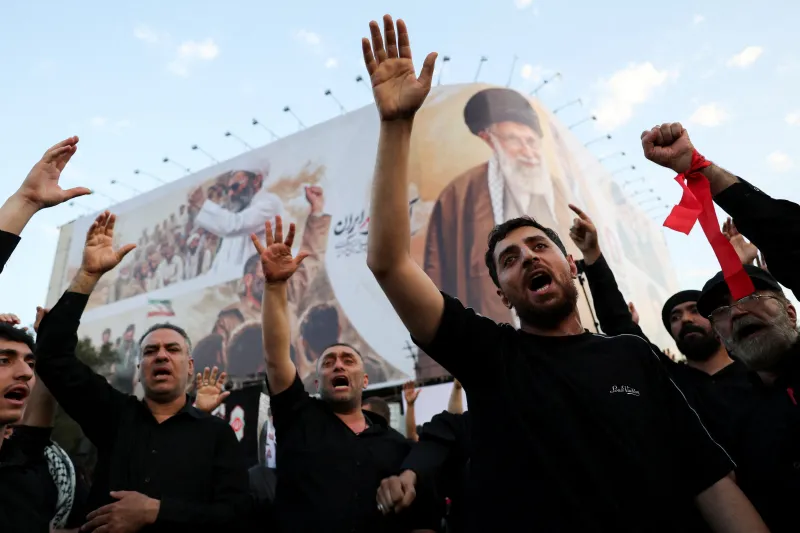
The same logic appeared in a far more consequential form before the US–Israeli war against Iran launched on Feb. 28, 2026. This time, expectations about political vulnerability influenced assessments not only of sanctions, but of what military force might accomplish.
The January 2026 uprising was critical in shaping the policy environment. Reuters reported on Jan. 29 that Trump was examining strikes against Iranian leaders and security forces partly to encourage protesters to return to the streets. Officials familiar with the discussions described possible attacks intended to create conditions for political change. US intelligence agreed that the unrest and underlying economic crisis had weakened the government but had not identified major fractures within the state apparatus.
Netanyahu made this case directly to Trump during an hour-long presentation in the White House Situation Room on Feb. 11. According to subsequent reporting by the New York Times, he portrayed Iran as ripe for regime change and argued that a joint military campaign could destroy its missile capabilities while limiting retaliation and keeping the Strait of Hormuz open. Israeli officials also suggested that Mossad could help instigate an uprising after the initial strikes. The presentation linked the prospect of political change to assurances that the military risks could be contained. Trump reportedly responded: “Sounds good to me.”
The presentation’s significance was that it linked Iran’s domestic weakness to estimates of the military costs of intervention. Political collapse was not simply an additional potential benefit of war; it offered an explanation for why the conflict might remain short and manageable. American intelligence officials were considerably more skeptical. The day after Netanyahu’s presentation, US officials reportedly challenged the most optimistic components of the Israeli scenario.
Yet Trump’s own assessment appears to have remained considerably more optimistic. When advisers raised the possibility that Iran could close the Strait of Hormuz, he reportedly dismissed the danger on the assumption that the government would capitulate before it came to that. When warned that a major campaign could significantly deplete US weapons stocks, including missile interceptors, Trump weighed that concern against the availability of large quantities of comparatively inexpensive precision-guided bombs.
This provides perhaps the clearest example of the third mechanism: expectations of political breakdown can lower the expected costs of coercion by supplying an anticipated endpoint. A war against a government expected to remain cohesive raises the possibility of sustained retaliation, disruption of the Strait of Hormuz, depletion of US munitions, repeated military operations, and a prolonged American commitment. Those same risks appear more manageable if policymakers believe the adversary will capitulate or unravel before they fully materialize. Expectations of Iranian fragility therefore did more than increase the possible benefits of military action; they discounted some of the costs that military and intelligence officials were explicitly warning about.
The possibility of political collapse remained part of the final decision process. Reuters later reported that, less than 48 hours before the attack, Netanyahu called Trump after receiving intelligence that Supreme Leader Ali Khamenei and other senior officials could be targeted together. Netanyahu argued that killing the leadership could bring Iranians back into the streets and create an opportunity for regime change. Sources familiar with the deliberations described the closing targeting opportunity and Netanyahu’s argument as catalysts in Trump’s final authorization of the operation.
Across these episodes, expectations of Iran’s political decline affected US foreign policy through a recurring logic. They reduced the value attached to diplomatic engagement because negotiations could strengthen or legitimize a government expected to weaken. They encouraged broader demands because policymakers believed greater leverage would become available with time. And they made coercion appear less costly because political breakdown offered an apparent endpoint to sanctions or military force.
Policy implications
The pattern documented above carries clear implications for US policy toward Iran. Expectations of approaching collapse have repeatedly distorted assessments of diplomacy, bargaining leverage, and the costs of coercion. A more durable strategy would pursue American interests without depending on a particular outcome in Iran’s domestic politics. Recommendations follow below.
First, Washington should stop treating the Islamic Republic as a temporary government whose approaching departure makes diplomacy unnecessary. Recognizing its persistence requires acknowledging that a government can face deep public dissatisfaction while retaining the institutions and coercive capacity needed to survive. Negotiations should therefore be judged by whether they advance US interests, rather than dismissed as a lifeline to a government presumed to be nearing its end.
Second, officials should treat predictions of collapse with greater skepticism, especially when those predictions support a preferred policy. The episodes examined here show how assessments of vulnerability can become expectations of imminent breakdown without sufficient evidence connecting the two. Economic distress, public anger, and military setbacks warrant close attention, but they do not establish that the state is losing its ability to govern or repress. Policy deliberations should give greater weight to evidence of elite cohesion, the loyalty of security forces, and the opposition’s organizational capacity.
Third, US demands should reflect what negotiations can realistically achieve. Expectations that Iran will become progressively weaker can encourage Washington to postpone compromise and expand its demands. But combining nuclear restrictions, missile limits, changes in regional policy, and an end to support for armed groups into a single bargain can make agreement politically impossible for Tehran. Washington should prioritize its objectives and pursue achievable agreements whose value does not depend on Iran’s eventual political transformation.
Finally, the United States should stop assuming that domestic unrest will make external pressure more effective. Protesters pursue their own goals, face severe risks, and cannot be expected to deliver the political outcome Washington seeks. Sanctions or military strikes may weaken particular state capabilities without strengthening an organized alternative; they may also disrupt mobilization or increase the influence of security institutions. US policy should assess what these measures can accomplish on their own, how Tehran might respond, and what costs would follow if the government endured. A strategy that depends on Iranians completing a transformation initiated by outside force leaves the strategy’s decisive step beyond Washington’s control.
Appendix: Iran Collapse Predictions Database
Scope and collection
The Iran Collapse Predictions Database, or ICPD, contains 381 public statements about the prospective collapse, overthrow, or political demise of the Islamic Republic, dated from 1980 through February 2026. Assembled by the author, it provides the material for Figures 1 and 2. The unit of observation is a recorded statement, rather than a unique person, publication, or crisis. Speakers may appear repeatedly, and several statements may originate from the same event; the observations are not necessarily independent.
The ICPD draws on English–language sources. Searches used Nexis Uni, Google, digitized newspaper archives (including, for example, those of the New York Times and Washington Post), and other publications’ online archives. Government records, congressional materials, think-tank publications, speeches, interviews, and archived web sources supplemented news coverage and commentary. Searches focused on statements anticipating the regime’s fall, overthrow, or approaching end, including formulations such as “days being numbered” or the “beginning of the end.” The collection was not drawn from a fixed panel of outlets with uniform archival coverage.
Definition and boundaries
A collapse prediction anticipates the fall or overthrow of the Islamic Republic, the replacement of its political order, or the end of clerical rule. The collection includes explicit deadlines, conditional forecasts, assertions of imminent breakdown, and open-ended claims of eventual demise. Statements that portray collapse as already beginning or identify a trajectory toward political disintegration are also represented. Their certainty and temporal precision vary.
The following examples show different forms of collapse predictions.
Dated political prediction:
John Bolton, July 1, 2017: “Before 2019, we here will celebrate in Tehran!” Delivered at an opposition gathering, the statement anticipates regime replacement by a specified date.
Collapse portrayed as underway:
Reza Pahlavi, June 17, 2025: “The Islamic Republic has reached its end and is in the process of collapsing.” The statement describes the breakdown as already occurring rather than specifying a future deadline.
Near-term prediction without a deadline:
Ted Cruz, remarks published Sept. 8, 2022: “I fully believe that soon this evil regime will collapse and be swept away.” The statement explicitly anticipates collapse in the near future but supplies no deadline. The delivery date is unconfirmed.
Recorded information and classifications
Records identify the speaker and role, statement date and date precision, source, claim, timing language, and stated reasoning. The presentation groups speakers as Iranian opposition in exile (138 statements), Western politicians and officials (106), scholars and think-tank analysts (72), journalists and commentators (55), and Middle East politicians and officials (10). Exile statements are subdivided into the National Council of Resistance of Iran/Mujahedin–e Khalq network (64), other exile opposition (40), and the monarchist/Pahlavi network (34). Classification follows the speaker rather than the venue: a Western politician at an opposition rally remains a Western politician.
Interpretation and limitations
The ICPD documents recurring expectations in the collected material, not an exhaustive or representative population of forecasts. It supplies no denominator of all Iran–related coverage and does not comprehensively sample survival or uncertainty assessments. Differences in media attention, English–language visibility, and archive availability warrant caution in interpreting annual counts as changes in frequency or prevalence. Inclusion does not establish sincerity, accuracy, independence, or policy influence; the article’s policy cases rely on separate evidence from official deliberations.