
Gold Repatriation Signals Eroding Trust
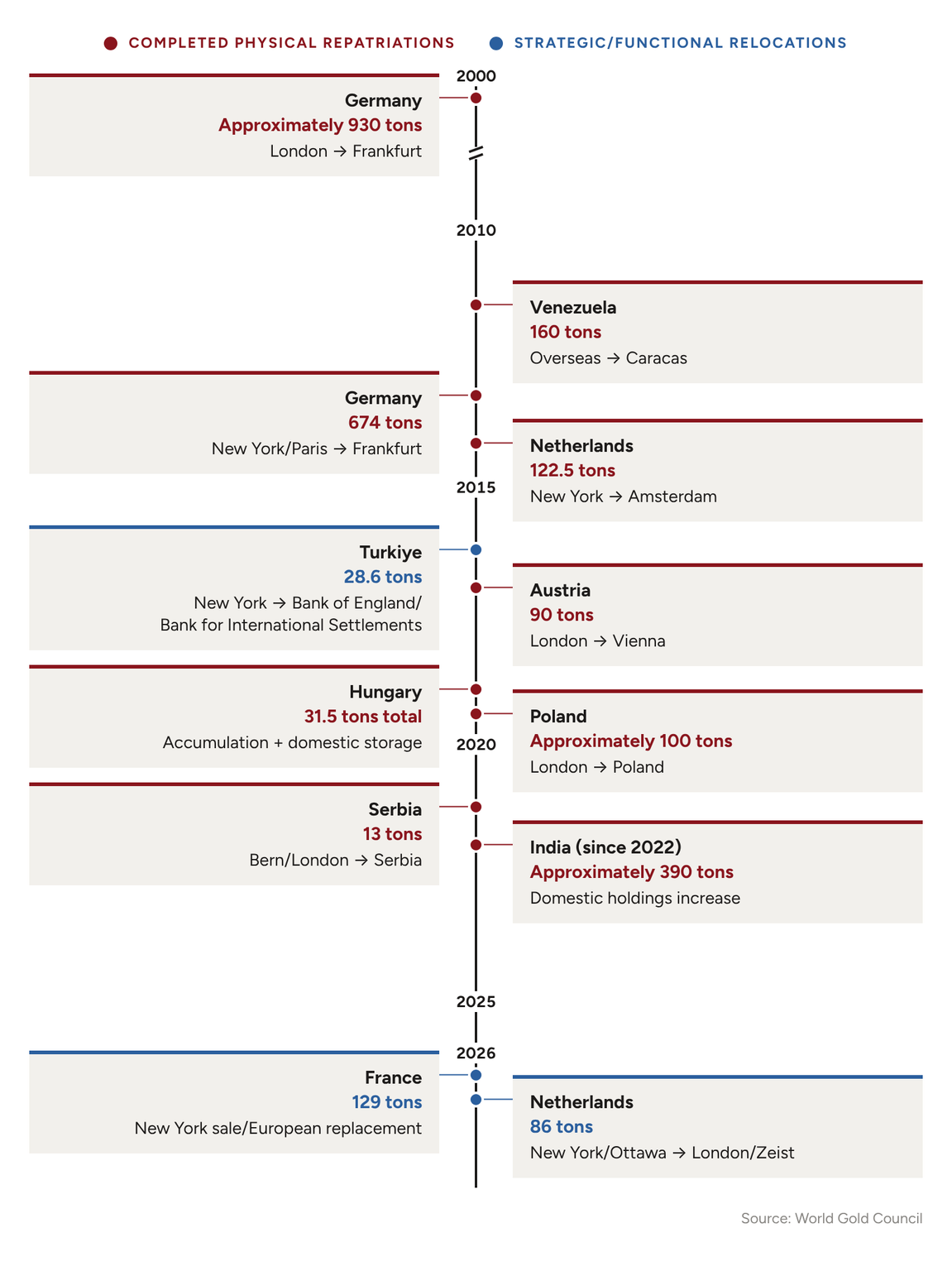
On September 2, 2026, the Dutch central bank (DNB) announced that between March and August it had relocated approximately 86 metric tons of gold from facilities in the United States and Canada to London and the Netherlands. The bank attributed this operation directly to rising geopolitical risks, emphasizing its commitment to strengthening crisis preparedness.
Improving the liquidity and tradability of its gold reserves formed part of those preparations, as did a more balanced distribution among North America, the United Kingdom and the Netherlands. Specifically, DNB sold around 59 tons held in New York and replaced them with equivalent gold in London. It also physically transferred more than 27 tons from the U.S. and Canada to its domestic Zeist facility.
As a result, London’s share of the Dutch gold reserves rose to 32 percent, surpassing the 31 percent held at home in Zeist. New York and Ottawa each account for 18.5 percent of the 612-ton total reserve.

Europe’s gold on the move
DNB Governor Olaf Sleijpen said that the bank did not expect to use the gold, but the move still drew attention, especially since it was not the first time a European nation had moved gold reserves out of the U.S. in recent years. Between July 2025 and January 2026, the Banque de France sold 129 tons of older, non-standard bars held at the Federal Reserve Bank of New York (about 5 percent of France’s total gold reserves) and purchased an equivalent amount of London Good Delivery bars for storage in Paris.
Officials described the decision as technical rather than political because many of the bars dated to the 1920s and no longer met the current purity and weight specifications used in international markets. However, the timing coincided with heightened transatlantic tensions under the second administration of U.S. President Donald Trump. Ongoing trade disputes and broader concerns about the reliability of U.S. custodianship after the 2022 freeze of Russian reserves also fueled speculation that the decision was not purely technical. Either way, France has removed the last of its gold from New York, and its entire 2,437-ton reserve is now held domestically.
Germany made similar moves earlier. Between 2013 and 2017, the Bundesbank repatriated 674 tons from New York and Paris, bringing roughly half of its reserves home to Frankfurt. Approximately 1,236 tons, or 37 percent of Germany’s total, remain at the New York Fed. In 2026, as trade tensions with the U.S. intensified, economists, taxpayer associations and politicians renewed calls to bring the rest home.
Former Bundesbank research head Emanuel Moench argued that storing such a large share in the U.S. had become risky and that greater strategic independence was warranted. However, Bundesbank officials have indicated that no new repatriation plan is under consideration. Italy faces similar domestic pressure, with about 43 percent of its reserves still stored in New York.
Why central banks are rethinking where they keep gold
These cases are part of a wider pattern evident in central-bank surveys and in individual countries’ actions. More institutions have increased domestic storage or diversified overseas locations in recent years. India has steadily repatriated gold from London. Serbia has concentrated its holdings at home. Austria previously rebalanced to hold half its gold domestically. Poland returned 100 tons from London in 2019 while expanding its overall reserves.
Several mutually reinforcing motivations lie behind these adjustments. Liquidity remains important, and London continues to offer the largest and most efficient physical gold market, which helps explain why the Dutch chose it over purely domestic repatriation.
Political considerations also matter, especially given the current geopolitical climate and the increasingly complex relations many countries have with the U.S. Demonstrating national control over a core reserve asset carries symbolic weight. Geographical diversification, meanwhile, is standard prudential practice.
class=”ds-markdown-paragraph”>最重要的是,2022年对俄罗斯资产的冻结表明,当地缘政治利益决定时,外国持有的储备可以被冻结,这一教训尚未被遗忘。制裁、贸易争端和地区冲突引入了关于可获得性和可靠性的新计算。荷兰的声明值得注意,因为主要的欧洲央行很少如此公开地援引地缘政治理由。
每一次在纽约持有量的减少,都是一个小小的信号,表明美国托管默认不再被视为无风险。当即便是亲密盟友也在调整其储存分布并以地缘政治风险为由时,这传达的信息是,盟国成员身份不再保证对机构延续性的无条件信任。
What Scenarios Lie Ahead
当然,这并不意味着美元储备地位即将崩溃或从国债的大规模撤离。然而,它确实强化了并行趋势——央行资产组合中黄金比例上升、持续的官方买入以及对非美元支付安排的试验——这些都表明各国正在认真考虑应急计划。
这些发展没有一项是不可逆的。长期的地缘政治稳定以及关于金融制裁的更明确规范可能会减缓或扭转这一趋势。央行仍然重视西方主要金融中心的流动性和安全性。与此同时,近期的决定却持续指向同一个方向。一旦机构展示出既有能力又有意愿为地缘政治危机制备而重新配置黄金,未来类似举措的政治门槛就会降低。德国在纽约的剩余持有量和意大利的巨大曝险是欧洲最具影响力的未解问题。
黄金历来具有地缘政治意义。在大国竞争重新出现并且金融基础设施被武器化的环境中,这种意义正在增加,这些举措的形象效应不容低估。比起长期内盟友结构和开放金融体系基本被视为理所当然的时期,现在更多国家优先考虑对其最终储备资产的实物控制。尽管迄今为止涉及的数量仍然有限,但其更广泛的战略逻辑具有更为深远的影响。

Gold Repatriation Accelerates Gradual Shift
Scenarios
Most likely: Continued gradual diversification away from New York
Gold’s share of official reserves will continue to rise, making the question of where it is held increasingly important. Additional European and Asian central banks will reduce concentration risk in New York and, to a lesser extent, London, citing tradability, preparedness and geographic balance.
London is likely to remain the preferred alternative for those who still seek high liquidity. Nations such as Germany and Italy could face recurring domestic pressure but are bound to move slowly, constrained by political considerations and the desire to avoid further friction with Washington.
Less likely: Acceleration triggered by a sanctions episode or access dispute
Another significant sanctions episode, a sharper deterioration in transatlantic relations or a high-profile dispute over access to foreign-held gold – such as the earlier dispute between Nicolas Maduro’s government in Venezuela and the Bank of England – could produce faster and more visible repatriations. The political cost of inaction would rise for governments that keep large shares abroad, and moves that currently take years could be compressed into months.
Least likely: Full restoration of the previous status quo
Restoring the earlier level of trust would require sustained geopolitical calm and a credible commitment that Western financial infrastructure will not be used against allies. That combination is difficult to envision today.
Paradoxically, one event could drastically increase the likelihood of this scenario. If a direct conflict between Russia and Europe broke out, central banks could move gold reserves off the continent, and the U.S. could once again be seen as the safest location to store them.