

Between 1941 and 1944, US real GDP rose 50 percent while real consumption rose only 3.2 percent. Military Spending enriched contractors and deferred debt through borrowing, but growth figures still mislead voters about household prosperity and the true cost of war.
Military Spending inflates GDP not welfare
Military expenditure can increase officially measured output and enrich selected groups while leaving regular households with fewer goods and greater financial obligations. For an economy sheltered from the fighting, the costs are less visible than ruined cities and lost lives. They appear mostly in forgone civilian production, taxes and debt. As governments weigh military commitments, growth figures alone are a poor indicator for whether their citizens are becoming more or less prosperous.
The United States provides an interesting historical case. Its wartime production record, the concentration of defense contracts and the history of public borrowing expose revealing patterns. Defense spending can be necessary to preserve freedom and security. That necessity does not, however, make warfare a source of wealth, even if some official data creates that illusion.
What the U.S. data shows
World War II produced an extraordinary expansion in recorded output. Between 1941 and 1944, U.S. real gross domestic product (GDP) increased by 50 percent. Yet real personal consumption rose by only 3.2 percent, while real private investment fell by 58 percent. Figures from the Bureau of Economic Analysis show how differently the wartime economy looked from the perspective of civilian spending.
Figure 1: Wartime output and civilian spending
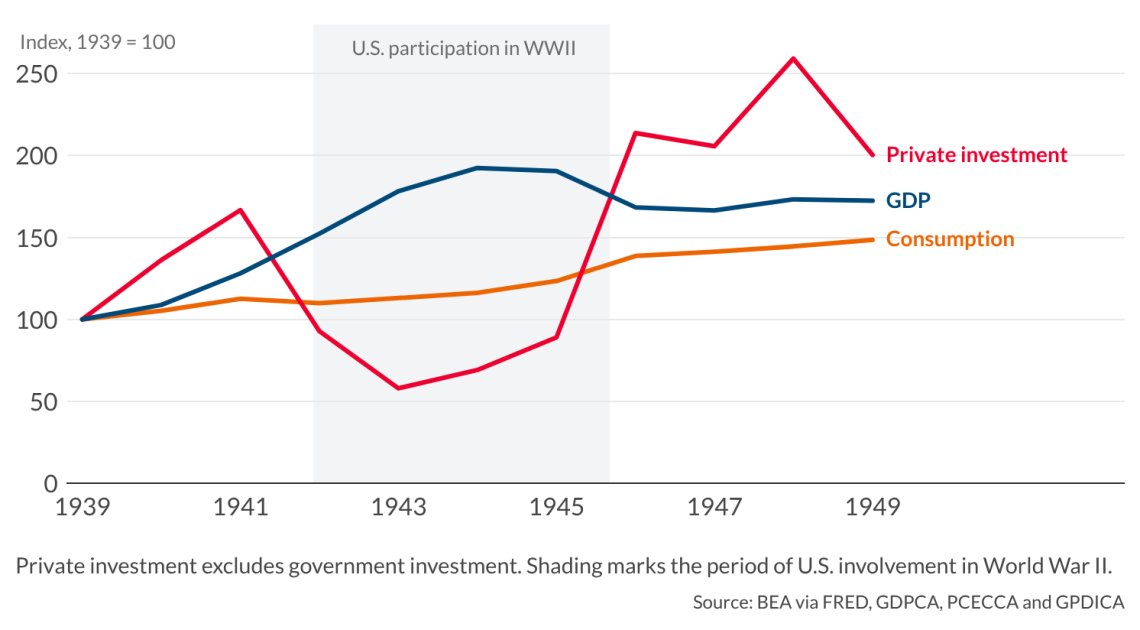
Demobilization and the cessation of hostilities reversed the pattern. In 1946, real GDP contracted, but consumption increased significantly and private investment more than doubled. The fall in aggregate output accompanied an expansion in civilian spending. These comparisons do not establish what would have happened without war, but they show why GDP and household prosperity must be distinguished. GDP figures alone would suggest that the U.S. fell into a deep recession with the end of the war (a 12 percent real GDP contraction in 1946) – much more severe than the financial crisis of 2009 (a 2.6 percent decline) or the Covid-19 pandemic of 2020 (a 2.1 percent fall).
But a look at private consumption reveals exactly the opposite. Private households in the U.S. enjoyed a significant boost of 12 percent to their real consumption in 1946. In contrast, during the financial crisis and the Covid pandemic, private consumption fell by 1.3 and 2.5 percent, respectively. Hence, GDP figures can be very misleading as a measure of overall economic wellbeing in times of war or crises.
Concentrated contracts distort political incentives
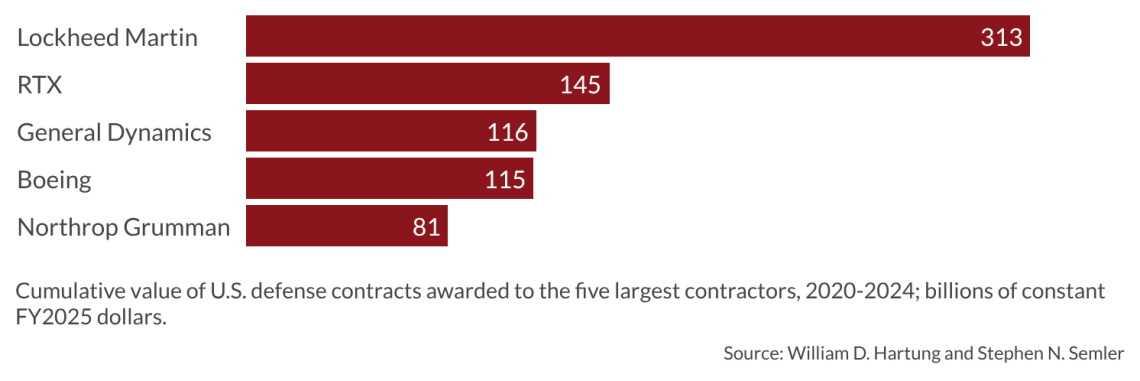
Military expenditure does create substantial business opportunities. A compilation by William Hartung and Stephen Semler finds that five firms received approximately $771 billion in Pentagon contracts during fiscal years 2020-2024. That was roughly a third of all Pentagon contracts. The figures measure awards, not profits, and include activities beyond active wars. They nevertheless show the scale and concentration of commercial interests in defense spending.
Figure 2: The largest Pentagon contractors
The fiscal legacy is equally striking. American federal debt held by the public increased from about 44 percent of GDP in 1939 to 106 percent in 1946. In 2025 it stood at approximately 98 percent, approaching the World War II peak despite a very different economic and military setting.
Figure 3: U.S. federal debt held by the public, 1939-2025
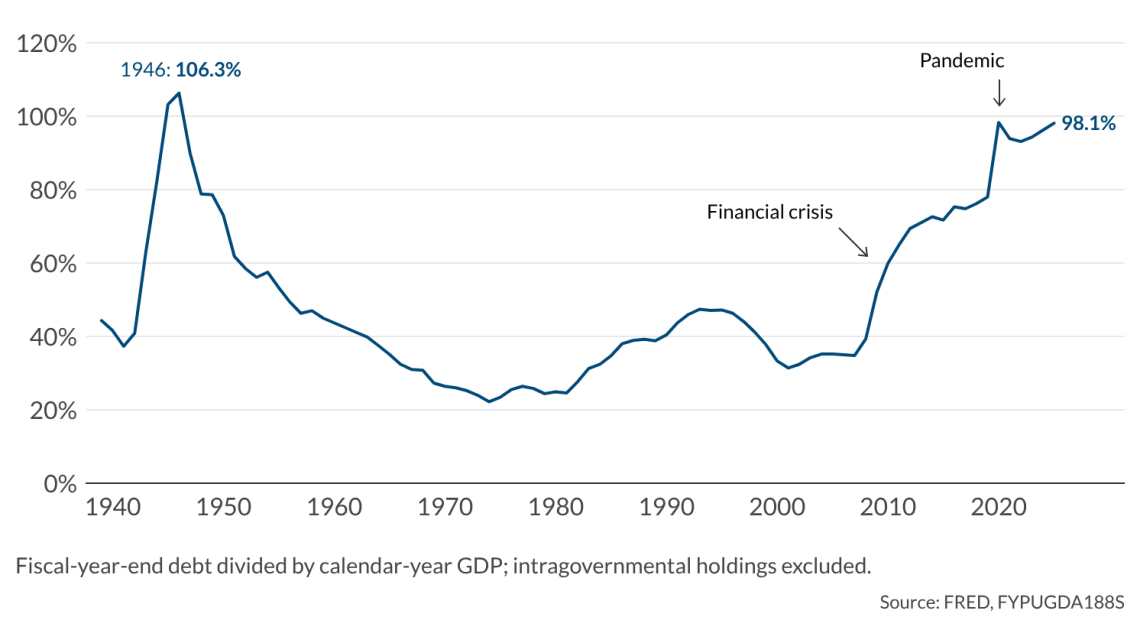
War cannot explain the entire trajectory. The debt-to-GDP ratio fell through the Korean War and much of the Vietnam War period; later increases also reflect civilian commitments, recessions and the pandemic. However, the comparison highlights the constraints that existing debt places on the ability to finance another major emergency.
Why military production can mislead
Economic historian Robert Higgs challenged the notion of wartime prosperity in his research on the American economy of the 1940s. His central insight was that mobilizing resources for military purposes does not establish an improvement in civilian welfare. Conscription and restrictions on consumption further weaken the usefulness of conventional economic indicators. Dr. Higgs also questioned wartime price measures: Rationing, shortages and quality changes made official inflation measures an unreliable guide to what households could afford.
GDP tracks production rather than welfare. Government purchases of newly produced goods and services enter the accounts, and much nonmarket government output is valued by its production costs. Building a missile therefore contributes to GDP even when households must forgo other goods to finance it. Simply spending more does not guarantee an equal increase in real output: Capacity constraints, imports and displaced private activity matter.
The relevant question is what scarce resources could otherwise have been produced. Engineers, machinery and energy devoted to military orders are unavailable for competing uses. During a slump, mobilization may employ idle resources and increase total output. Even then, the measured increase in GDP does not demonstrate that military production was the best available use of those resources. Potential security benefits must be assessed alongside their opportunity costs.
The slippery political slope of military spending
The distribution of benefits from military spending creates a political problem. A contractor expecting another order has a strong incentive to defend the relevant program. Each taxpayer bears only a small fraction of its expense and has less reason to investigate it. Employment tied to military production can also give elected representatives an incentive to preserve spending. Such concentrated benefits and dispersed costs can sustain commitments even after their strategic justification from a foreign-policy perspective has weakened.
Moral hazard arises where insulation from the consequences encourages greater risk-taking. It is a potential feature of military policy when those influencing decisions capture benefits while taxpayers, soldiers and civilians in other countries bear much of the downside. The concentration of contracts does not imply that commercial pressure caused any particular war, but it does confirm that strong business interests in prolonged military spending exist.
Military Spending cannot buy prosperity
Borrowing can weaken the immediate political constraint by deferring taxation. The resources are used now, while debt servicing places the burden on future budgets and taxpayers. Inflationary financing can impose an additional loss of purchasing power. Likewise, rising stock prices of companies in the military-industrial complex represent real gains for their owners without necessarily being a benefit for society as a whole. The illusion lies in treating those gains − higher GDP and stock indices − as evidence that the general public has become richer.
Scenarios
Democratic accountability is a crucial factor in each of the following scenarios. To make informed decisions, voters need clear information about military objectives, financing and alternatives, and must judge parties by their conduct in office. Treating defense orders or rising GDP as proof of prosperity makes that scrutiny harder.
Most likely: U.S. maintains military commitments while avoiding wider direct war
The U.S. maintains extensive military commitments while avoiding a much wider direct war. Political support for procurement remains strong because strategic concerns overlap with commercial and employment interests. Some defense industries expand, but households see no comparable improvement in living standards.
Borrowing accommodates spending pressures alongside existing civilian obligations. Debt remains elevated, limiting the government’s ability to react to future shocks. Moderately higher inflation seems to be the likely path of least resistance. The probability of this scenario is 60 percent.
Less likely: Restraint becomes an electoral priority
Voters increasingly connect overseas commitments with painful domestic tradeoffs and reward political programs that commit to reducing military spending. Persistent cost-of-living pressures or disputes over taxes, affordability and the quality of public services could sharpen that demand, even when military spending is only one of various contributors to rising costs.
Diplomacy and a narrower definition of essential commitments support lower expenditure. Procurement reform reduces opportunities for politically protected contracts. The transition to restraint brings losses to some suppliers and communities, and measured GDP may initially weaken. Over time, however, lower financing requirements and the release of resources create scope for civilian investment.
While U.S. voters have regularly supported candidates campaigning for a more restrained foreign policy, the likelihood of fiscal restraint emerging is low, because campaign promises alone are not sufficient. The probability of this scenario is 25 percent.
Least likely: Wider conflict accelerates fiscal expansion
Escalation draws the U.S. into substantially larger military operations or a prolonged expansion in support of allies. Emergency procurement rises before policymakers agree on matching taxes or spending cuts. Debt increases, while shortages and disrupted trade raise production costs.
Military output may lift GDP in some sectors even as civilian consumption and investment weaken. Higher inflation becomes entrenched as demand outpaces supply and monetary policy accommodates the fiscal expansion. The economic burden extends well beyond the countries experiencing direct destruction. The probability of this scenario is 15 percent.