
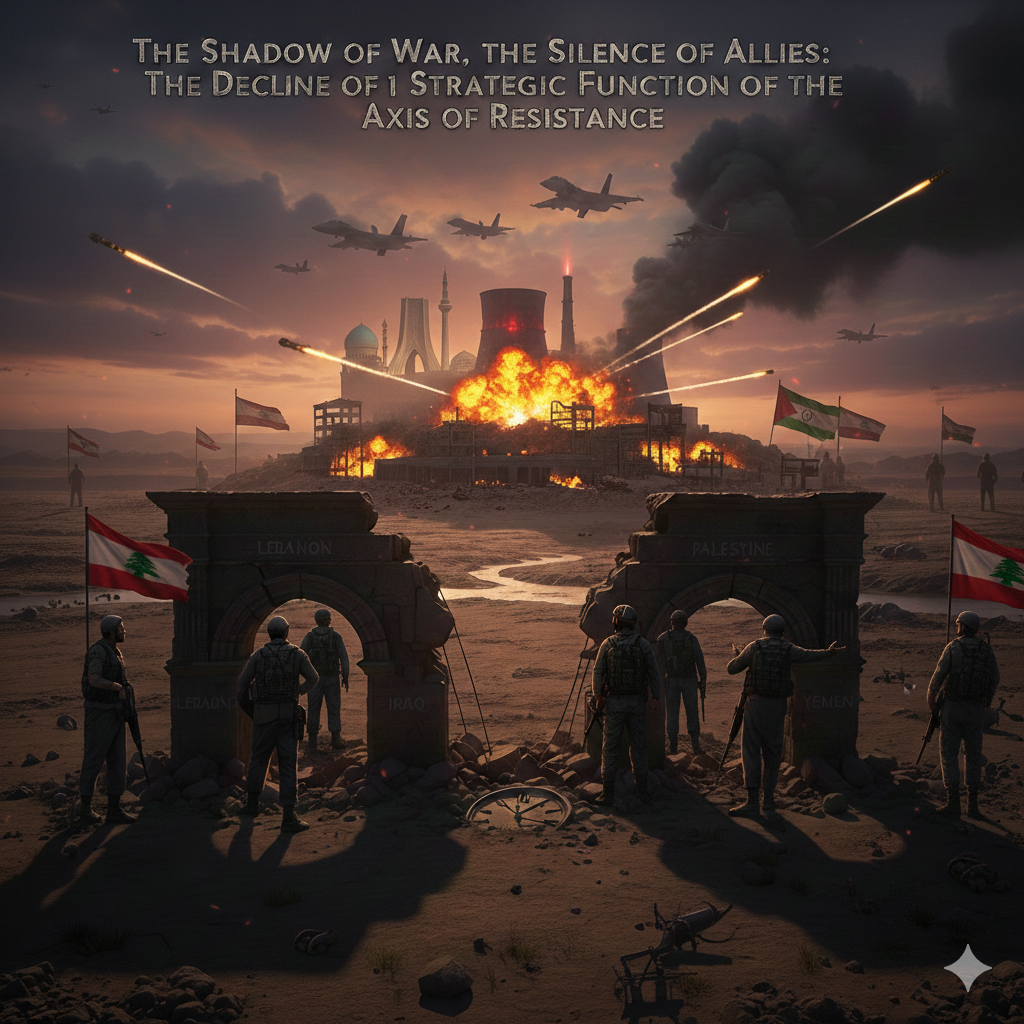
Since October 2023, Israel’s blows and Assad’s fall shattered the Axis of Resistance’s cohesion. Members now prioritize survival over collective defense. Iran’s networked deterrence can impose costs but cannot alter strategic outcomes—shifting the region to ambiguity and attrition.
Mero: Developments in West Asia from 7 October 2023 to February 2026 may be analyzed as a transition from a framework of asymmetric deterrence to a phase of strategic ambiguity and the gradual erosion of the Islamic Republic of Iran’s networked power. What took shape over four decades under the designation of the “Axis of Resistance” was, in effect, an informal security architecture that, by relying on aligned actors in Lebanon, Palestine, Iraq, Syria, and Yemen, sought to significantly raise the cost of any direct attack on Iran. This strategy—referred to in Tehran’s official discourse as “forward defense”—was premised on the principle of transferring the battlefield beyond national borders; in other words, any threat against Iran would simultaneously activate multiple fronts against the adversary.
From “Al-Aqsa Storm” to a Shift in the Balance
The operation carried out by Hamas on 7 October 2023, known as “Al-Aqsa Storm,” was tactically surprising and sophisticated. Nevertheless, its strategic consequences for Iran’s network of allies unfolded contrary to expectations. Israel regarded the event as an opportunity to redefine the rules of engagement and expanded the scope of its response in a manner that targeted not only Gaza but the entire architecture of the Axis.
Successive blows to Hezbollah in Lebanon, the assassination of field commanders, and complex intelligence operations revealed deep Israeli security penetration within the layers of this network. In this context, the elimination of figures such as Ismail Haniyeh and subsequently Sayyed Hassan Nasrallah was not merely the removal of individuals; it represented a weakening of the Axis’s symbolic capital and psychological cohesion. Such developments conveyed a clear message: Iran’s networked deterrence was no longer immune to infiltration and preemptive strikes.
If Israel’s blows shook the operational pillars of the Axis, developments in Syria destabilized its logistical foundation. The fall of Bashar al-Assad’s government in December 2024 signified the rupture of Iran’s land corridor to the Mediterranean—a route of vital importance for transferring equipment to Hezbollah. Syria constituted not only strategic depth but also the geographic linchpin of the Axis. The removal of this link transformed the network from a relatively contiguous structure into a collection of dispersed actors.
The “12-Day War” and the Test of Deterrent Insurance
In June 2025, the joint Israeli and American strikes on Iran’s nuclear facilities in Natanz, Fordow, Isfahan, and Arak—what the media termed the “12-Day War”—marked the culmination of this trajectory. According to analysts, the direct entry of the United States into the battlefield and the bombardment of Iran’s nuclear facilities constituted a turning point in the level of tension between Tehran and Washington, demonstrating that the conflict had moved beyond the realm of shadow warfare.
The decisive point was the limited and fragmented response of the members of the Axis of Resistance during this period. While the original logic of this network rested on the simultaneous activation of fronts in support of Iran, no such comprehensive mobilization materialized in practice. This relative silence, more than anything else, reflected a shift in the cost–benefit calculations of the proxy actors—actors who had before them the experience of the extensive destruction of 2023 and 2024.
Now, with U.S. aircraft carriers deployed in the region and the dual proposition of “agreement or war” on the table, the central question concerns the Axis’s practical capacity to serve as a defensive shield. A realistic assessment suggests that this network still retains the ability to impose costs: Hezbollah can unsettle Israel’s northern front, the Houthis possess the capacity to disrupt shipping in the Red Sea, and Iraqi groups are capable of limited attacks against U.S. bases. The fundamental difference, however, lies in the fact that such actions generate attritional deterrence rather than decisive deterrence against a large-scale military campaign.
In other words, the Axis of Resistance today can generate costs, but it is unable to alter the strategic outcome. This distinction creates a profound gap between the “capacity to disrupt” and the “capacity to rescue.”
Three Scenarios and the Future of the Regional Order
Three plausible scenarios lie ahead—an American attack, a stricter agreement than the JCPOA, or the continuation of a “no war, no peace” situation. Each carries distinct consequences; yet in all three, a constant variable is evident: the diminished effectiveness of the network that was once regarded as Iran’s national security insurance. If a direct war were to occur, dispersed asymmetric responses would be likely, but they appear unlikely to reverse the balance. In the event of a stringent agreement, Tehran would probably curtail the scope of its operational support for its allies in order to reduce pressure. In the third—and seemingly more probable—scenario, conditions would drift into a state of inertia; a situation in which the Axis neither collapses nor returns to its former function.
In conclusion, it should be noted that the developments of the past two and a half years signify less the destruction of the Axis of Resistance than its transition from a phase of ideological cohesion and confidence in collective efficacy to a phase of caution, dispersion, and calculated pragmatism. Whereas the prevailing belief in the past was that “the whole is stronger than the sum of its parts,” each component is now increasingly focused on survival and the management of its own costs. Accordingly, West Asia has entered a period in which deterrence rests not on certainty but on ambiguity and mutual attrition—a period that began on 7 October 2023 and whose endpoint remains uncertain.