
The US-Iran memorandum of understanding halts active warfare but ignores critical security threats, including Iran’s missile proliferation and proxy networks. Arab nations now face an unravelling containment structure, potential US troop withdrawals, and a contested Strait of Hormuz.
The sudden diplomatic breakthrough between Washington and Tehran has caught the region off guard. While the Arab Gulf states officially endorse the new interim truce to prevent outright military conflict, deep anxieties persist below the surface. This deal pauses immediate hostilities but leaves long-term regional stability entirely unprotected, forcing the Arab Gulf states to prepare for an emboldened Iran.
Arab Gulf states face risk
The Arab Gulf states are publicly supporting the US–Iran MoU to avoid further hostilities. However, the associated concessions from the US in the MoU come with numerous security concerns for the region.
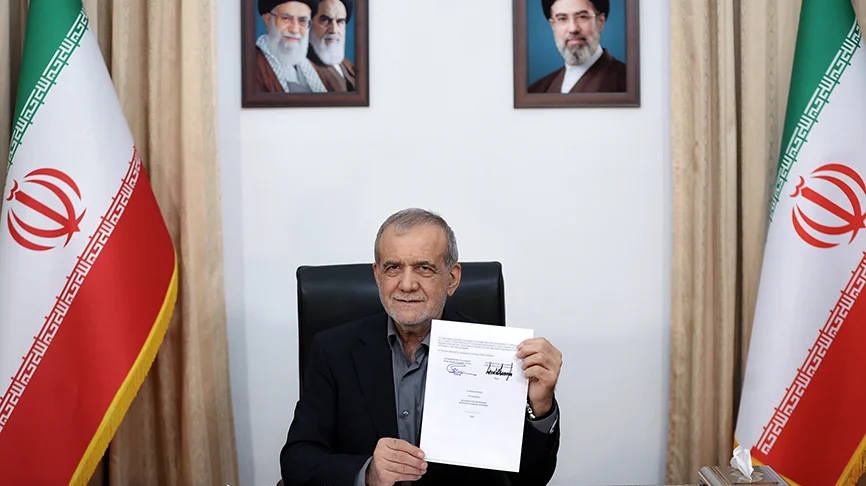
On 17 June 2026, United States President Donald Trump and Iranian President Masoud Pezeshkian remotely signed the Islamabad Memorandum of Understanding Between the United States of America and the Islamic Republic of Iran, or US–Iran MoU for short. The interim agreement is intended to formalise the ceasefire between Iran and the US and restore shipping through the Strait of Hormuz. It also sets out an extendable 60-day negotiating period for a final deal on the future of Iran’s nuclear programme. To incentivise Iran to comply, the US has committed to a range of economic and security concessions that, if a final deal is reached, would put an end to the American decades-long containment policy toward Iran.
The Iran war has left the Arab Gulf states in the unenviable position of having to facilitate diplomacy and support a flawed deal that fails to address their main concerns and risks empowering their adversary, Iran, to prevent a worse outcome: a return to hostilities. With the world eager to restore normality in the Strait of Hormuz to head off a global energy and food crisis, the scope for challenging the Iran–US agreement, however flawed, is limited.
Even the United Arab Emirates, which initially favoured a military approach to addressing the threat posed by Iran, has since rallied, along with the rest of the Arab Gulf states, behind the ceasefire agreement. The damaging economic impact of the war, the loss of confidence in the US and the absence of a unified position among their ranks have left the Arab Gulf states with virtually no other choice but to support the agreement to meet their immediate economic and security needs, no matter the long-term cost.
How Arab Gulf states respond
Errors of omission
From the Arab Gulf states’ perspective, the US–Iran MoU repeats the shortfalls of the 2015 Joint Comprehensive Plan of Action (JCPOA) by failing to address their core security concerns. The agreement makes no mention of Iran’s ballistic missiles or uninhabited aerial vehicle (UAV) programmes, despite its firing of thousands of projectiles at Arab Gulf states during the war.
Although Trump had pledged to ‘destroy [Iran’s] missiles and raze their missile industry to the ground’ at the start of the war in February 2026, he has since shifted positions by arguing that it would be ‘unfair’ for Iran not to have missiles so long as other countries in the region did. Having failed to force the capitulation of the Iranian regime through military and economic pressure, Trump’s change of heart may reflect the fact that the US no longer enjoys the leverage, or the international support, that it had over Iran before the war.
The agreement also overlooks Iran’s support for non-state armed groups (NSAGs) in the region, including Hizbullah in Lebanon, the Ansarullah (Houthis) in Yemen or the Popular Mobilization Units in Iraq. Iran-backed militias have turned Iraq into a launchpad for strikes against Bahrain, Kuwait, Saudi Arabia and the UAE, prompting limited retaliation by Saudi Arabia and possibly Kuwait.
In fact, the agreement appears to provide protection to Iran’s armed NSAGs, which at Iran’s insistence are covered by the ceasefire agreement, from further attacks by Israel or the Arab Gulf states. Israel has significantly degraded Hamas and Hizbullah and assassinated top Houthi civilian and military leaders since the Hamas-led 7 October 2023 attacks, inflicting considerable damage to Iran’s regional network, albeit at an immense humanitarian cost to the populations of Gaza and Lebanon.
Pressure on Arab Gulf states
The US–Iran MoU is ambiguous about the future governance of the Strait of Hormuz, leaving it to Iran, Oman and the rest of the Arab Gulf states to work out an arrangement. The agreement specifies that Iran is to facilitate the passage of commercial vessels through the strait ‘with no charge’ for a 60-day period only, leaving open the question of collecting tolls or fees once the 60-day period is over. Iran’s parliament speaker and chief negotiator, Mohammad Bagher Ghalibaf, has sought to resolve the ambiguity in Iran’s favour by stating that the strait ‘will never return to its pre-war conditions and will be administered’ by Iran.
In a joint statement, Iran and Oman committed to reaching an agreement on ‘the future administration of navigation in the Strait of Hormuz and the services that will be provided in this regard and the costs associated with them’, confirming suspicions that Iran intends to enforce a de facto tolling mechanism in the strait under the thin pretext of charging fees.
In response, Trump has stated on Truth Social that no tolls will be charged during or after the 60-day period, except possibly by the US ‘for services rendered’ protecting the countries of the region. US Secretary of State Marco Rubio’s recent assurances that Iran will not be allowed to collect fees may not be fully reassuring, given the United States’ inconsistent messaging and his marginal role within the Trump administration in overseeing US negotiations with Iran.
The Arab Gulf states, barring Oman, have resisted Iran’s attempts to formalise its control over or charge fees for transit through the Strait of Hormuz. In May, the Arab Gulf states instructed ships not to engage with the Persian Gulf Strait Authority, a body set up by Iran to coordinate transit, or use the shipping route indicated by Iran, which cuts through its territorial waters. During a Gulf Cooperation Council (GCC) consultative meeting held in Jeddah in April, leaders of the GCC states – except Oman, which skipped the meeting – expressed their ‘categorical rejection of […] the imposition of fees under any circumstance’. Qatar has since softened its stance, however, arguing that charging temporary fees for mine clearance was ‘negotiable’.
Arab Gulf states navigate concessions
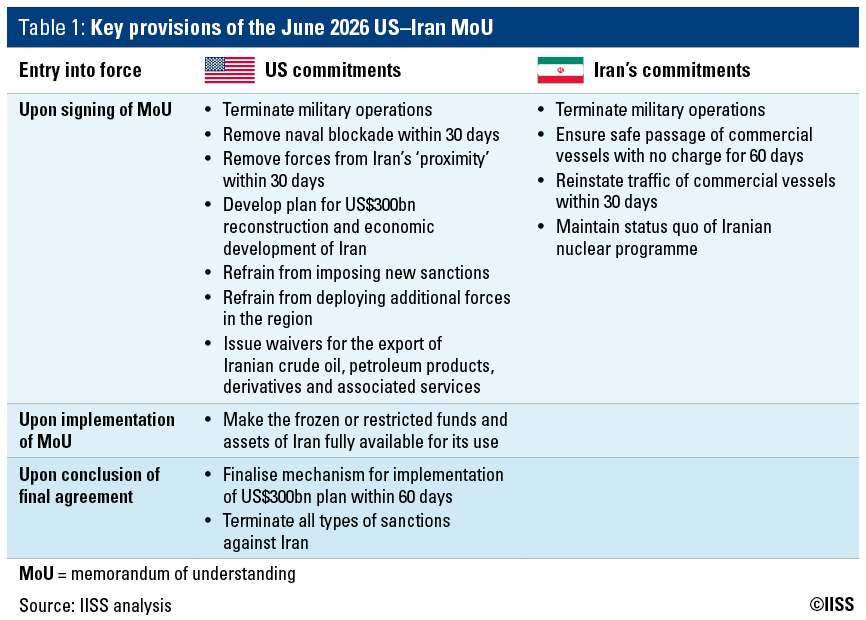
In return for the cessation of hostilities and resumption of shipping through the Strait of Hormuz, the US makes a range of financial and security concessions to Iran that enter into force during the initial 60-day period following the signing of the US–Iran MoU.
During this period, Iran could gain access to an estimated US$20 billion in hard currency, including US$12bn in unfrozen Iranian funds and US$8bn in oil and petrochemical-export revenues, assuming a return to pre-war export levels. The Islamic Revolutionary Guard Corps, which controls large segments of the Iranian economy, including the oil and petrochemicals industry, is poised to benefit. Tehran is likely to channel at least a portion of these resources toward rebuilding its military capabilities and supporting its regional network of NSAGs as a matter of priority.
The US has also committed to withdrawing its forces from Iran’s ‘proximity’, likely referring to its blockading naval forces but also potentially to military bases and facilities located in the Arab Gulf states. Ejecting the US military presence from the Gulf region has long been a strategic objective of Iran, one reiterated by its new supreme leader, Ayatollah Mojtaba Khamenei, during a holiday marking the expulsion of Portuguese forces from Hormuz during the seventeenth century. US disengagement from the region would run counter to the decades-old policy of the Arab Gulf states of hosting foreign forces as a means of deterring threats and would leave them exposed, at least in the short run, against their aggressive neighbour, Iran.
Pending a final deal that sets limits to the Iranian nuclear programme, the agreement also commits the US to implementing plans for a US$300bn reconstruction and development programme for Iran, one that US Vice President JD Vance has claimed the Arab Gulf states would fund.
The commitment marks a significant departure from the Trump administration’s signalling in early June that it was considering the use of Iran’s frozen funds to support the repair of damages inflicted by thousands of Iranian missile and UAV strikes on the Arab Gulf states. US Senator Lindsey Graham, a close Republican Party ally of Trump, had initially compared the idea of the US$300bn fund, first leaked by Iran, to ‘a Marshall Plan for Germany with the Nazis still in charge’.
While Saudi Arabia’s foreign minister, Prince Faisal bin Farhan Al Saud, has brushed aside the notion of financing Iran’s reconstruction, citing a lack of trust and the kingdom’s own development plans, Qatar has expressed greater openness to the possibility of using investments to incentivise more peaceful conduct by Iran.
What Arab Gulf states inherit
Unwinding US containment
If Tehran and Washington see the nuclear negotiations through, Iran stands a chance to emerge fully unshackled from US and international sanctions. Unlike the JCPOA, the US–Iran MoU commits the US to lifting not only nuclear-related sanctions but ‘all types of sanctions’ previously imposed on Iran, presumably including those related to its sponsorship of terrorism, human-rights abuses and ballistic-missiles programme. Yet, it is unclear whether the US will be able to persuade or compel Europe to lift European Union or United Nations sanctions.
France has stated that it would seek ‘major concessions’ and ‘a radical change in posture’ from Iran before it approved the lifting of UN sanctions, describing Iran’s missiles programme and support for regional NSAGs as destabilising. Assuming the Europeans play along, however, a comprehensive lifting of sanctions would spell the end of the US containment policy toward Iran, in place since the 1979 Iranian Revolution, allowing Iran to reintegrate into the global economy and eventually emerge as a stronger regional power.
The end of US containment of Iran would mark a fundamental shift in the regional-security equation with far-reaching consequences for the Arab Gulf states. Despite Rubio’s assurances to the contrary, the Arab Gulf states lack influence over the final outcome of an Iran–US deal. Having survived the combined American and Israeli onslaught, prompted the withdrawal of US forces from its vicinity and extracted a wide range of concessions, Iran will be emboldened by its strategic victory over the US. The reintegration of the Iranian economy into the global system will eventually result in the flow of massive economic resources to a regime demonstrably hostile to its neighbours in the Gulf.
The durability of the Iran–US ceasefire and the successful conclusion of a final nuclear deal are not beyond doubt, however. The deal’s success depends on the behavior of several actors, including Israel, Hizbullah and the Arab Gulf states that are not party to it.
The US implementing its commitments, notably the removal of sanctions and passing of a binding UN Security Council (UNSC) resolution, will also depend on the assent of Congress and other veto-wielding members of the UNSC. The Trump administration’s mercurial conduct and Iran’s delay tactics will remain an obstacle to the building of trust between the two sides. Seeking re-election in October, moreover, Israeli Prime Minister Benjamin Netanyahu’s government may reignite the war with Hizbullah, given its overwhelming popularity among Israel’s Jewish population, forcing Iran to respond.
Conclusion
Stuck between a bad and worse outcome, the Arab Gulf states have opted to support the US–Iran MoU in the hope of avoiding being caught in the crossfire of another regional conflict. Despite the Arab Gulf states’ vested interest in Iran–US negotiations, however, US unreliability, divisions among their ranks, their economic and security vulnerabilities and their aversion to war place them at a disadvantage, with insufficient leverage to shape the final outcome of these negotiations and the regional-security order that emerges from it.