
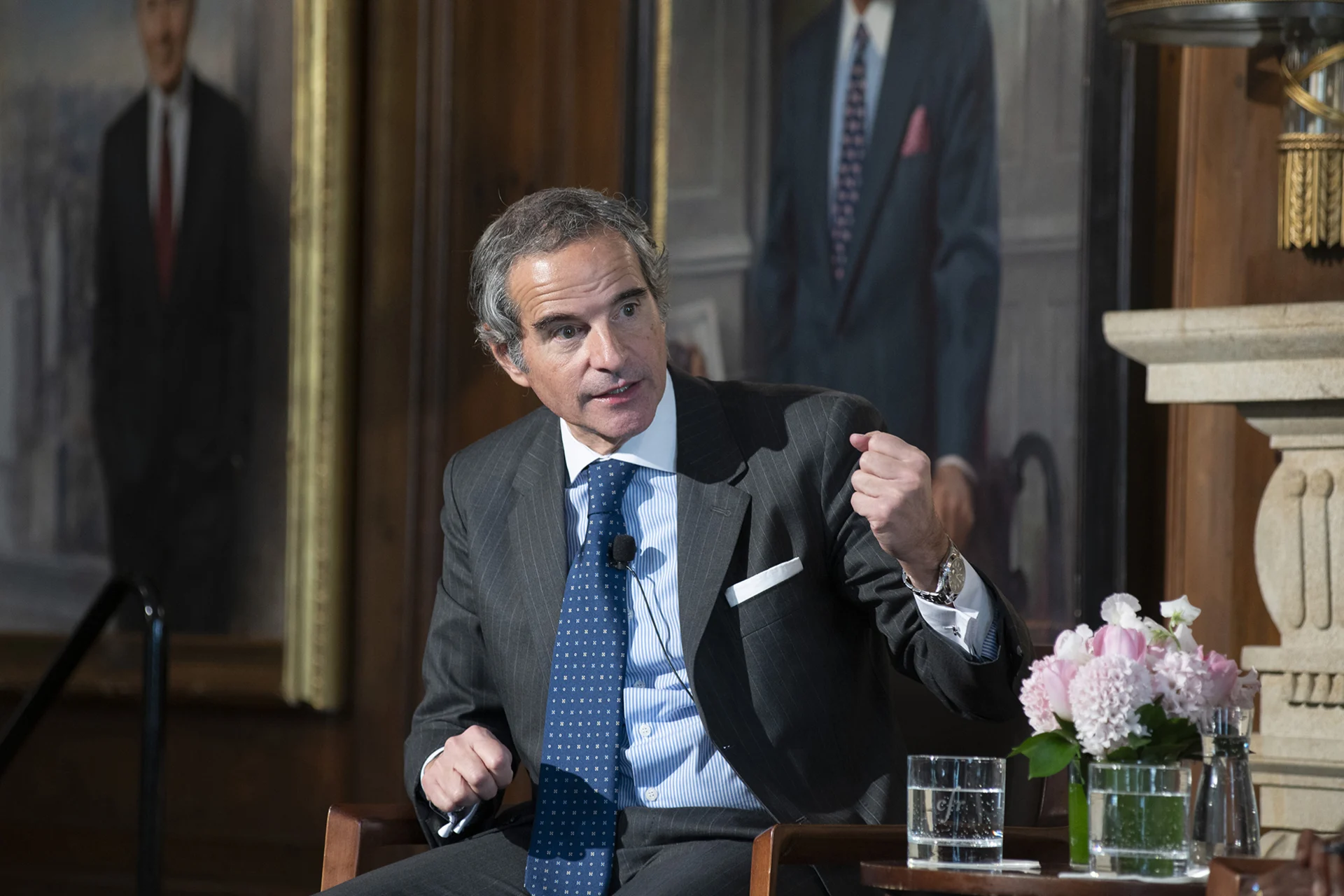
Grossi’s UN leadership pitch: restore trust through initiative, not waiting for mandates. His Zaporizhzhia model—identifying impermissible actions rather than territorial lines—could navigate P5 gridlock. The secretary-general has “authority,” not power. Funding crisis solvable through dialogue with big powers.
secretary-general of the United Nations will need to lead at a time of crises in all three pillars of the institution: peace and security, development, and human rights. Candidate Rafael Grossi tells CFR why he is suited for this moment.
The United Nations needs to be reorganized and revitalized while it confronts mounting challenges to its core mission. These include the conflicts in Iran and Ukraine, the sharp drop in development assistance from wealthy nations, and an authoritarian rollback of human rights gained over decades. The person charged with leading the revival will be the next secretary-general, due to be selected this fall by the UN General Assembly, with the assent of the UN Security Council. The candidate must have the approval, or at least the acquiescence, of all five permanent Security Council members.
The Council on Foreign Relations has launched its UN Secretary-General Candidates Series by hosting an on-the-record conversation with one of the four nominated candidates, Rafael Grossi, who currently heads the International Atomic Energy Agency (IAEA). Here are the main takeaways from his April 23 conversation at CFR.
The United Nations needs an effective crisis manager. Grossi said his experiences at the IAEA have prepared him well for the secretary-general role, particularly in handling complex emergencies. He cited his experience leading IAEA teams in the field. He described leading the IAEA team that went to the Zaporizhzhia Nuclear Power Plant to prevent a nuclear accident during repairs to the damaged facility. He went to occupied Ukraine and negotiated with Russian and Ukrainian leaders, even though both sides were skeptical of the need for an impartial party. He noted that he has been to Ukraine several times since Russia’s full-scale invasion in 2022, crossing the front lines under fire. The IAEA was the first international organization to operate in occupied Ukrainian territory during that war.
Grossi described how he adjusted his negotiating strategy at Zaporizhzhia from delineating territory to identifying impermissible actions. The negotiations were able to advance, he said, by clarifying what the parties could not do: don’t shoot at a nuclear power plant, and don’t militarize a nuclear power plant. He would aim to be a pragmatic negotiator drawing from a bag of diplomatic tools. He stressed the need to consult and explain—but never to surprise—his interlocutors.
Skillful engagement with the Security Council is essential. Drawing on his on-the-ground experience, Grossi said that if he were secretary-general, he would not wait for the member states to task him; he would take the initiative to help forestall conflict. He also stressed that the secretary-general ought to be constantly engaged with the Security Council—the UN’s most powerful body—even in the face of pushbacks and contradictions. He lamented the loss of consensus among the five permanent veto-wielding members of the Security Council (P5) on the fundamental importance of nonproliferation. A decade ago, the P5 could agree on the need to constrain North Korea’s nuclear program. In that era, the Security Council could adopt such a resolution by consensus. Now, even if they could reach an agreement the process would be more “transactional,” he said. Members would be voting case-by-case rather than reaffirming a shared principle. But he said the council still shows some ability to act on major peace initiatives; he noted that China and Russia abstained from voting on Security Council Resolution 2803, which endorsed a peace plan for Gaza, allowing it to be adopted.
This is a high-stakes moment for the United Nations. In this time of turbulence, Grossi thinks the tenure of the next secretary-general could be as consequential as the first. Member states and their publics have lost faith in the organization. An active secretary-general would restore trust in the institutions. In Grossi’s view, the secretary-general does not have “power;” the secretary-general has “authority.” He has met with Russian President Vladimir Putin and Foreign Minister Sergey Lavrov in Moscow and with Chinese Foreign Minister Wang Yi in Beijing. He thinks these countries will not reject outright a proactive UN secretary-general who exerts authority. Summing up his approach, he asserted, “I’m a realist in every sense of the word.” He observed that the secretary-general’s role is “service to peace,” but it is thankless and lonely.
Grossi is confident that the UN’s funding crisis can be ended by a good interlocutor having dialogues with the big powers and restoring their trust and confidence. He noted that the United Nations is also good for the United States.
Finally, when asked about the functional agencies within the United Nations system, he noted that international organizations that solve common issues and have discernible objectives that can only be resolved internationally are doing well. He cited the International Civil Aviation Organization and the International Telecommunications Union as examples.