
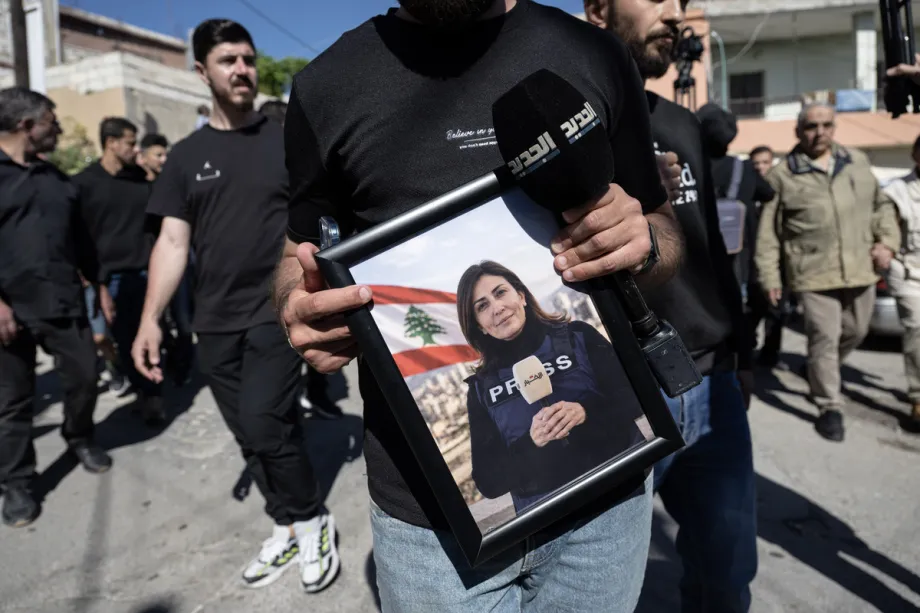
Khalil was killed by a second strike after she and colleagues went to report on an initial attack—a tactic known as “double tap.” More than 2,400 have been killed in Lebanon. Gaza has become the deadliest environment for media workers in history, with 61 journalists killed. Impunity normalizes replication. Explicit ceasefire protections for journalists are required.
There is a particular cruelty in silencing those whose sole weapon is a camera, a notebook, or a voice. The killing of Lebanese journalist Amal Khalil in southern Lebanon is not an isolated tragedy; it is part of a pattern that is becoming impossible to ignore, and even harder to explain away. In a war already saturated with grief, the deliberate or reckless targeting of journalists signals something deeper than battlefield error. It suggests an erosion of the very rules that once attempted to civilise conflict.
On 22nd April 2026, during what was meant to be a brief, US-mediated ceasefire, Israeli strikes hit a civilian vehicle near al-Tayri. When Khalil and her colleague Zeinab Faraj moved to report on the aftermath, a second strike hit the building where they had taken shelter. Rescue teams attempting to reach them were themselves targeted, delaying aid for hours. By the time access was finally granted, Khalil was dead beneath the rubble.
She became the fourth Lebanese journalist killed in just weeks. The sequence—strike, response, second strike—has been described by observers as a ‘double tap’, a tactic that raises serious legal and moral questions.
The outrage from Lebanese officials was immediate and justified. The language used—“flagrant violation”, “brazen crime”—was not diplomatic excess; it reflected a growing consensus among legal experts and press-freedom organisations that such incidents may constitute grave breaches of international humanitarian law.
Yet the facts on the ground continue to collide with official denials. Israel maintains that it does not target journalists and often asserts that strikes are aimed at militants. In some cases, it has posthumously alleged links between slain reporters and armed groups. These claims, frequently unsubstantiated, have been repeatedly challenged by organisations such as Human Rights Watch and the Committee to Protect Journalists, which point to video evidence and patterns of strikes on clearly marked media personnel. The dissonance between assertion and evidence is widening, and with it, the credibility gap.
The scale of the violence underscores the urgency. As of March 2026, more than 2,400 people have reportedly been killed in Lebanon, with over a million displaced. Across the broader conflict landscape, including Gaza and the West Bank, dozens of journalists have lost their lives since late 2023. One investigation counted at least 61 journalists killed in that period alone, making it one of the deadliest eras for the profession in modern history. These are not incidental losses; they represent a systemic threat to the flow of information itself.
What is unfolding in Lebanon cannot be disentangled from a far larger and more troubling pattern that has already taken shape in Gaza, where the scale of journalist killings has reached historic proportions.
Gaza has, in effect, become the deadliest environment for media workers ever recorded, a distinction that should unsettle any government that claims allegiance to international humanitarian law. The killing of figures such as Abed Shaat, a clearly identified cameraman struck while documenting an aid convoy, underscores how ambiguity has replaced accountability, and how denial has become routine rather than exceptional. experts warn that this erosion is not contained; it is setting precedent, normalising impunity, and accelerating a global decline in journalist safety, with UNESCO reporting a 67 per cent increase in deaths in conflict zones in recent years.
In this light, the strike that killed Amal Khalil does not stand alone as an aberration—it sits within an emerging doctrine of war in which the elimination of witnesses risks becoming tacitly permissible. For policymakers, the implication is stark: when the systematic silencing of journalists is absorbed into the background of conflict, the collapse is not only operational but normative, corroding the credibility of the very international order that depends on the visibility of truth.
What is at stake extends beyond individual lives. When journalists are killed, the immediate effect is silence. Stories go untold, evidence goes unrecorded, and accountability becomes more elusive. In conflicts where narratives are fiercely contested, controlling information can be as strategically valuable as controlling territory. Analysts have noted that targeting journalists reflects a shift towards ‘information warfare’, where the aim is not only to defeat an opponent but to shape the story that reaches the outside world.
This dynamic is not unique to Lebanon, but the current context is particularly stark. The perception—widely held in Beirut and increasingly echoed in international circles—is that impunity persists. Despite repeated condemnations from the United Nations, UNESCO, and global NGOs, meaningful accountability remains elusive. The continued military support provided to Israel by key allies, including the United States and several European nations, complicates efforts to enforce compliance with international norms.
It raises uncomfortable questions about whether the so-called rules-based order applies equally to all, or only to those without powerful backers.
For policymakers everywhere, this is no longer a distant or containable crisis but a direct test of the integrity of the international system itself. States that claim fidelity to international law, press freedom and a rules-based order cannot afford the luxury of selective consistency without paying a strategic price.
That inconsistency does more than weaken moral authority; it actively erodes deterrence, inviting repetition by those who see that consequences are negotiable. In such an environment, silence is not restraint but complicity, and credibility—once fractured—rarely returns intact.
There is also a strategic dimension. Erosion of international norms does not occur in isolation; it invites replication. If one state can target journalists without consequence, others may follow. The result is a more dangerous world for reporters, and by extension, for anyone who relies on accurate information to make decisions—governments included. Intelligence, diplomacy, and humanitarian response all depend on credible reporting from conflict zones.
The human dimension, however, remains central. Amal Khalil was not a statistic. She was a witness, a storyteller, and a participant in the essential democratic function of informing the public. Her death resonates not only in Lebanon but across a global community of journalists who increasingly find themselves on the front lines. The message her killing sends—to hesitate, to withdraw, to remain silent—is precisely the message that must be resisted.
There are practical steps that can and should be taken. Ceasefire agreements must include explicit protections for journalists and humanitarian workers, with mechanisms for real-time coordination and verification. Independent investigations into alleged violations must be supported, not obstructed. Military aid and cooperation should be conditioned on adherence to international humanitarian law, with clear consequences for breaches. These measures are not radical; they are the minimum required to preserve a semblance of order in war.
Ultimately, the question is not only about legality but about values. The protection of journalists is a proxy for the protection of truth itself. When that protection erodes, so too does the capacity of the international community to respond effectively to crises. Decisions become less informed, debates more polarised, and solutions more elusive.
In the end, wars are remembered not only for their outcomes but for the principles they uphold or abandon. The fate of journalists in Lebanon will be one measure of that legacy.