
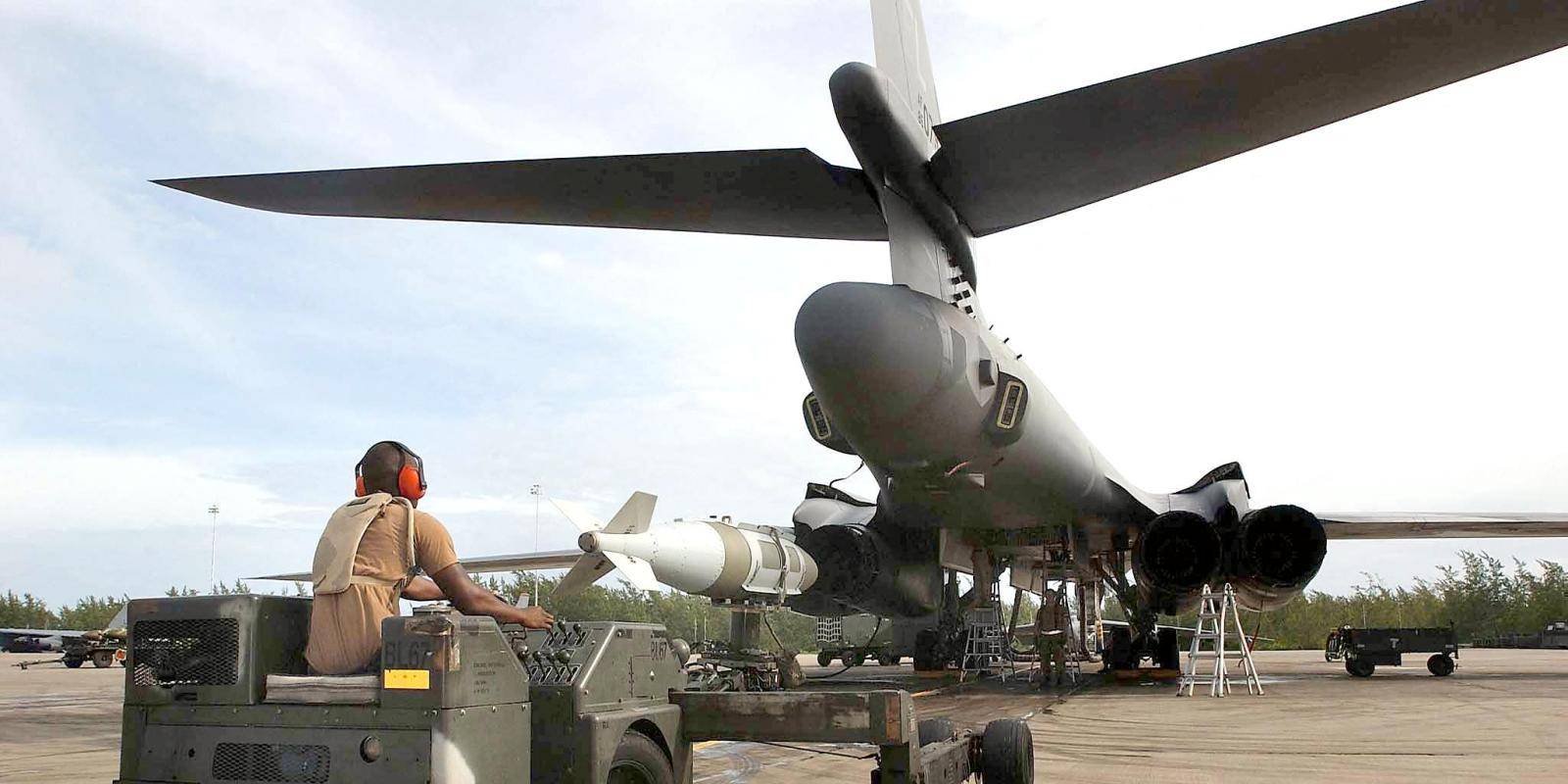
Trump’s focus on Diego Garcia underscores its role as a U.S. power-projection hub for potential Iran strikes. Amid China’s rise, the base remains critical for deterrence and rapid response—underpinning American dominance despite sovereignty disputes.
President Trump’s comments regarding the island’s potential use in a strike on Iran show its continued importance in projecting US power in the Indian Ocean region – even in a rapidly changing strategic environment.
President Donald Trump’s critique of the UK’s 2025 agreement to transfer sovereignty of the Chagos Archipelago to Mauritius triggered a wave of media attention in January 2026. In February, the president appeared to walk back his criticism of the deal, which would see the UK obtain a 99-year lease on Diego Garcia – the largest Chagos island and the site of a major UK/US military base.
But President Trump criticized the deal again on 18 February, linking Diego Garcia to the US military buildup for a possible strike on Iran:
‘Should Iran decide not to make a Deal,’ he said, ‘it may be necessary for the United States to use Diego Garcia… in order to eradicate a potential attack by a highly unstable and dangerous Regime.’
The headlines the president generates tend to centre on the wisdom and fairness of the UK’s deal with Mauritius. But this misses another important part of the story: the entire concept of a military base on Diego Garcia was conceived and initiated by the US, not the UK, to assert American control in the Indian Ocean.
The disputed presence of the military base is therefore a story about American power and strategy as much as the legacy of the British Empire. The president’s comments show the island’s continuing importance to longstanding American policy in the region. So do reports that Diego Garcia may have been used to mount an operation to seize a sanctioned oil tanker.
Why is there a US base on Diego Garcia?
Following the end of World War II, as decolonization progressed and more countries became independent, US naval planners worried that US access to overseas bases was diminishing relative to its Cold War opponents: China and the Soviet Union.
One leading planner was concerned that in the event of hostilities in the Indian Ocean region ‘access via Suez and undisputed access via Singapore or through the Indies may be denied’, arguing that the US Navy therefore needed a base in the Indian Ocean.
Diego Garcia was a strong candidate: it had military advantages (an airfield and anchorage potential), political advantages (a small population, and administrative status under the UK) and a useful location, in the middle of the Indian Ocean. It is about 3000 kilometres from both the Bab-el-Mandeb Strait at the mouth of the Red Sea and the Malacca Strait near the South China Sea. This would allow the US military to project power across the ocean, deter adversaries and reassure allies.
The UK had already built a small base in Deigo Garcia during World War II, and British troops remained there until the end of the war.
In 1961, the US proposed that the UK government detach the Chagos Archipelago from colonial Mauritius to create a new territory that would ensure basing rights for future US and UK military use. Over the following years, the UK and US governments entered secret negotiations over the detachment of the Chagos Archipelago from colonial Mauritius.
In the final agreement, the US government agreed to make payments to the British of up to $14 million, or half the cost of creating the ‘British Indian Ocean Territory’.
Since then, the military base in Diego Garcia has served as an anchor for American operations. The island hosts an extensive airfield with runways long enough to accommodate large military aircraft like B-52 bombers, KC-135 tankers, reconnaissance aircraft and transport planes. It also has major fuel storage facilities, radar installations, and control towers that can support regional military operations.
Diego Garcia also hosts a deep-water port that can dock, resupply, and provide maintenance to large naval vessels including aircraft carriers, destroyers, and submarines. There are multiple piers and docks equipped with modern systems to support rapid response operations.
Diego Garcia was a critical, high-volume launchpad for US air operations in the 1991 Gulf War and 2003 Iraq War.
And in the early 2000’s the base provided support for US airstrikes in Afghanistan, targeting Taliban and al-Qaeda forces. Questions have also been raised about the possible role of Diego Garcia as a CIA ‘black site’ during the ‘War on Terror.’ In 2024 and 2025, the US used the base to launch operations against the Houthis in Yemen.
China and regional rivalries
The US is not the only military that operates in the Indian Ocean. France and India are the two leading naval powers of the Indian Ocean region.
India has its own military presence and relationship with Mauritius and is currently constructing a major air base and naval jetty on the island of Agaléga about 1767 kilometres away from Diego Garcia. This base is planned to include a long runway, deep-water jetty, and radar and communications infrastructure capable of supporting Indian maritime patrol aircraft including US-made Boeing P-8 surveillance planes.
Mauritius officially frames the infrastructure as mutually beneficial coastguard support, but the base significantly bolsters India’s ability to project power and conduct long-range surveillance in the western Indian Ocean. More broadly, India also supports Mauritius with coastal surveillance radar stations, training, defence equipment, and maritime security cooperation.
France also has a neighbouring military presence in the Indian Ocean within its own island territories like La Réunion and Mayotte. About 7,000 French military personnel operate under the Forces Armées de la Zone Sud de l’Océan Indien, conducting surveillance, counter-piracy, disaster response, and deterrence missions. French submarines also patrol the region as part of Paris’s continuous at-sea nuclear posture. These positions together give France significant control over the southern part of the Indian Ocean.
Notably, France also faces a number of sovereignty disputes in the Indian Ocean. In both Réunion and Mayotte there have been various independence movements overtime. Repeated referendums in Mayotte have demonstrated a desire amongst islanders to remain a part of – and deepen integration – with France. However, Comoros still maintains its historic claims to Mayotte.
Today, many Comorians consider the ‘return’ of Mayotte a national cause – not unlike Mauritius’ claims to the Chagos Archipelago, although the Chagos Archipelago is much farther away from Mauritius than Mayotte is from Comoros. Both the African Union and United Nations recognize Mayotte as part of Comoros. The Comoros–France sovereignty dispute over Mayotte is thus a continuing challenge in the region.
France and Mauritius are also in an ongoing territorial dispute over Tromelin island. In 2010, both countries signed an agreement to promote environmental protection there but have not resolved the sovereignty issue.
In recent years China has also developed a significant Indian Ocean presence. The expansion of Chinese commercial, military, and dual-use shipping in the Indian Ocean has led to growing security concerns amongst the major navies of the Indian Ocean, including the US, France, India, and Australia.
That concern fuelled much of the criticism in the UK about the sovereignty agreement – with opponents arguing the 2025 deal could allow China to expand its influence in Mauritius and the region.
Policymakers in Washington and London continue to press the counter-China narrative about the Chagos Archipelago – arguing that the deal leaves nothing to prevent China building a base on the Chagos Islands. But this argument overlooks the complexity of the Indian Ocean region. Mauritius and India’s important strategic relationship would likely blunt any Chinese efforts to develop a strategic or dual-use presence in Mauritius.
Besides, China has focused its partnerships and port developments elsewhere in the region, from Gwardar Port in Pakistan to the Kyaukphyu Port in Myanmar and beyond. Rather than competing directly for a presence in Mauritius, China has successfully distributed its maritime interests amongst countries where the US and UK have less leverage.
Furthermore, Beijing does not have a clear Indian Ocean strategy. Instead, it has benefitted from the narrative that Western countries like the UK (and by extension the US) have violated international law in the Chagos Islands and continue to face an active sovereignty issue in the Indo-Pacific. That serves as a useful counterweight to China’s own sovereignty disputes in the South China Sea.
The ‘Donroe Doctrine’ and the future of Diego Garcia
Diego Garcia’s importance is likely to increase as the US seeks a secure fallback position amid shifting alliances and regional rivalries.
Even in the context of the so-called ‘Donroe Doctrine’, in which the Trump administration has sought to reorient US defence strategy towards the Western Hemisphere, the island does not represent overreach. Instead, Diego Garcia functions as a support node that underwrites US hemispheric control.
The nature of maritime warfare is also evolving. This will have implications for the future of Diego Garcia. For example, drones like autonomous undersea vehicles (UAVs) or ‘supercarrier’ ships that can operate unmanned aerial systems (UAS) are being added to the US arsenal. From Diego Garcia, these capabilities would extend the US’s ability to project power and threaten use of force across the Indian Ocean region.