
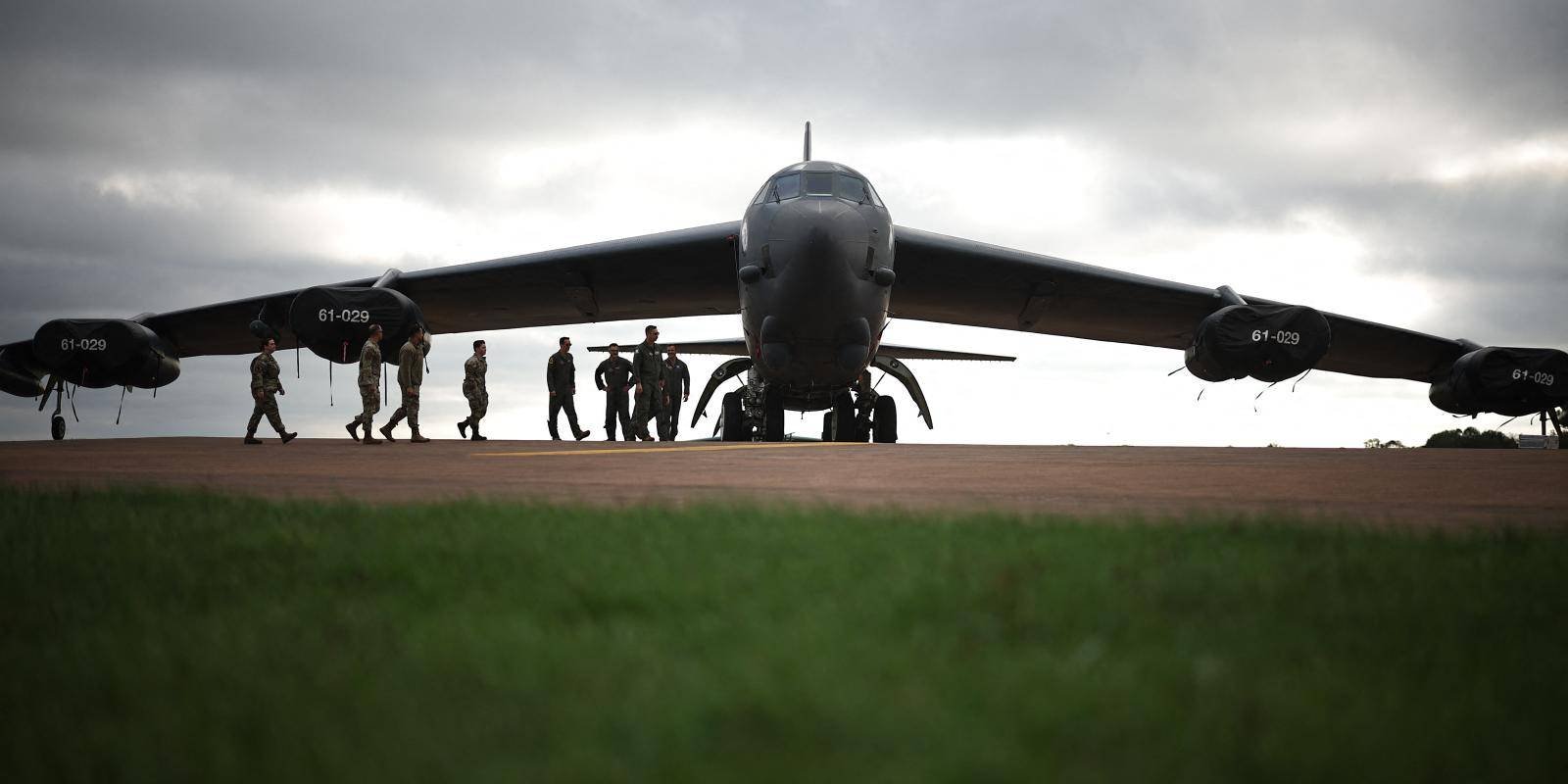
The UK permits US use of its bases for defensive strikes against Iranian missiles targeting Gulf allies, attempting to avoid becoming a party to the unlawful US-Israeli war. This blurry distinction may prove untenable as conflict escalates.
The UK has taken a step closer to involvement in the US and Israeli war against Iran.
The UK government initially refused President Donald Trump’s request to use its military bases in support of the war with Iran. But on 1 March, Prime Minister Sir Keir Starmer announced he would, after all, permit the use of UK military bases such as RAF Fairford in the UK and the overseas base on Diego Garcia. This is to be limited to ‘defensive’ action against missiles and drones based in Iran. This limited concession was reportedly negotiated with Washington, in accordance with London’s view on the legal issues involved.
Throughout, the prime minister has been adamant that the UK has not participated in the initial US and Israeli offensive, and that this remains the case. He argued that the UK would, under his leadership, never contemplate going to war without a legal basis. This seems to confirm reports that the UK attorney general may have advised that the US and Israeli operation is not in accordance with international law.
Few states have been willing to say so publicly. And some have endorsed the attacks. But the UN Secretary-General has confirmed that the US-Israeli attacks on Iran violate the fundamental prohibition of the use of force. This view is widely shared among the legal expert community.
And some governments are now finding their voice in defending the international legal order, including Spain and France, with Canada belatedly also joining in.
Countries also routinely refuse the use of foreign bases on their territory for aggressive operations. They will even deny the right of overflight over their territory by foreign forces heading for a controversial military operation.
Compliance with international law is not optional for the UK. According to the Ministerial Code, members of the government, including the prime minister, have the ‘overarching duty to comply with the law, including international law and treaty obligations’.
How then is the UK government attempting to square the circle of credibly supporting its regional allies without becoming a party to the war against Iran?
The UK’s complicated legal arguments
The United Nations Definition of Aggression confirms that a state must not allow ‘territory placed at the disposal of another state to be used by that other state for perpetrating an act of aggression against a third state’.
However, merely allowing the use of a base on UK territory for hostile action against a third state would not necessarily constitute an act of aggression. Deeper involvement may be required.
Still, by giving in to the initial US request, the UK would have risked assuming a share of the international legal responsibility for the attacks against Iran.
Iran invoked its right to self-defence in response to the US attacks, announcing that ‘all bases, facilities, and assets of the hostile forces in the region shall be regarded as legitimate military objectives within the framework of Iran’s lawful exercise of self-defense.’ However, that would only be lawful if these facilities on the territory of third states were indeed all involved in the conflict.
Regional states hosting US bases adamantly assert that they have not permitted the launch of any attacks against Iran from those bases. Indeed, several countries tried to dissuade the US from launching the operation in the first place. Despite these efforts, Iran has attacked many of its neighbours in the Gulf, including Saudi Arabia, Kuwait, Oman, the United Arab Emirates, Qatar, Bahrain and Iraq. Iran has therefore itself committed an act of aggression against these regional states – one compounded by the indiscriminate nature of the attacks.
While the UK did not participate in the initial attack on Iran, Starmer has reported that it has had ‘planes in the sky’ since the outbreak of the conflict to help intercept missiles and drones directed against regional allies.
The UK can rely on its own right to self-defence if Iran targets groups of UK citizens in the Gulf specifically because they are UK citizens. The UK also has a right under international law to a limited and proportionate answer to the apparent Iranian drone attack against its military base at Akrotiri, Cyprus, which is sovereign UK territory. However, the UK seems reluctant to take such action, perhaps to avoid entering a direct, escalatory conflict with Iran.
The UK attorney general clarified in the summary of his advice that, ‘as well as defending itself and its position in the region, the UK is acting in the collective self-defence of regional allies who have requested support’. However, this describes a kind of passive defence, trying to intercept missiles and drones as they approach the Gulf states. UK forces will not mount an active defence against missile installations ‘at source’ in Iran, in support of the Gulf states. Instead, authority has been granted to the US to do so, using UK bases.
It is not clear whether this means that the US is doing so under UK licence, as it were, acting to implement London’s right to collective self-defence in aid of the Gulf states – or whether the US is acting in their defence under its own steam.
A delicate distinction
This complicated UK approach seems to blur the distinction between the unlawful US and Israeli war against Iran, and the lawful UK campaign to defend regional allies against unjustified Iranian assaults using US assets operating from UK bases.
The UK is attempting to shore up that distinction by indicating that strict rules are in place to ensure that the UK bases are only used for strikes against ‘missile facilities in Iran which were involved in launching strikes at regional allies’. But it may not be realistic or practical to determine in each instance which Iranian missiles facilities have targeted regional allies or, more to the point, which will do so in the future. Presumably some have been used to attack both Israel and US forces, and regional states.
Iran will certainly not be persuaded by this distinction. Its authorities will not be able to tell which US strikes launched from UK bases aim to protect UK regional allies, and which are part of the US’s overall aggressive campaign to subdue its government.
The attorney general adds that the UK bases may only be used for strikes against missile facilities used by Iran against ‘countries not previously involved in the conflict’. In other words, according to this distinction, it is out of the question for US aircraft flying from UK bases to strike Iran to protect US forces in the region or to preserve Israel from counterattacks.
US pilots launching from UK bases may find it difficult to accept that they can only engage offensive Iranian weapons that threaten the Gulf states, but not those that threaten their own forces amidst a deadly, live conflict.
Presumably, the somewhat complicated legal rationale of the UK government is meant to facilitate US action at the behest of close regional allies, and to alleviate the fury of US President Donald Trump at having initially been denied the use of the UK bases – without slipping too far towards becoming a party to a conflict that lacks a legal basis.
In truth, though, the euphemism of the UK having had ‘planes in the sky’ since the beginning of the conflict does not really overcome one fact.
Entering the theatre of conflict and shooting down Iranian drones and missiles that are unlawfully targeting regional allies may be laudable. But in a sense, doing so already makes the UK a party to the conflict – at least the conflict between Iran and those regional states – however defensive the UK’s role may be. Moreover, if the Gulf states decide to respond by striking Iran, as they are entitled to, the UK could become involved in more active defence.
Despite the fine legal craftmanship underpinning it, Starmer’s decision potentially makes it just a little more difficult for the UK to maintain the distinction between involvement in defence of itself and its allies, and involvement in the principal conflagration between Iran and the US and Israel.