
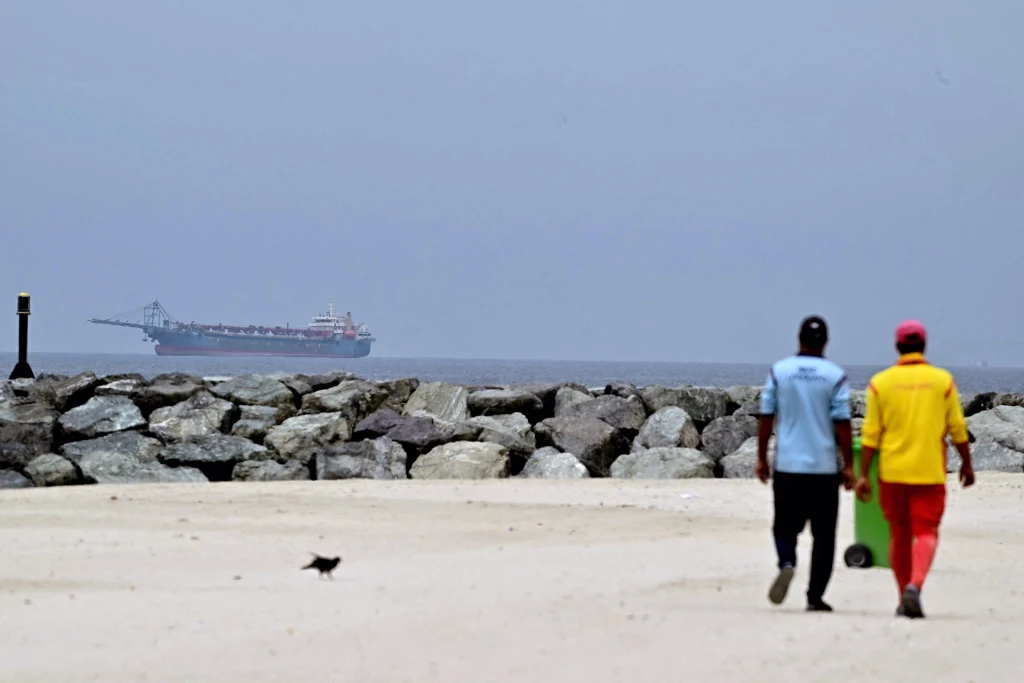
Utilizing the UN Office for the Coordination of Humanitarian Affairs (OCHA) to lead a dedicated aid track mirrors the successful 2022 Black Sea playbook. This narrow, technical approach facilitates military deconfliction for stranded food and medicine while providing a low-stakes confidence-building measure to resolve the primary commercial blockade.
The United Nations needs to establish a humanitarian corridor through the Strait of Hormuz. This would release much-needed aid through the waterway, address growing food and medical needs, and provide U.S. and Iranian negotiators an easy win to build an on-ramp for a larger breakthrough.
Sam Vigersky is an international affairs fellow at the Council on Foreign Relations. Vigersky was the lead U.S. humanitarian negotiator at the United Nations from 2019 to 2024.
Despite a fragile United States-Iran ceasefire and marathon peace negotiations in Islamabad over the weekend, the Strait of Hormuz is an ever-increasing bottleneck. The waterway has seen just a trickle of traffic passing through since the war began, and President Donald Trump imposed a blockade of the strait on Monday. Meanwhile, the failed UN Security Council vote on April 7 to reopen the waterway, vetoed by China and Russia, shows the international community has no quick fix to counter Iran’s leverage.
Still, there is one immediate diplomatic outcome that is within reach of all parties if they would only choose to pursue it: a humanitarian corridor through the strait.
Though the war’s effect on global trade has been particularly catastrophic, other conflicts—such as the Syrian civil war and Russian invasion of Ukraine—have also triggered commercial disruptions. But there has always been a critical carve-out: humanitarian corridors, negotiated first and separately from broader commercial access. Parties were willing to say yes to aid—as they did in Syria and Ukraine—when they said no to everything else, not because humanitarian passage was the most important goal, but because it was the easiest point of agreement.
And yet, the United Nations and the international community are choosing the hardest path to start. With the Security Council and the secretary-general’s task force for fertilizer bypassing this initial step altogether, negotiators in Islamabad arrived without a technical framework detailing the what, where, and how needed for agreement on a humanitarian corridor—squandering an easy win, as talks collapsed. In doing so, they not only failed to release frozen supplies of life-saving aid in the Persian Gulf region but also forfeited a critical confidence-building measure for a larger breakthrough in commercial traffic.
That has to change—and fast. The United Nations needs a robust, standalone initiative dedicated exclusively to a humanitarian corridor. The question is no longer whether the lack of one will cost lives, but how many.
Dozens of aid agencies remain frozen, and the millions they serve are growing more desperate by the day. Dubai and its International Humanitarian City, once an unrivaled hub, now has rows of Costco-sized warehouses full of life-saving supplies going nowhere.
Save the Children has essential medicines stuck in Dubai that are supposed to be arriving at ninety primary health-care facilities in Sudan, the largest humanitarian disaster in the world. The World Health Organization reported delayed shipments of supplies from the Gulf to twenty-five countries, including $6 million in medicines for Gaza. Millions of civilians around the world are on the brink of starvation, and seventy thousand metric tons of food—enough to feed four million people in crisis for one month—are stranded at sea.
Fortunately, UN Secretary-General António Guterres already has a playbook to follow for this crisis. In 2022, he brokered the Black Sea Grain Initiative, a UN-mediated agreement between Russia and Ukraine that created a maritime corridor for humanitarian food and fertilizer exports at the height of war. The results: thirty-three million metric tons of corn, wheat, and other foodstuffs reached forty-five countries, helping stabilize global food prices at a moment of surging food insecurity. A Hormuz humanitarian corridor would have a similar effect.
Signals from warring parties suggest an agreement is possible. In a March 22 letter to the UN International Maritime Organization, Iran wrote that “non-hostile” ships can pass through the Strait of Hormuz; just a few days later, the Iranian ambassador to the United Nations in Geneva agreed to “facilitate and expedite” humanitarian and agricultural shipments through the strait. The United States, too, has made clear it wants to see maritime traffic resume.
These diplomatic openings can only be tested by UN humanitarian negotiators who understand how to translate words into frameworks and operations. They need to define what constitutes humanitarian aid, develop a list of priority destinations, and decide who needs to be at the table. Logistics, including military deconfliction to ensure safe passage, will follow.
Success in establishing a humanitarian corridor will hinge on who leads the charge. The Hormuz task force Guterres has set up is co-led by four separate UN agencies, yet sidelines its best chance at success: the UN Office for the Coordination of Humanitarian Affairs (OCHA).
This oversight needs to be corrected immediately. OCHA’s role is unambiguous. It has been mandated by the UN General Assembly as the sole entity to coordinate life-saving relief across the UN and NGOs since 1991. Disregarding this precedent isn’t just bad policy; it undermines confidence in the UN’s respect for the will of its member states.
What’s more, it ignores Guterres’s own effective playbook. The Black Sea Grain Initiative had two task forces running in parallel. One focused on Russian food and fertilizer exports, and the other on Ukrainian grain shipments and humanitarian needs. This time around, there is no dedicated humanitarian track.
Tapping OCHA to lead a humanitarian workstream would limit the scope to something agreeable and achievable, building confidence and needed infrastructure for a larger breakthrough around fuel and fertilizer. Other UN agencies, including those currently on the task force, can take the baton from there. But starting small and winning can build the trust needed for what comes next.
Every day those containers sit idle in Dubai, more children who could have been fed, watered, or treated are turned away for the last time. Ultimately, the United Nations solved this problem before by starting with what’s easiest. Why are they starting instead with what’s hard?