
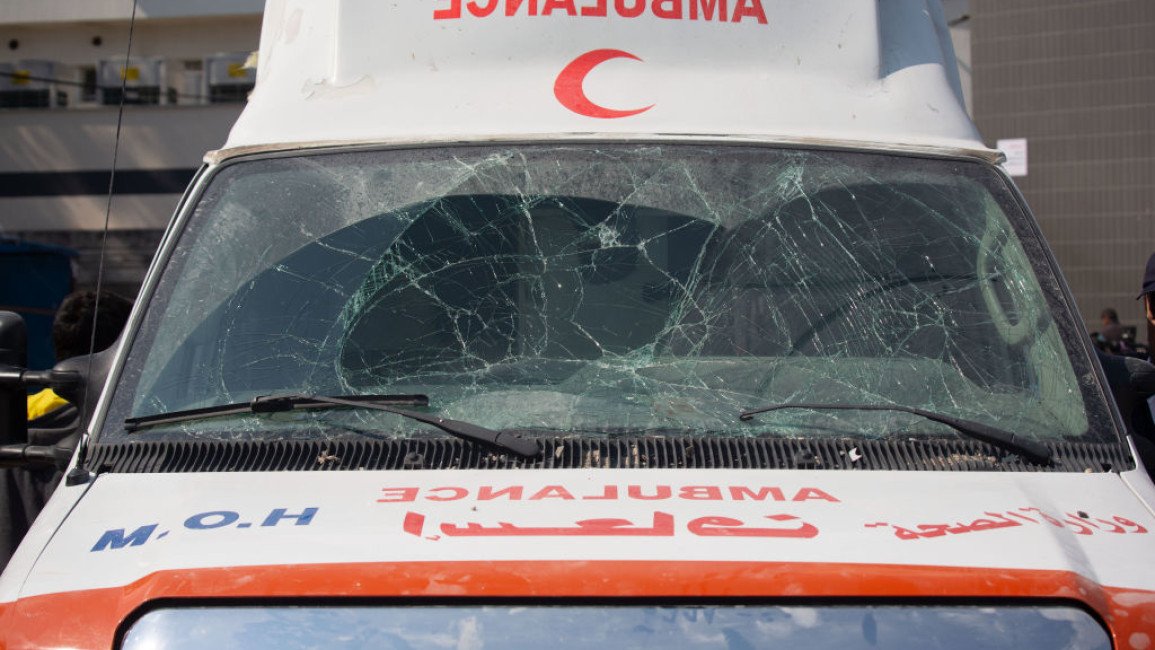
After three agonising hours spent sitting in a stuffy taxi on the way to the hospital, my grandmother was at her limit.
“Why does it have to be this way?” she lamented to my mother, who was accompanying her on the arduous journey. A simple endoscopic examination, which should have you in and out of the hospital on the same day, resulted in an almost 48-hour ordeal.
Our local hospital in al-Bireh, Ramallah did not have any medical scope available with a camera attached, something my grandmother urgently needed to determine what was causing blockage within her biliary system.
Her doctor made the quick decision to schedule the endoscopy only a few days after the initial appointment, in order to ensure my grandmother’s condition did not worsen. He was based out of a hospital in al-Khalil, a city a few hours away, where the appropriate medical equipment was available.
Luckily, my grandmother was stable enough to travel with my mother, but for those in more critical condition, the journey would be detrimental.
Inferior treatment
A facet of Israel’s genocidal and settler colonial empire is ensuring that Palestinians do not have anywhere near the same facilities and medical rights as Israelis, both in the West Bank and Gaza.
In the West Bank alone, things like delays in medication arrivals, subpar ambulance travel times and logistical jigsaw puzzles to complete a full body physical are commonplace. One medical centre may not have the facilities to conduct simple things like blood tests or X-rays, forcing patients to schedule with an entirely different office, which can often delay test results.
The rapid nature of settlement expansion within the West Bank not only impedes on resources available to Palestinians, but it also makes it increasingly difficult to travel from place to place due to road closures and restrictions.
In my grandmother’s case, the endoscopy was the first step in a long process that resulted in her receiving an advanced cancer diagnosis. Her doctors advised her to undergo both chemo and immunotherapies, but even access to these forms of care have been severely impacted by Israel’s brutality. Immunotherapy is not readily available in many cities within the West Bank, including Ramallah, which meant that we had to wait for over a month to begin treatment, given that the hospital was implementing it for the very first time.
She was also forced to delay treatment when the supply of chemotherapy drugs were low. Even when the chemotherapy is available in the hospital, waiting hours to begin the treatment is now the norm due to understaffing and the lack of supplies. For those who live in villages where there are no major hospitals, the time spent traveling back and forth to the cities can prove to be a death sentence.
However, many families would not even reach this stage of care, since costs are very high and private insurance is required in the majority of cases, in order to ensure consistent treatment.
The strain on resources is a direct result of occupation, and is another tool of Israel’s consistent and unceasing genocidal efforts. Slaughtering tens of thousands of people in Gaza, and burning people alive while still in their hospital beds, have become common practice for the occupation. Additionally, Israel purposely targeting healthcare infrastructure, blocking ambulance routes, and arresting doctors, has also been normalised and treated with complete impunity.
Amidst the complicity of their leaders who are either arming those committing this terror or remaining silent, doctors around the world have spoken out against the attacks on Palestinian patients. They have proven true that the sentiment of “do no harm” goes beyond their individualised practices and careers.
One such example is Palestinian doctor Nidal Jboor, who has used his platform to advocate for his people through Doctors Against Genocide – an organisation he co-founded “to increase global awareness about what’s happening and mobilise the medical community to fight this”. He grew up in the town of Masafer Yatta and knows first-hand the brutality of Israeli occupation, and even had his land in Palestine recently seized.
In the face of passive aid, that is rarely followed by any concrete action, Jboor like many of the doctors taking action everywhere, see it as incumbent upon those in the medical field to speak out against the atrocities Israel is committing.
Even under the guise of a so-called “ceasefire”, Israel has continued their attacks on Gaza and amplified their presence in the West Bank. The medical sector preserves Palestinian life, which is why the occupation wants to weaken it as much as possible.
Medical infrastructure should be an innately human right that is protected under international law, yet it is consistently stripped away from those most in need. Palestinians have been dehumanised to the extent that healthcare has become a privilege to be granted by Israel as and when it decides.
My grandmother’s painfully long hospital journey is only a fraction of what people in the West Bank deal with on a daily basis, let alone what Gazans are facing after over two years of ongoing genocide. On the international stage, Palestinian bodies are numbers to add to an ever-growing death count that is treated like the required collateral damage for the occupation to continue to grow.
We should not have to beg for sustenance, medical care, and free movement, but until the rest of humanity wakes up from their ignorant or passive slumber, and takes action against Israeli brutality and oppression, this will continue to be the harsh reality for Palestinians.