
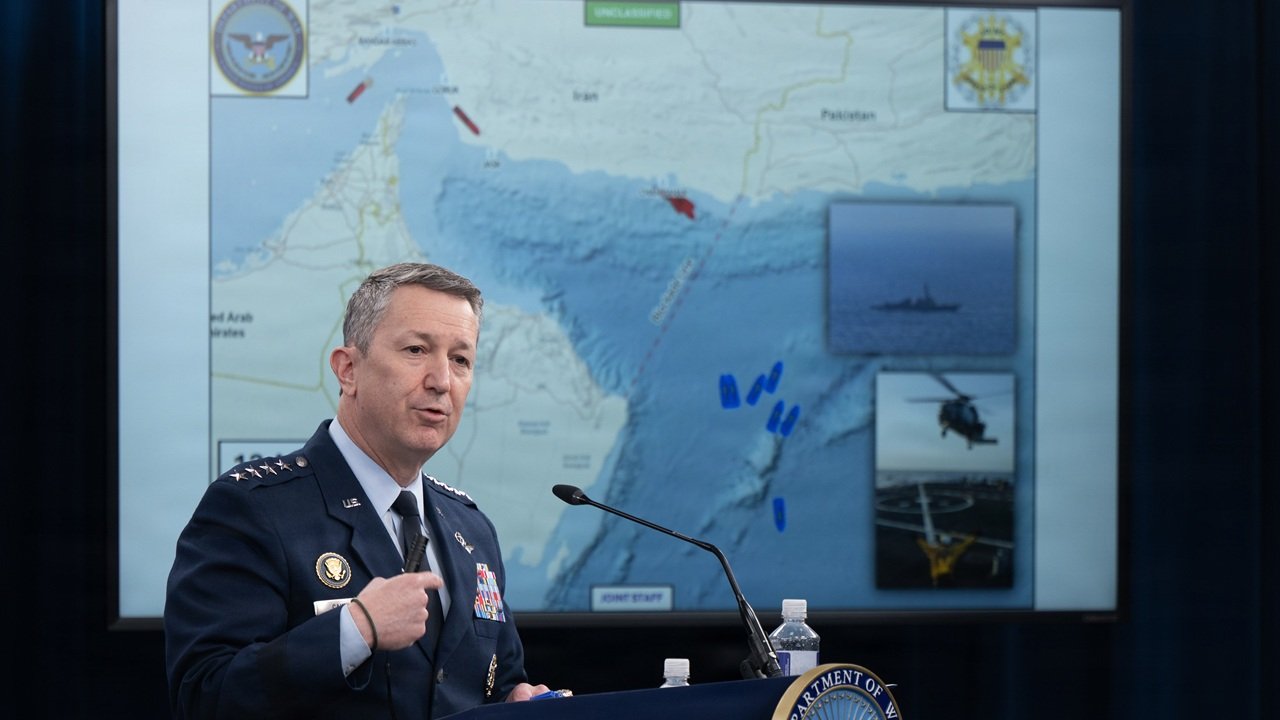
The U.S. is enforcing a close blockade of Iranian ports while Iran mounts its own counter‑blockade of Hormuz, creating a rare dual blockade. Historical patterns show blockades work cumulatively and slowly, yet both sides hope economic pressure will break the other first—an uncertain bet.
The US Navy and Iran are simultaneously attempting to blockade the same target—an unusual, but hardly unprecedented, state of affairs.
Blockades have gone global.
The blockade is a perennially enticing mode of sea warfare. It empowers a supreme navy to strike directly at a seagoing rival’s economy, bringing the hurt by dint of sea control. In fact, America’s “evangelist of sea power,” Captain Alfred Thayer Mahan, defines ”command of the sea” in large measure as the ability to sweep an antagonist’s fleet from important waters and blockade its shores. “Overbearing power upon the sea,” opines Mahan, helps the fleet that rules the waves cut off a foe that depends on seaborne trade and commerce from sea lanes that make mercantile endeavors possible.
For Mahan, cutting off a seafaring foe from the high seas is like cutting the roots of a plant. Its saltwater economy shrivels and dies.
The Blockade Is a Staple of Military History
This is of more than academic interest. Today, of course, the US Navy is blockading Iranian seaports in the Gulf of Oman, the maritime anteroom to the Strait of Hormuz and Persian Gulf. In part the blockade squadron, made up chiefly of a dozen or so Arleigh Burke-class guided-missile destroyers, is executing what naval commentators describe as a “close blockade.” This in-your-face type of blockade means the enforcing ships of war hug the enemy coastline, intercepting ships bearing suspected contraband in close proximity to hostile harbors. Vessels defying the blockade are subject to visit, boarding, search, and seizure of forbidden goods.
Oil is the most obvious forbidden cargo in the case of Iran, but the US authorities have noted the blockade also bars shipments of other military materiel—ammunition, weapons systems, dual-use electronics, most anything that would help the Islamic Republic reconstitute military might devastated by weeks of US-Israeli air strikes. This is a sweeping ban.
Close blockades are commonplace in marine history. For instance, Great Britain’s Royal Navy imposed a stifling quarantine on the United States during the War of 1812, dispatching flotillas to loiter off ports such as Boston, Newport, and New York. At that stage in US history, internal communications—roads, for the most part—were so woefully underdeveloped that interstate commerce was synonymous with coastwise commerce. An effective Royal Navy blockade thus pinched the US economy internally, rather than merely interdicting foreign trade and commerce.
Fast forward half a century, and the Union Navy encircled the Confederacy during the American Civil War, imposing a leaky blockade that nonetheless choked Southern imports and exports—in particular the exports of “King Cotton” on which Confederate leverage with potential European benefactors such as Britain and France depended.
Close blockades have become unappealing as shore-based anti-access weaponry—coastal artillery, sea mines, short-range submarines and surface raiding ships, warplanes flying from land airstrips—have proliferated and advanced technologically. For example, the Royal Navy stood far from imperial German shores during World War I, loath to venture closer to German ports for fear of coming under assault from land.
Instead the Royal Navy fell back, cordoning off the North Sea by means of a “distant blockade,” the second mode of blockading operations. British battleships sealed off the Scotland-Norway gap, obstructing German shipping that coveted access to the broad Atlantic. Geography played a pivotal part in the British distant blockade—as it does in nautical operations of all sorts. The British Isles lie astride sea lanes connecting northern European antagonists—the Dutch Empire in bygone centuries, Germany during the world wars, and, today, Russia’s Baltic Sea precincts—from the Atlantic high seas.
The Tradeoffs of a Blockade’s Distance from Shore
And of course there’s a military component to blockades. No matter how fortuitously geography may have blessed a blockading power, it must field a navy with sufficient capabilities and numbers of ships to enforce the marine cordon. This is demanding duty. Martial sage Carl von Clausewitz deplored ”cordon-warfare” because defending a distended defense perimeter is so asset-intensive. After all, mathematicians define a line as infinitely many points in series. Trying to be stronger than an enemy force at infinitely many points strains the doughtiest defenders. Clausewitz implores field commanders to keep defensive cordons short—and supply lavish fire support to firm up the perimeter.
There are tradeoffs between close and distant blockades. The more distant the blockade, the longer the defensive perimeter must be. Standing closer to shore simplifies interdiction, but the intimate approach exposes blockading warships to fire from land. A distant blockade reduces risk to the fleet, but demands more assets to patrol the offshore frontier.
Where US naval commanders arrange the blockading squadron on the nautical chart speaks volumes about how they envision balancing efficacy against risk. The Strait of Hormuz resembles a convergent-divergent nozzle. The closer in the blockading squadron ventures, the shorter the defensive cordon and the easier it is to police the nozzle’s inlet. The Clausewitzian geometry is favorable, but the danger escalates in proportion to proximity to Iranian shorelines. The farther out, the longer the quarantine line, prompting the ghost of Clausewitz to frown, but the danger from Islamic Revolutionary Guard Corps (IRGC) anti-access ordnance abates commensurately.
Taking the Iran blockade global eliminates defensive lines altogether. It also amplifies the need for plentiful intelligence to find and apprehend would-be blockade runners anywhere in the seven seas. Making a global blockade—which amounts to the outer layer of a layered blockade strategy—effective will demand yet more US Navy and Coast Guard enforcement ships.
Dual Blockades Are Rare, But Not Unheard Of
Now, dual blockades in which both combatants blockade the same general seaways are unusual in history. The US Navy and Coast Guard are mounting their blockade of Iranian harbors, while the IRGC has sought to interdict the narrows of the Strait of Hormuz with the threat of sea mines, speedboats, and shore-based armaments.
Still, there is significant precedent for dual blockades. Britain blockaded Germany during both world wars while keeping the Royal Navy fleet at a safe distance from German seacoasts. German naval magnates quickly realized that U-boats could easily evade the British blockade fleet. So Berlin staged a counter-blockade by dispatching submarines to the central Atlantic to interdict shipping between Britain and North America. While ultimately unsuccessful and even self-defeating—unrestricted submarine warfare drew the United States into World War I, after all—the German distant blockades imposed grave hardships on an import-dependent Britain. Much as Mahan would have predicted.
Blockades (Usually) Unfold Over Time
One final observation. Like other forms of economic warfare, blockade is what Admiral J.C. Wylie calls a “cumulative” mode of combat. Cumulative campaigns are scattershot campaigns made up of a multitude of small-scale tactical engagements. No individual engagement imposes major material or psychological impact on the blockade’s target, but together many small engagements can add up to something big. Something big over time, Admiral Wylie would hasten to add. This is war by statistics. Wylie regards cumulative operations as intrinsically slow-acting, and indecisive in themselves.
Of course, the Islamic Republic could be an exception to Wylie’s rule. Economic sanctions can work in a relative hurry when the party levying sanctions cuts off the targeted party’s access to a vital and irreplaceable asset. The same may go for blockades. The Strait of Hormuz could prove to be a fatal liability as well as a strategic advantage for Iran. The Iranian economy is utterly dependent on hydrocarbon exports across the sea. An effective US naval blockade would sever this economic lifeline, squelching the flow of resources Tehran needs for warmaking. In short, an effective blockade would pit Iran’s penchant for “resistance” against its ability to withstand economic distress.
Can a layered blockade buck historical trendlines, and prove quick and decisive? That is the proposition America and Iran are putting to the test.