
Iran’s military relies on Chinese dual-use exports: sodium perchlorate for solid rocket fuel, drone engines, and precision electronics. Trump’s tariff threat is legally ineffective. A fentanyl-style leverage mechanism targeting specific ports and corporate registries could compel Chinese enforcement.
China supplies Iran’s military by shipping materials and components with dual military and civilian uses.
Last week, President Donald Trump threatened to levy a 50 percent tariff on any country caught supplying Iran with weapons, effective immediately and without exemption. On April 15, he told Fox Business that Chinese President Xi Jinping had written back. As President Trump put it, “I wrote him a letter asking him not to do that, and he wrote me a letter saying that, essentially, he’s not doing that.” Trump sounded satisfied.
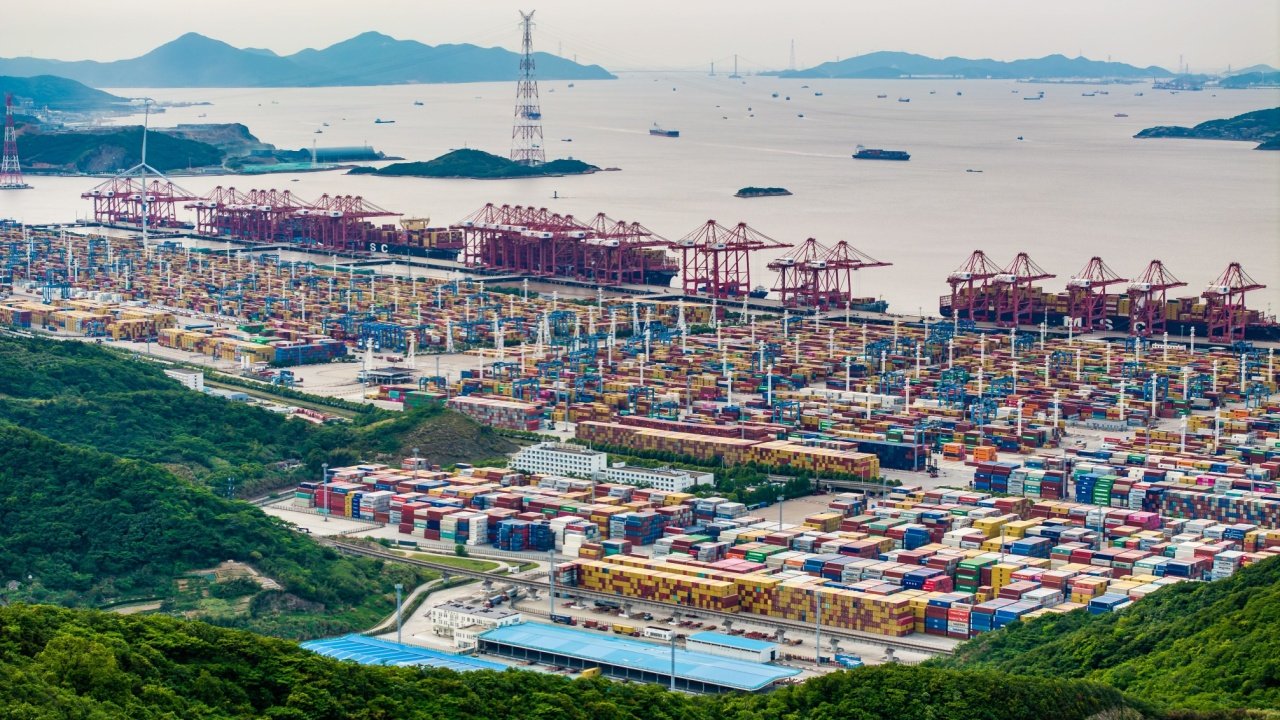
Five days later, the USS Spruance captured the Iranian container ship Touska as it tried to run the US naval blockade in the Gulf of Oman. According to the shipping analytics firm Kpler, the vessel was returning from Gaolan port in Zhuhai, southern China—a facility that The Washington Post notes specializes in the loading of sodium perchlorate, the precursor chemical for solid rocket fuel. Trump, updating his tone, called the cargo “not very nice” and suggested it was a “gift from China.”
Xi did not lie. His letter was almost certainly true, narrow by design, and worthless in any practical sense. The guarantee hinges on the definition of “weapons.” If the word means assembled combat platforms rolling off a state-owned production line, Beijing’s record is largely clean. The People’s Liberation Army (PLA) is not handing Shahed drones or Kheibar Shekan missiles to Tehran.
But that category captures almost nothing of what powered Iran’s campaign over the past six weeks—the strikes that knocked 17 percent of output off Qatar’s Ras Laffan liquefied natural gas terminal, damaged refineries from the Red Sea to Kuwait, and forced Gulf air defenses to burn through interceptor stockpiles. The platforms are Iranian by badge. Their industrial provenance runs through the civilian ports and workshops of the People’s Republic of China.
This is not a coincidence. China’s exports to Iran’s military production lines fall under civilian customs codes as dual-use chemicals, aviation parts, or industrial electronics—whichever label the shipper chooses. Sodium perchlorate is the clearest case. It is classified as a dual-use chemical with legitimate civilian uses in fireworks and flares. It is also refined into ammonium perchlorate, which fills roughly “70 percent of the fuel load in solid-fueled ballistic missiles.”
European intelligence services assessed that a single 1,000-ton delivery from Zhuhai to Bandar Abbas in early 2025 was sufficient for propellant for 200 to 260 ballistic missiles. A further 2,000 tons arrived later that year. The Touska was attempting the same route pioneered by other sanctioned Iranian vessels. When a pair of similar ships departed from Gaolan in early March, experts pointed out that Beijing could have easily held the vessels at port. Instead, it chose not to do so.
Beijing’s Foreign Ministry response to the interception showcased the strategy in action. Spokesman Guo Jiakun expressed concern on April 20 over “the US’ forcible interception of the vessel” and called for restoration of “normal passage through the strait.” On April 21, pressed directly on former UN Ambassador Nikki Haley’s allegation that the ship was carrying missile chemicals from China, Guo replied that “the vessel seized by the US is a foreign container ship” and that China “rejects any false association and speculation.”
Nothing in the statement is literally false. No assembled missile was aboard. The PLA did not charter the ship. Taken within Beijing’s carefully curated definitions—which do not treat dual-use chemicals as military exports—the denial is airtight.
The drone supply chain tells the same story in miniature. The Shahed-136 loitering munition costs its manufacturers between $20,000 and $50,000; the Patriot interceptor fired to stop it costs upwards of $3 million. None of the platforms rolled out of a Chinese state factory. The piston engine that powers the Shahed-136 descends from Germany’s Limbach L550E, acquired by Chinese businessmen in 2011 after the original firm ran into financial trouble, with production relocated to Fujian. Precision machining, aerospace-grade radar altimeters, GPS antennas, programmable logic chips: almost every input that lets a cheap drone find a specific LNG terminal traces back to a Chinese industrial park and ships out under a civilian customs code.
The suppliers are not household names. They are micro-enterprises operating with a handful of employees and stated business scopes unrelated to aviation. Shenzhen Caspro, sanctioned by the US Treasury in 2024, was officially in “automotive electronics” while shipping aerospace-grade radar altimeters to Iranian military projects. Guilin Alpha, with three registered employees, supplied precision aviation parts and then filed for simplified deregistration, claiming it had never traded. The starkest illustration sits in Chinese corporate filings.
In 2021, Xiamen Limbach Aircraft Engine created a wholly owned subsidiary with a slightly different name. Ownership was then transferred to a related company chaired by the same individual. When US sanctions hit the parent in October 2024, they struck a zero-employee shell. The subsidiary, with sixty-three employees and active military procurement contracts, carried on.
This is why individual sanctions designations do not work. This is not an intelligence failure—none of China’s activity in this case is hidden. The problem is bureaucratic inertia. The drafting, interagency review, and publication of an OFAC or Entity List designation takes months. A Chinese micro-enterprise can legally deregister and reconstitute under a new name within weeks, within a permissive domestic environment.
Beijing’s own Export Control Law is, on paper, sufficient to shut down this trade. When the Chinese state wants to police exports of rare earths, gallium, or germanium, it does so with granularity that shames Western customs services. Against the drone-component and chemical-precursor proliferators named in US sanctions announcements, the Chinese state has taken no visible domestic action.
That exposes the defect in Trump’s tariff threat. A 50 percent surcharge triggered by shipments of Chinese weapons to Iran will catch nothing because no such shipments exist. Enforcing it against the Touska would require Washington to redefine sodium perchlorate as a weapon unilaterally. This move would invite a trade war over a chemical with genuine civilian applications while leaving the actual supply chain untouched. The enforceable version of Trump’s policy targets not what Xi has promised to stop, but what he has declined to stop: the absence of domestic Chinese enforcement against firms Washington has already sanctioned.
A working template exists. For years, Beijing accurately noted that China did not export illicit fentanyl; Chinese chemical firms exported legal precursors, which Mexican cartels then synthesized. Washington’s breakthrough came when it stopped demanding that Beijing admit to exporting drugs and instead leveraged the threat of an IEEPA tariff explicitly tied to the “failure of the PRC government to arrest, seize, detain, or otherwise intercept chemical precursor suppliers.” That recalibration produced, by October 2025, a Chinese scheduling of 13 additional precursor chemicals and a functional counternarcotics working group. Progress was limited, but real.
An analogous mechanism is urgently available for the dual-use defense supply chain. Tariffs and secondary sanctions should be tied not to whether China ships “weapons,” but to Beijing’s demonstrated non-enforcement against the specific entities, ports, and corporate registries that Washington has already designated—Xiamen Limbach, Shenzhen Caspro, Gaolan port, and their successors. That is a standard Xi cannot evade.
President Trump extended the ceasefire this week, though the US naval blockade remains in place. Trump is expected to meet Xi in Beijing next month. Between those dates, the arithmetic of Ras Laffan stands: $30,000-munitions find $3 million-interceptors, launched from workshops Xi has truthfully promised not to run as weapons factories. The next letter between presidents should target what the last one elided.