
Flintlock 2026 brought together GNU deputy defense minister (west) and Saddam Haftar (east) in Sirte. US envoy Boulos is mediating between Haftar senior and Dbeibeh. A proposed formula would install a Haftar son as Presidential Council head. Russian Wagner mercenaries are in east/south; Turkish forces in west. Assassinations of key figures continue.
The initiative runs alongside an agreed budget and political discussions on power-sharing facilitated by an American envoy, but Washington is concerned about the presence of foreign fighters.
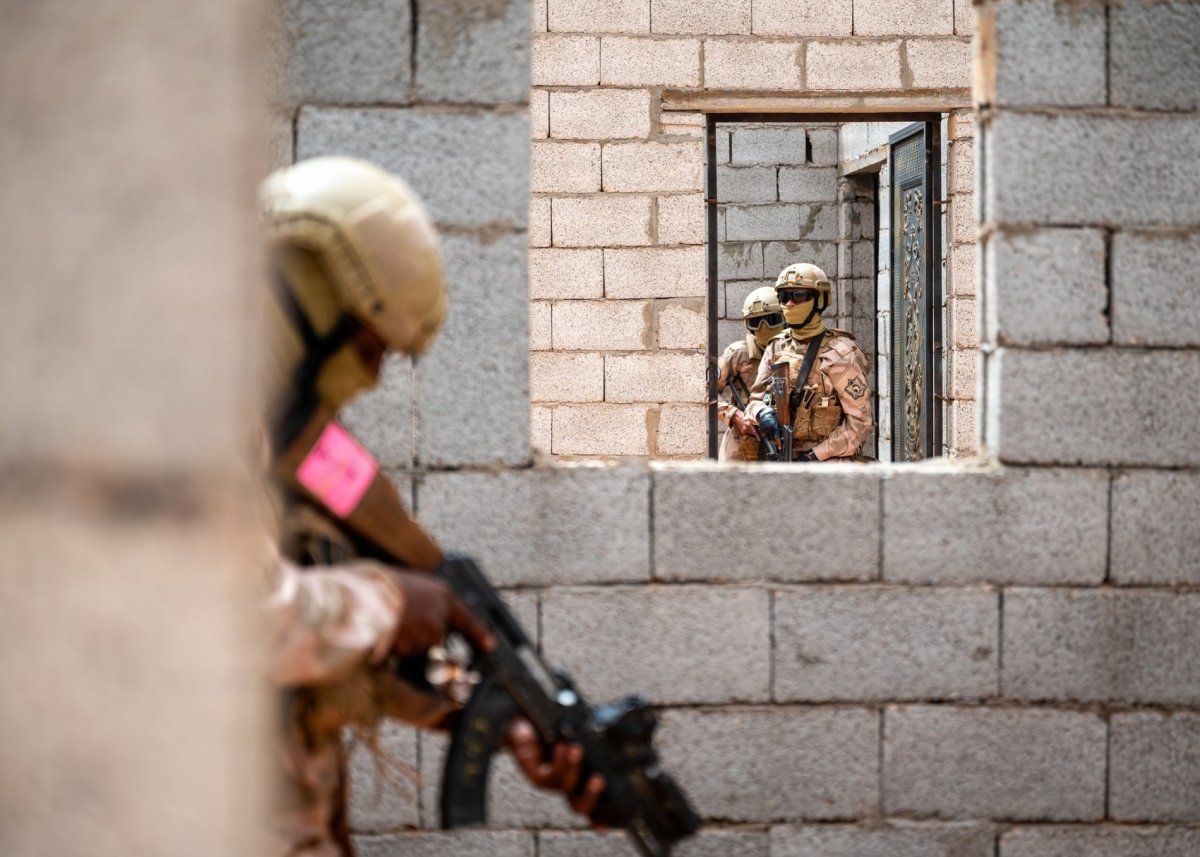
For the first time in more than a decade, fighting forces from rival factions in eastern and western Libya have been brought together, in a military exercise facilitated by the United States’ Africa Command (AFRICOM) in the Libyan city of Sirte. The Flintlock 2026 military exercise takes place alongside Washington’s continued support for mediation between Libya’s two governments, with US President Donald Trump’s senior adviser for African and Arab Affairs Massad Boulos playing a central role.
Representing western Libya was Abdel Salam Zoubi, deputy defence minister in the Tripoli-based Government of National Unity (GNU), while Lt. Gen. Saddam Haftar, deputy commander of the Libyan National Army (LNA), represented the east. The exercise placed Libyan forces within a single framework for the first time. Military personnel from across North and West Africa, alongside American and European participants, also took part in the manoeuvres to strengthen cooperation, enhance joint operational capabilities, and forge lasting relationships.
Exercise Flintlock began after dual opening ceremonies in Libya and Côte d’Ivoire on 14 April 2026. Conducted with the participation of Italian Special Forces, it focuses on strengthening counterterrorism capabilities and operating a joint multinational operations centre to improve regional security coordination, according to a statement issued by AFRICOM.
Unification efforts
Washington would like to reunify Libya’s military forces and bring an end to their division, which began after the country fragmented following the death of former dictator Col. Muammar Gaddafi, who was killed by rebel forces in 2011. The US wants to curb the influence of foreign troops and mercenaries in Libya, including that of the Russians deployed in eastern and southern Libya.
This military initiative forms part of a broader effort to bring together Libya’s fragmented political forces through a new distribution of power between LNA commander Field Marshal Khalifa Haftar (Saddam’s father) and Abdul Hamid Dbeibeh, prime minister of the GNU, his cousin and national security adviser, Ibrahim Dbeibeh, and allies in the west, where Turkish forces and Syrian fighters remain present.
Libya’s political and security conditions have been unstable since Gaddafi was overthrown in October 2011. The country has endured political division since 2014, when the House of Representatives was elected, and the former General National Congress refused to recognise its authority.
Two governments, in Tripoli and Benghazi, now compete for power in Libya. The internationally recognised GNU, based in Tripoli, is the successor to the former General National Congress. The second is the government appointed by the House of Representatives, led by Osama Hammad, while the forces of the LNA under Field Marshal Khalifa Haftar control the east and south of the country.
Boulos has succeeded in bringing Libya’s rivals to the table, with several meetings between Ibrahim Dbeibeh and Saddam Haftar, but this has met some resistance from political and military figures in western Libya, who see Field Marshal Khalifa Haftar as a threat after his forces’ failed 2019 attempt to seize the capital, Tripoli.
The head of Libya’s Presidential Council, Mohamed al-Menfi, fears losing his position if a political settlement between Dbeibeh and Haftar is reached, so he has sought to introduce strict regulations governing military training exercises in what appeared to be an effort to block any moves undertaken beyond his Council’s authority. Sources report that the proposed formula would install one of Haftar’s sons as head of the Presidential Council, while Dbeibeh would remain as prime minister and ministerial portfolios would be divided between the two camps.
Striving amid setbacks
The United Nations’ Support Mission in Libya welcomed the participation of representatives from both western and eastern Libya in the Flintlock exercises and renewed its support for efforts to unify Libya’s military and security institutions, describing this as an essential step in state-building.
In recent years, Libya has witnessed several assassinations of military, security, and political figures. Among those killed was the former head of the Stability Support Apparatus, Abdul Ghani al-Kikli. Lt. Gen. Mohammed al-Haddad, chief of the general staff in western Libya, died in an air crash, together with several military leaders. Saif al-Islam Gaddafi, the son of Muammar Gaddafi, was also killed. He would have posed a formidable challenge in any forthcoming election or political process.
US-Libyan military cooperation is not new. AFRICOM previously supported the former Government of National Accord during its 2016 war against Islamic State in Libya, American forces conducting hundreds of airstrikes against the group’s positions and giving Libyan forces logistical and operational support. This contributed to the defeat of IS in Sirte, where these exercises are now being held.
Today, the focus is on foreign forces and mercenaries, and their damaging effects both domestically and across the wider region. Turkish and Italian forces remain stationed in western Libya, while Russian mercenaries (that once formed part of the Wagner Group) are deployed in the east and south.
Boulos has persuaded the Libyan parties to approve the country’s first unified budget in more than 13 years, to support economic stability and ensure the equitable distribution of development allocations. Under Joe Biden, Trump’s White House predecessor, the US passed legislation to break the cycle of instability through a ten-year strategic plan.
The aim was to help Libya advance in its transition towards a unified, democratically-elected, and stable political system with broad participation across Libyan society. It also sought to establish a unified military and security apparatus under civilian control, with state monopoly over the legitimate use of force. Yet stability requires Libya’s rival factions to make concessions, and it is not yet clear whether those who head the country’s rival fiefdoms are willing to give up what they have accrued.