
The IRGCN’s distributed swarm tactics, low-cost vessels, and thousands of naval mines have survived CENTCOM strikes. Elite fragmentation—with IRGC hardliners overriding diplomats—restricts negotiating flexibility. Decapitation strikes have reinforced hardline cohesion rather than moderating outcomes. Horizontal escalation via Houthi Bab al-Mandab threats is a growing risk.
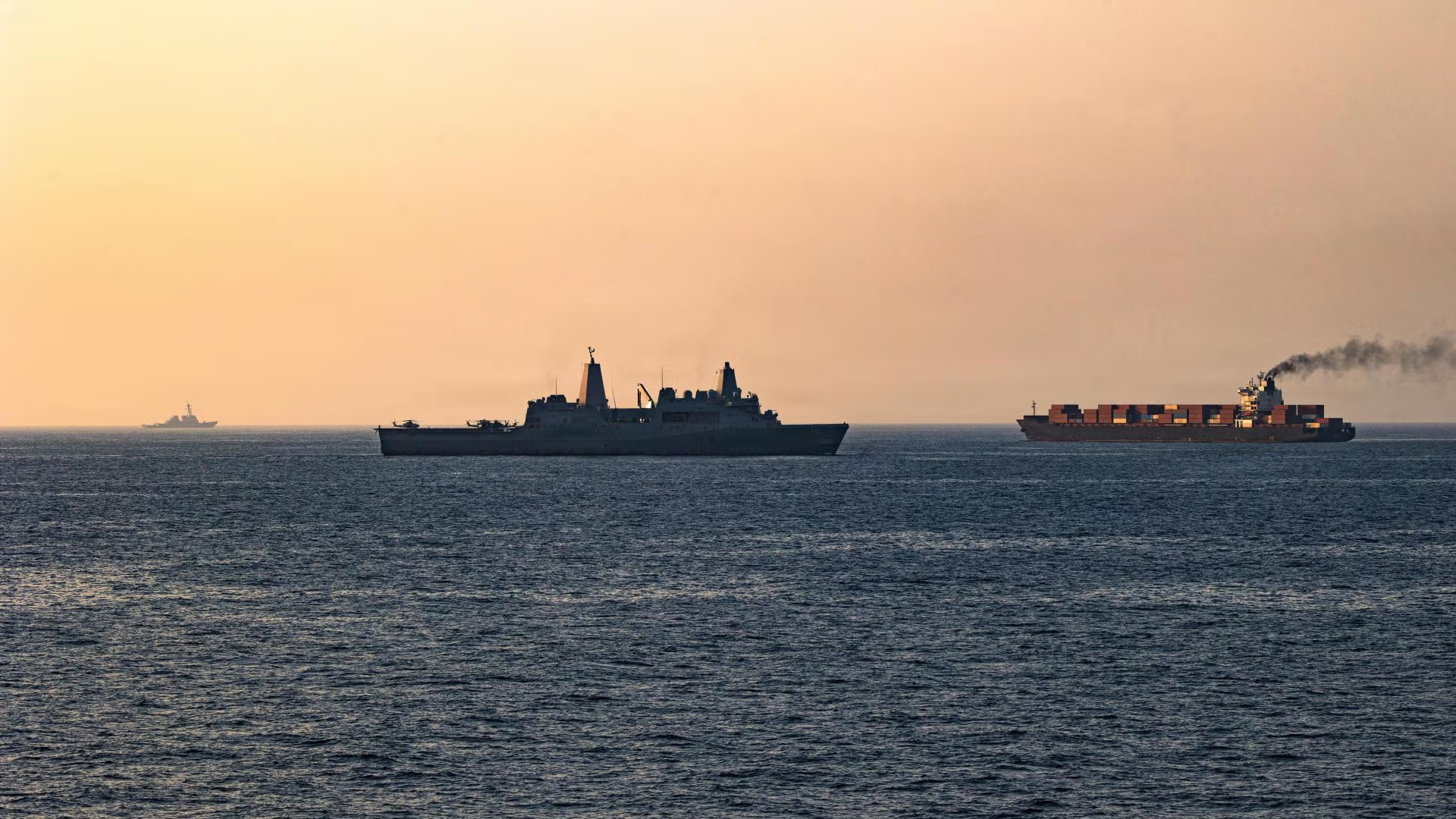
The naval campaign orchestrated by United States Central Command (CENTCOM) has inflicted significant losses on Iran’s conventional maritime assets, with dozens of Iranian platforms destroyed, disabled, or resting at the bottom of the Gulf. Despite these successes, the Strait of Hormuz remains at the core of the current impasse between Washington and Tehran.
Just this week, Iran’s Islamic Revolutionary Guard Corps (IRGC) seized two container vessels attempting to exit the Gulf and targeted but failed to capture a third. These incidents marked the IRGC’s first confirmed vessel seizures since the war began in late February.
Iran is also seeking to levy transit fees on ships passing through the strait. This effort risks setting a precedent that could give Tehran’s Houthi proxies the green light to threaten shipping through the Bab al-Mandab Strait, complicating international maritime traffic even further.
How is Iran, despite losing most of its conventional naval forces, still able to threaten the Gulf and the Strait of Hormuz?
Understanding the current dynamic playing out in the waters off the Arabian Peninsula requires attention to the IRGC’s strategy—and of the actors implementing it. Most of Iran’s conventional platforms sunk or disabled by allied strikes belonged to the Artesh, the regular armed forces of Iran. By contrast, the Islamic Republic’s Revolutionary Guards maintain their own asymmetric naval inventory built specifically for combat operations in the Strait of Hormuz, much of which remains intact. The IRGC is using these assets to imperil the strait.
This unconventional force’s table of organization and equipment centers on a distributed “mosquito fleet” concept, built for asymmetric combat operations and threat projection. Within this organizational system, fast, armed crafts operate in coordinated groups alongside low-signature auxiliaries, including fishing dhows and other civilian vessels repurposed for covert minelaying. The IRGC reinforces this maritime layer with a robotic component consisting of unmanned systems, as well as a tactical Anti-Access/Area Denial (A2/AD) deterrent composed of anti-ship ballistic and cruise missiles. This overall architecture is designed to impose friction and attrition rather than to seek or win a decisive naval engagement.
Further, the Islamic Revolutionary Guard Corps Navy (IRGCN) has designed a force-generation pattern built around dispersion, speed, and volume rather than reliance on large capital ships. Many of the IRGCN’s fast-attack crafts are inexpensive, lightly built, highly mobile, and often armed with short-range anti-ship missiles, rockets, and heavy machine guns. Some vessels are even configured as explosive-laden suicide crafts.
The IRGCN’s military posture is also optimized for the cluttered littoral environment of the Strait of Hormuz. In this construct, sensors and shooters are loosely coupled, allowing a force to absorb losses while maintaining its operational tempo. The IRGCN designs and manufactures its vessels to remain affordable, evade sanctions, and be easily replaceable in wartime. This approach enables Iran to generate mass at a relatively low cost while placing an adversary’s high-value assets—and the global maritime economy—at risk.
Operationally, the IRGCN relies on swarm tactics and compressed engagement timelines to disrupt otherwise superior naval forces. Using these methods, small craft can approach from multiple axes and often blend with civilian traffic to saturate surveillance and defensive systems before closing distance for attack or harassment.
Strategically, this approach seeks not control but denial. It complicates access to key waterways, raises the economic and military costs of intervention, and sustains coercive leverage without escalating into full-scale war. The IRGCN’s core concept of operations is designed to exploit geography and asymmetry, turning narrow straits into contested zones where persistence and ambiguity favor the defender.
The shallow, narrow lanes of the Strait of Hormuz near Omani territory all but force transiting vessels to approach Iranian waters. Iran’s deployment of naval mines further increases the risk of interdiction. Recent reporting suggests that the Islamic Republic has already begun mining operations in the strait.
Iran’s dangerous groupings of naval mines, including the Maham-2, are optimized for shallow waters, employ advanced sensors, and are difficult to detect. This often frustrates mine-clearing operations. The Maham-7, another Iranian mine, uses non-metallic components and an unconventional geometry to reduce the likelihood of sonar detection. Multi-axis magnetic and acoustic sensors allow the Maham-7 to target a range of vessels, and it can be deployed from surface ships, helicopters, or parachutes, increasing its versatility in shallow waters. For deeper waters, Iran deploys the Maham-3, which employs acoustic and magnetic triggers to inflict significant damage.
Because of these asymmetric capabilities, the degradation of Iran’s conventional fleet has not provided the United States and its allies complete and undisputed maritime control over either the Gulf or the Strait of Hormuz. As a result, the conflict’s operational center of gravity has shifted toward the IRGCN’s asymmetric naval-warfare capabilities. The Strait of Hormuz therefore remains a denial battlespace, where attrition allows Tehran to hold global shipping at risk despite its significant tactical losses.
A Threat That Is Difficult to Destroy
While the big guns of Iran’s conventional navy have been removed from the fight, the simpler systems that remain—drones, small speedboats, and naval mines—constitute a military architecture that resists decisive destruction. These assets can be contained, but not fully annihilated.
To begin with, weapons used in asymmetric naval warfare are inexpensive, numerous, and easy to distribute. Destroying hundreds would eliminate only a fraction of total inventories, as the IRGC boasts maintaining thousands of these vessels and can replenish its stocks even while fighting. Moreover, these small crafts are difficult to locate—and even harder to hit. Open-source intelligence tracking suggests that the Islamic Republic has constructed underground bunkers for its asymmetric naval warfare deterrent, just as it has built subterranean cities for its missile architecture.
Iran’s stocks of naval mines likewise number in the thousands. These mines can be deployed covertly, from dispersed positions along Iran’s rugged coastline or through deniable actors operating under civilian cover.
Finally, the robotic component of Tehran’s forces warrants particular attention. Unlike missiles, the power of which is always constrained by launcher attrition, Iranian drones have already demonstrated their capacity to damage commercial shipping.
The Ceasefire Paradox in the Strait of Hormuz
With the threat of Iran’s asymmetric naval assets constantly present, any attempts to forge a ceasefire between the US-Israeli coalition and the Islamic Republic remain fraught. The recent two-week ceasefire, already tenuous because of the contested Strait of Hormuz, was set to expire this week and was not officially extended. After hostilities seemed to resume earlier this week, President Donald Trump unilaterally extended the ceasefire window. Iran, however, stalled its response to this move, and claimed that any ceasefire would be meaningless as long as the blockade in the critical chokepoint of the Strait of Hormuz remained in force.
In the meantime, military operations have continued in the strait, with both the US Navy and the IRGCN on high alert. The US Navy continues maritime-interdiction and enforcement of the blockade on Iranian ports, while US CENTCOM has welcomed a third aircraft carrier, the USS George H.W. Bush, into its area of responsibility.
Iran’s approach to this phase of the conflict centers on threats of mine-laying, visible swarm activity to deter transiting traffic, and selective attacks designed to reinforce these deterrent signals. Tehran’s goal appears to be controllable restriction rather than closure of the strait, which would allow Iran to modulate pressure as needed. Iran will likely continue to pursue this strategy in an effort to strengthen its position ahead of any ensuing negotiations, unless the United States changes the cost-benefit calculus confronting the Islamic Republic—or internal shifts within the regime change that balance of power.
Tehran’s Shadow Chain of Command: Visible Negotiators, Hidden Authority
When President Trump unilaterally extending the recent ceasefire, he called on Tehran to produce a “unified proposal.” While it is no secret that Washington’s North Atlantic Treaty Organization allies have been divided in their approaches to the conflict, the administration’s phrasing marked its most explicit reference to date of the multiple factions vying for power within Iran’s elite.
Even before the current war, the Iranian regime included hardliners opposed to negotiating with the United States, including Parliament member Amir Hossein Sabeti. These figures often function as unofficial spokesmen for the radical factions within the IRGC. Nonetheless, before his death, Supreme Leader Ali Khamenei had managed to impose some measure of discipline on the regime’s multiple competing power centers, the results of which were visible during the 2015 nuclear negotiations.
Following Khamenei’s death in US-Israeli air strikes and the nominal accession of his son, Mojtaba, that discipline has all but vanished. The recent death of Ali Larijani, secretary of Iran’s Supreme National Security Council, may have further contributed to the resurfacing of divisions between the regime’s political leadership and its security apparatus, led by the IRGC—particularly in the absence of a powerful top cleric.
Paradoxically, recent decapitation strikes against Iran’s senior leadership appear to have triggered a wave of messaging emphasizing political resolve. Senior regime figures have stressed unity and cohesion across their social media platforms.
From a rhetorical standpoint, this is atypical for the Islamic Republic and authoritarian systems where overt unity campaigns often signal underlying strain rather than strength. Whether intentional or not, this messaging, amplified by Western media coverage, may have surfaced, rather than suppressed, latent divisions within the regime.
The power structure driving Iran’s negotiations is therefore complex. Mohammad Bagher-Ghalibaf, despite serving as speaker of Parliament, does not exercise final authority in discussions. Instead, the IRGC exerts direct control over diplomatic decision-making and frequently overrides civilian diplomats it deems ineffective in negotiations.
This dynamic restricts Iran’s negotiating flexibility and helps explain recent public retractions of statements on uranium enrichment and access to the strait. Reporting indicates that the inner circle of IRGC General Ahmad Vahidi, who is currently wanted by Interpol, is advancing its preferences by exploiting pressure in the maritime domain. Vahidi has most likely translated his operational leverage into political influence, including against potential internal rivals such as Ghalibaf. Israeli media have even claimed that Ghalibaf recently stepped down as a negotiator, though these claims remain unconfirmed.
Elite fragmentation is not new in Iran, especially amid wartime pressure. Evidence of elite divergence has surfaced repeatedly over the last two months, most notably when IRGC units launched missile salvos against Gulf Arab neighbors on the heels of comments by Iran’s president, Masoud Pezheskian, suggesting that Tehran would not attack those countries.
Similarly, Iran’s state-aligned media broke from usual practice to issue unusually sharp criticisms of Foreign Minister Abbas Araghchi after he announced the reopening of the Strait of Hormuz in a post on X. These outlets warned that the statement created strategic ambiguity at a sensitive moment and undercut the regime’s information control efforts. Hardline platforms, including Mehr News Agency, further argued that the statement handed President Trump an advantage in shaping international perceptions of the conflict on favorable terms that did not reflect the operational reality of the fight.
What to Monitor in the Coming Days
Internal power dynamics in Tehran. Iran’s internal power dynamics are directly constraining negotiations, with IRGC-linked hardliners undercutting others’ efforts to maintain diplomatic flexibility. Media reports about possible US targeting of figures such as Ahmad Vahidi reflect a coercive logic intended to remove spoilers from the equation. Thus far, however, decapitation attacks have had limited effects on Iran’s system and have instead often reinforced hardline cohesion rather than moderating outcomes. This dynamic limits the political and military payoff behind any decapitation strikes.
Asymmetric maritime activity. Iran’s so-called mosquito fleet—vessels that pose an asymmetric threat to the United States and its allies—has become increasingly active. As a result, the likelihood of fast-boat swarm attacks and naval-mine incidents have drastically increased.