
Iran Oil Pain creates significant economic pressure, yet historical analysis suggests that regional logistics crises and regime resilience often mitigate the intended political outcomes of sustained Iran Oil Pain.
Understanding the Reality of Iran Oil Pain
President Donald Trump now appears to share a view gaining traction in some policy circles: that sustained pressure on Iran’s oil sector could inflict lasting damage on its production and eventually force Tehran to compromise. The thesis is appealingly simple, yet dangerously incomplete.
It is true that if export constraints persist, the Islamic Republic could face meaningful output curtailments within weeks or months. The actual timing depends on factors such as storage capacity, domestic consumption, sanctions evasion, and alternative export routes. Still, if current constraints persist, Iran would likely have to reduce output across selected fields, with some wells eventually taken offline if constraints persist. The pressure on Tehran is real.
Yet the narrative often overstates the precision of the timeline, the irreversibility of any production loss, the uniqueness of Iran’s predicament, and the Islamic Republic’s sensitivity to economic pain.
Regional Consequences of Iran Oil Pain
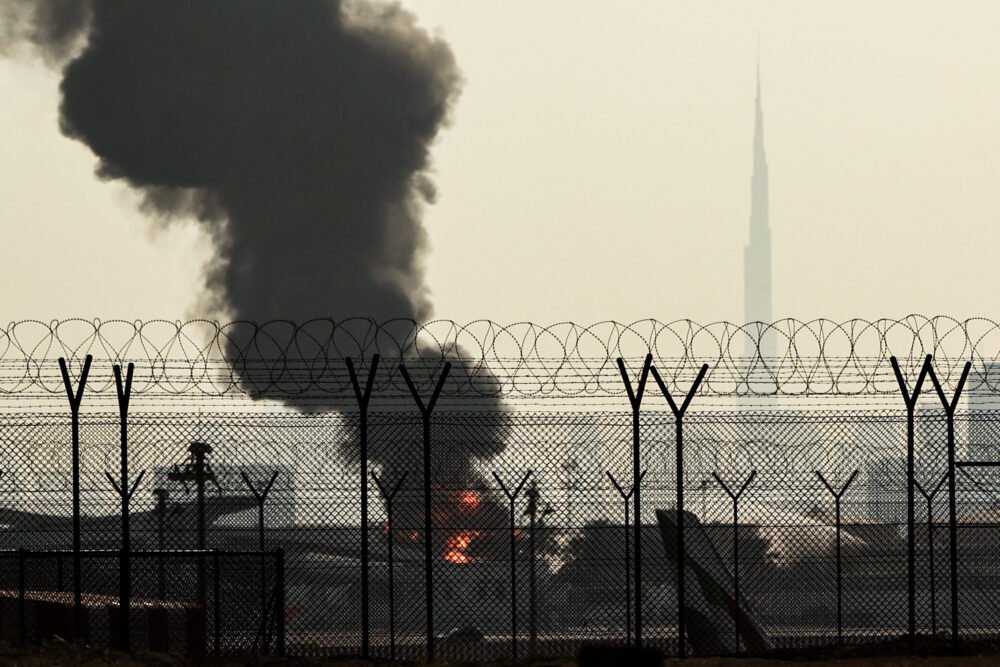
This is by no means an exclusively Iranian logistics crisis. The Strait of Hormuz normally carries roughly 20 million barrels per day (bpd) of oil produced by the littoral states — about one-fifth of global consumption. A prolonged disruption would impact every Gulf exporter reliant on that waterway.
Iraq appears among the most exposed because of its dependence on oil and natural gas export infrastructure at the port of Basra. It has a nominal alternative outlet through the northern Kirkuk-Ceyhan pipeline to Turkey’s Mediterranean coast with a nameplate capacity of roughly 1.6 million bpd, but the route has been running at only around 15 percent of that capacity, hobbled by the long-running Baghdad-Erbil payment dispute and persistent technical problems. For practical purposes, Iraq has no meaningful bypass. Kuwait, too, is highly vulnerable. Qatar’s exposure is less about crude oil than liquefied natural gas (LNG) and condensate exports, where force majeure declarations have already underscored the seriousness of the disruption.
Strategic Infrastructure and Rerouting
Saudi Arabia and the United Arab Emirates, by contrast, are relatively better positioned, having invested in pipelines that partially bypass Hormuz; but available rerouting capacity remains limited compared to normal export volumes. The United States Energy Information Administration (EIA) estimates their combined immediately usable bypass capacity is roughly 4.7 million bpd. These are meaningful cushions, though they fall well short of those countries’ normal Hormuz throughput.
As of late April, Goldman Sachs estimated Gulf crude production was running 57 percent below prewar levels, with roughly 14.5 million bpd offline. Earlier in April, EIA scenario estimates suggested regional curtailments could approach 9 million bpd under severe stress. Precise wartime figures are inherently uncertain, but the broader direction is unmistakable.
In other words, this is a chokepoint crisis, in which some states possess partial workarounds, spare capacity, or export routes that bypass the Strait of Hormuz, while others remain heavily dependent on a single vulnerable passage. The pain is regional, but it is not distributed evenly.
Technical Risks of Iran Oil Pain
There is also confusion around the phrase “permanent production loss,” which often conflates two very different risks. The first is above-ground infrastructure damage. If key terminals such as Kharg Island are degraded or repeatedly disrupted, exports could slow sharply and repairs may take time.
The second is field and reservoir impairment from prolonged shut-ins. That risk is real, but highly field-specific. Outcomes would depend heavily on how well Iranian engineers manage shutdowns and restarts, as well as on geological conditions, reservoir pressure, the age and maturity of affected fields, and how long the shut-in lasts.
The more credible concern is not that Iran would suddenly lose the ability to pump oil, but that some fields could return more slowly, at lower rates, or with lasting reductions in productive capacity. In other words, the damage would likely be partial, uneven, and costly — not absolute.
Political Miscalculations of Iran Oil Pain
More importantly, many observers make a deeper analytical mistake in assuming that the Islamic Republic weighs costs the way a normal commercially minded state would. It does not. The prospect of losing 10-20% of its oil production capacity is highly unlikely to convince the current decision-makers in Tehran to concede to American demands.
For decades, the regime has repeatedly prioritized survival, coercive leverage, ideological commitments, and internal control over economic welfare. It has tolerated sanctions, isolation, inflation, capital flight, and deep economic damage when leaders judged those costs preferable to strategic concession. Long before this crisis, mismanagement and corruption were already eroding Iran’s oil sector and broader economy.
That does not mean continued US pressure is irrelevant. Revenue losses, operational strain, and infrastructure vulnerability all matter. Yet the real question is not simply whether Iran could lose production capacity. It is how large any loss would be, how durable it would prove, and how heavily it would weigh in the calculations of those actually calling the shots in Tehran.
The Decisive Calculus
Production losses that look decisive on a spreadsheet may carry less weight in the regime’s calculus than many Western analysts assume. Tehran may also be betting that its tolerance for pain exceeds that of its rivals and an oil-sensitive global economy — that others will seek relief long before it seeks compromise.
This is why countdown narratives — the belief that mounting oil pressure will predictably force Tehran to concede on a fixed timetable — are dangerous. They tempt policymakers into believing that economic pain automatically produces political leverage or capitulation — and that once a threshold is crossed, strategic concession will follow. That is not always the case, especially with a regime that has repeatedly shown little regard for the welfare of its own people.
The Islamic Republic may indeed be under growing oil pressure. But the better frame is not a neat countdown. It is a regional logistics crisis colliding with a regime that has its own decision-making logic.
By all means, watch the gauges. Just do not forget that Tehran tends to read them differently.