
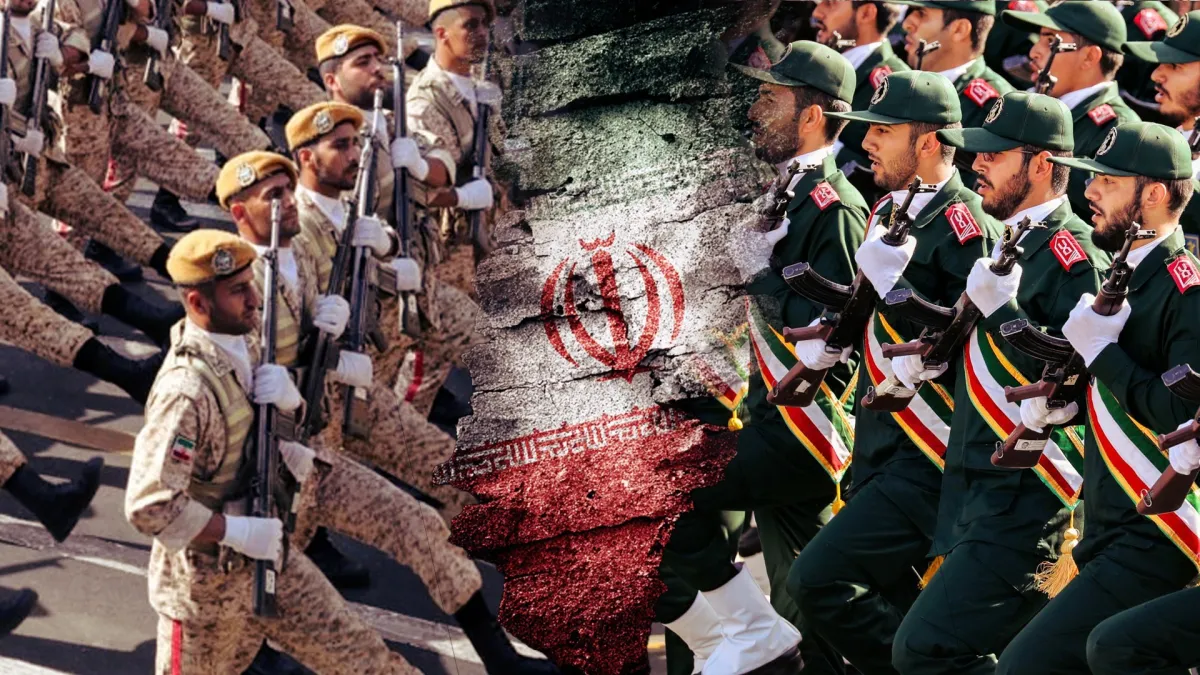
Clashes erupted between Iran’s Revolutionary Guards and regular army during recent wars, fueled by distrust since 1979. Guards expelled officers over alleged leaks, detained dozens. Army resents marginalization; without Khamenei’s authority, power struggles risk structural instability.
The historic Iran military rivalry has escalated from bureaucratic friction into direct, violent confrontations across multiple cities. This internal Iran military rivalry threatens the core stability of the regime during an unprecedented period of regional conflict. As factions clash openly, the deepening Iran military rivalry exposes massive structural fractures that could permanently alter the country’s defense hierarchy, pushing an already vulnerable nation into a volatile Iran military rivalry for absolute state control.
Sky and ground battles fuel the Iran military rivalry
The chaos that engulfed Iran during the wars of March and April did not unfold only in the skies above the country, with airstrikes, missile fire and exploding drones. According to former Iranian military officers, activists and analysts, another conflict was intensifying behind the scenes: a widening struggle between Iran’s powerful Revolutionary Guards and the country’s conventional army.
The tension between the Islamic Revolutionary Guard Corps, or I.R.G.C., and the regular military traces back to the earliest days of the Islamic Republic.
In May 1979, shortly after consolidating power, Ruhollah Khomeini established the Revolutionary Guards as a parallel military force intended to protect the new regime from any potential coup by the national army, which revolutionary leaders viewed with suspicion because of its ties to the deposed shah.
Although the new leadership quickly purged many senior military commanders, distrust of the army persisted for decades.
Over time, the Revolutionary Guards steadily expanded their authority across Iran’s military hierarchy, political institutions and economy, ultimately becoming the dominant force inside the state. Yet beneath that consolidation of power, resentment continued to simmer among rank-and-file officers and soldiers in the regular army, particularly as the Guards deepened their influence over Iran’s domestic security apparatus and regional operations abroad.
Elite purges deepen the Iran military rivalry
After weeks of outreach through Iranian opposition intermediaries, Alhurra said it had established contact with three former Kurdish officers from the Iranian army — including a retired brigadier general — as well as activists who monitor internal divisions within Iran’s ruling establishment. All currently reside inside Iran and maintain ties to active-duty officers.
Those sources described a sharp escalation in tensions during the 40-day conflict involving Iran, the United States and Israel.
According to the accounts, armed confrontations broke out between Revolutionary Guard units and army personnel in Tehran, Tabriz, Isfahan, Kermanshah, Mariwan and Ahvaz, resulting in casualties on both sides.
The clashes, the sources said, began after Revolutionary Guard commanders expelled army officers and soldiers from joint military installations, accusing them of leaking information about missile bases and drone facilities to Israel and the United States.
The sources added that Revolutionary Guard intelligence later detained dozens of army officers and enlisted personnel after the confrontations were contained. Many, they said, remain in custody.
Institutional marginalization worsens the Iran military rivalry
Several of the sources also described growing frustration inside the regular army, where some officers have increasingly resisted directives issued by the Revolutionary Guards, particularly regarding military operations inside Iranian cities.
According to those accounts, many army officers view Guard-led operational planning as ineffective and politically driven, while lower-ranking personnel resent what they see as years of institutional marginalization by the Guards and their leadership.
Aso Qadri, an Iranian Kurdish political activist based in Europe, said the conflict is driven less by ideology than by competition over authority inside an increasingly fragmented power structure.
“In theory, Mojtaba Khamenei is considered the leader of the Islamic Republic,” Mr. Qadri said in comments to Alhurra, referring to the son of Iran’s former supreme leader. “But in practice, he has not exercised the same decisive authority as his father. That has shifted power toward overlapping military and security networks that compete with one another even as they cooperate.”
“In that environment,” he added, “the Revolutionary Guards are trying to tighten their grip over every institution of the state.”
Analysts and Iran specialists interviewed by Alhurra said internal rivalries within the Iranian system — particularly between the Revolutionary Guards and the regular military, as well as between state intelligence agencies and Revolutionary Guard intelligence — have intensified since the death of Ali Khamenei in a joint American-Israeli strike on his residence in Tehran on Feb. 28.
Post-Khamenei power vacuum intensifies Iran military rivalry
Fuad Abu Risala, secretary general of the Arab Front for the Liberation of Ahvaz, said the roots of the conflict stretch back to the founding of the Islamic Republic itself.
“The divide between the Revolutionary Guards and the Iranian army has become even deeper in the absence of the supreme leader,” Mr. Abu Risala said. “The army is looking for an opportunity to free itself from the Guards — or perhaps to settle decades of marginalization.”
He predicted that more anti-Guard activity could emerge in the coming months, including clandestine military operations carried out by officers seeking to exploit what he described as growing disorder and weakening control by the Guards.
Mr. Abu Risala also argued that many Iranians — particularly among non-Persian communities — increasingly view the Revolutionary Guards and their regional proxy networks as instruments of repression, while the regular army retains a greater degree of public acceptance.
Iran does not publish official figures on the size of its armed forces. But estimates obtained by Alhurra from Iranian opposition sources suggest that the regular military still surpasses the Revolutionary Guards in manpower, though not in influence or resources.
According to those estimates, the regular army includes roughly one million personnel, including about 700,000 active-duty troops and 300,000 reservists across the ground, naval and air forces.
The Revolutionary Guards, by comparison, are estimated to have approximately 500,000 members spread across their ground, naval and aerospace divisions, as well as the Quds Force and intelligence branches.
The Basij militia, which operates under the authority of the Guards and plays a major role in domestic security enforcement, is believed to include around 300,000 active personnel and more than two million reserve volunteers.
Resource disparities shape the Iran military rivalry
Despite the army’s numerical advantage, analysts say the Revolutionary Guards possess vastly superior resources and weaponry.
The Guards oversee Iran’s ballistic missile and drone programs, along with large portions of the country’s unconventional weapons infrastructure and nuclear program. The conventional army, by contrast, relies largely on aging equipment that has seen limited modernization since the Iran-Iraq war.
The Guards also wield enormous economic power through Khatam al-Anbiya, a sprawling engineering and business conglomerate that dominates major sectors of Iran’s economy and plays a central role in sanctions-evasion networks and foreign trade.
That financial reach has enabled the Guards to sustain military operations and weapons development programs on a scale far beyond the capabilities of the conventional army.
Lamar Arkandi, a researcher specializing in extremist movements, described the widening divide as a potentially dangerous turning point for Iran’s internal security structure.
“This is an extremely serious development,” Ms. Arkandi said. “It could evolve into a struggle for control between the leadership of the Revolutionary Guards and the army.”
She said the Guards would likely impose additional security measures across Iranian cities in an attempt to contain the tensions before they spill into broader unrest or clashes among competing security institutions.
“Once fractures begin appearing within the security apparatus itself,” she added, “Iran moves from a state of tension into a state of structural instability. That is far more dangerous for the regime than ordinary political dissent.”