
Western Alliance China Policy is currently undergoing a structural collapse as allies hedge against a transactional Washington. Global stability now depends on a unified Western Alliance China Policy. Recent shifts in the Western Alliance China Policy suggest a dangerous tilt toward Beijing’s influence. To prevent total subordination, leaders must repair the Western Alliance China Policy.
The Rising Stakes for Western Alliance China Policy
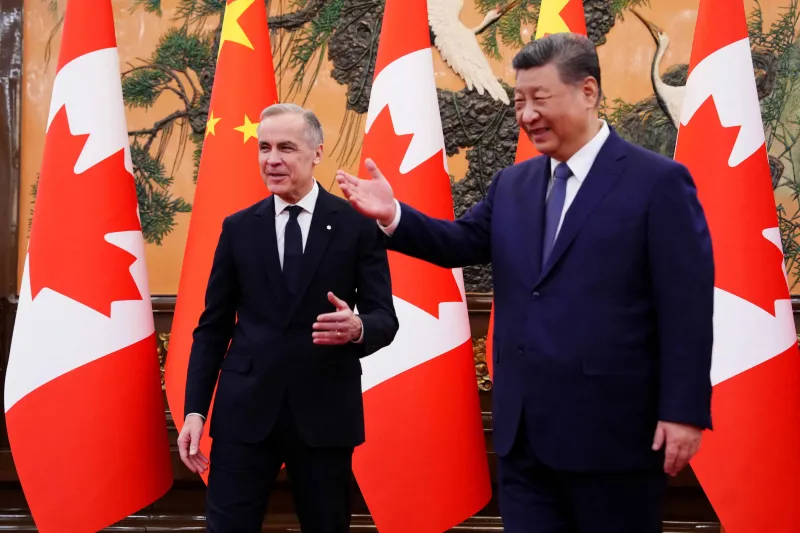
In January, after weeks of threats by U.S. President Donald Trump to annex Canada as the “51st state,” Canadian Prime Minister Mark Carney stood in Beijing’s Great Hall of the People, radiating cordiality toward the leaders of a country he had called Canada’s greatest geopolitical threat less than a year earlier. In a meeting with Chinese Premier Li Qiang, he said that “the progress that we have made in the partnership sets us up well for the new world order.
” It was not a great moment for the United States. Yet that scene—a leader anxious about Washington, rushing to Beijing with a newfound urgency—has played out again and again since Trump’s return to the White House.
In 2025, the leaders of Australia, France, Georgia, New Zealand, Portugal, Serbia, Slovakia, Spain, and the European Union all traveled to China. In January, the pace of visits accelerated, with the leaders of Finland, Ireland, South Korea, and the United Kingdom arriving in quick succession, followed in February by Uruguay’s president and Germany’s chancellor. In April, Spain’s prime minister cemented the pattern with his fourth visit in four years.
They walked red carpets, shook hands with senior Chinese Communist Party officials, and signed memorandums to shore up relations. The accumulating spectacle—what Chinese state media has called a “wave” of visits—reinforced the CCP’s narrative of a rising China and a declining United States.
Why Hedging Undermines Western Alliance China Policy
Now these and other leaders are likely watching with trepidation as Beijing prepares to receive the president of the United States next week. For Canada and other U.S. allies and partners, the primary impetus for deepening ties with China is Trump himself. Under pressure from a United States behaving like a predatory hegemon, these politicians feel that they have no choice but to hedge. Meeting Chinese President Xi Jinping sends a signal to Trump that they have other options and will not be subordinated into all-or-nothing allegiances or unfair trade agreements. In this way, the growing distance between Washington and its partners is a diplomatic gift for Beijing.
But ahead of Trump’s visit, Carney and other leaders have no guarantee that any deals Trump and Xi strike won’t leave them worse off. They cannot trust Trump to consider their interests, so they have to hope that Chinese officials will remember their concerns about China’s manufacturing overproduction, weaponization of trade, and foreign interference and will grant them economic relief in return for their displays of accommodation. Their vulnerability underscores the problem in their collective action on this front and the need for Carney and other leaders to align their China policies and messages, defend common redlines, and collectively impose costs on Beijing for its coercion.
Restoration of Trust and Coordination
Although the shattered trust between the United States and its allies cannot be quickly restored, Washington can still aid this effort. It may be too late for the Western alliance to forge a truly unified approach to China, but coordination is not out of reach. For his part,
Trump should lead by example, eschew the mistakes of other visiting heads of state, and refuse ephemeral deals that deepen the United States’ dependence on China. Rather than seeking superficial adulation from Beijing, he should use the upcoming visit to strengthen deterrence by coordinating in advance with allies and setting redlines that none will cross, signaling he will impose costs for Chinese coercion that targets any of them, and conditioning any concessions on verifiable follow-through. That would diminish Beijing’s confidence in its strategy of compelling accommodation from individual countries.
Trump and subsequent foreign delegations should use each trip to China as an opportunity to demonstrate firmer alignment on positions and interests. Such an approach would create space for the Western alliance to focus on enduring objectives: preserving advanced industrial capacity and a technological advantage, diversifying critical supply chains to eliminate chokepoints, and constraining Beijing’s global influence.
Economic Risks to the Western Alliance China Policy
THE HOUSE ALWAYS WINS Individually, each of the official visits to Beijing may have been defensible and even served the visiting state’s rational self-interest.
But in the aggregate, the result has been a political and propaganda bonanza for Beijing. By accepting the terms Xi sets and performing in his authoritarian pageantry, these prestigious visitors are gratifying his yearning to be recognized as the world’s foremost strongman. Over time, such displays add up, and when combined with acquiescence on material matters such as Western leaders’ reluctance to sanction Chinese companies that support Russia’s war on Ukraine, they can shape other countries’ assessments of geopolitical power and legitimacy.
Such a shift in Beijing’s favor would ultimately harm U.S. partners and allies. Beijing has long pursued economic policies that strengthen its own autonomy while making others more dependent. And it has not hesitated to weaponize access to China’s market and control of supplies, particularly critical minerals, to defend its interests and impose its will. The United States’ partners, now hedging against a transactional Washington, are compelled to accommodate China. But deeper entanglement with China’s authoritarian state-capitalist system risks the greater danger: subordination to Beijing.
On their visits to China, state leaders let their hosts dictate the terms of engagement, which equates their presence with tacit acceptance of the CCP’s revisionist agenda. Moreover, because China’s market still exerts a gravitational pull, visiting politicians find it hard to resist the instant gratification of commercial agreements. Most arrive with large business delegations representing companies that are enmeshed in the Chinese economy and seeking political and regulatory cover for trade, investment, and operations.
Beijing, meanwhile, is playing a longer game. Chinese officials weaponize economic interdependence for leverage in pursuit of more profound strategic and political advantages. Chinese protocol and propaganda officials ensure that each visitor accepts a script and choreography that reinforce Xi’s narrative of China’s inevitable rise. Deference to Beijing is now a requirement for economic cooperation.
Visiting leaders must convey grievances and criticisms privately, if at all, and in public must speak the language of “strategic partnerships” and “resets,” not of human rights and democracy. Even disagreements over sovereignty and security matters—for example, China’s military intimidation in the western Pacific and its use of espionage, technology theft, and disinformation—must be framed as “misunderstandings.” The perception all this creates is that the world is coming to Beijing and that decoupling is impossible.
Trade Imbalances and Western Alliance China Policy
Chinese officials calibrate deliverables to their assessment of each visitor’s deference and leverage, ensuring that immediate outcomes and long-term trends tend to tilt in China’s favor. For example, Carney loosened restrictions on imports of Chinese state-supported electric vehicles—initially imposed in coordination with Washington—in exchange for a rollback on Beijing’s duties on Canadian canola and other food products. Ottawa’s concession showed Beijing that a U.S. ally spurned by Trump could be pressured to break ranks.
European leaders have struck their own deals for relief from Chinese duties on dairy products, beef, and brandy while courting investment and market access.
British Prime Minister Keir Starmer, for instance, hailed a cut in tariffs on Scotch whisky from ten to five percent, not long after his government approved a contentious new Chinese embassy in central London and dropped charges against two men accused of spying for China. The most recent leader to visit Beijing, Prime Minister Pedro Sánchez of Spain, secured market access for Spanish pork and other minor concessions, all the while echoing CCP slogans about opposing the “law of the jungle,” being on the “right side of history,” and supporting Xi’s “Four Global Initiatives” in a “multipolar order” with China as “one of the centers.
The asymmetry in that relationship, meanwhile, still holds: China still supplies 11 percent of Spain’s imports while taking just two percent of its exports, a bilateral surplus that has grown faster than the countries’ total trade. And Spanish investment flows into China are at a three-decade low, even as Madrid has allowed Chinese investments in critical infrastructure and battery and electric vehicle plants without requiring technology transfers.
In other words, few of these deals buy economic resilience for the visiting countries. Instead, they reorient trade in ways that impede the development of their own economies.
Exports to China are increasingly dominated by agricultural commodities, processed foods, and natural resources—fiercely competitive industries that require heavy investment in logistics, making substitution easier for Chinese buyers than foreign suppliers. Cases of CCP coercion targeting Australian wine, Canadian canola, and Norwegian salmon illustrate the imbalance: Beijing can rotate suppliers and leave unfavored ones to absorb years of losses. To stay in Beijing’s good graces, these countries must accept ever more imports of China’s increasingly advanced manufactured goods while their own industrial and technological bases wither.
The result has been persistent trade surpluses for China, reaching a historic high of $1.2 trillion last year. The competitive pressure on industrial sectors around the world has led some analysts to speak of a “second China shock.
China already accounts for roughly 30 percent of global manufacturing output, and the UN Industrial Development Organization projects that it will produce 45 percent by 2030. Meanwhile, established industrial powers including Germany, Japan, and the United States are set to further decline. Even commodity-heavy economies such as Australia and New Zealand have seen their exports to China fall. These countries increasingly serve as farms, mines, and gas stations servicing China—while depending on Chinese factories, refineries, and technology.
The Fragmented Coalition
THE COALITION THAT WASN’T Foreign leaders are not oblivious to how they are being used. Last December, French President Emmanuel Macron acknowledged as much. “Their trade surplus is unsustainable,” he said in an interview after his visit to Beijing. “They are killing their own customers, particularly by no longer importing much from us.” He warned that if China failed to address the imbalance—wreaked by its overproduction, artificially undervalued yuan, anemic consumer spending, and persistent market access barriers—European governments would be forced to impose barriers to protect their own industries.
In February, German Chancellor Friedrich Merz also urged Chinese officials to address the trade imbalance. As Chinese producers have moved up the value chain that underpins German industry, Germany’s own auto exports to China have dropped nearly 70 percent since 2022, and its manufacturing sector has bled tens of thousands of jobs. Chinese orders for German machine tools fell by a third in 2025 alone.
But to have any hope of curtailing China’s aggressively mercantilist industrial, fiscal, and monetary policies, every visiting leader would need to signal their displeasure—and that message would need to be reinforced by a coalition with the power to impose costs. Instead, each country has pursued its own short-term commercial gain at the expense of collective solidarity. In March, China’s 15th Five-Year Plan made plain the CCP’s intent to ignore foreigners’ sporadic entreaties and proceed with dominating advanced technology and manufacturing.
By subordinating security and human rights to immediate commercial gain, these governments are exposing their citizens to foreign interference, arbitrary detention, and transnational repression, with diminishing prospects for recourse.
The British government’s stance is illustrative. In a private meeting with Xi in January, Starmer pressed for the humanitarian release of Jimmy Lai, a 78-year-old British citizen and Hong Kong newspaper publisher who had been convicted the previous month on politically driven national security charges for defying the CCP. Starmer then expressed his hope for “a more sophisticated relationship” between China and the United Kingdom. Days later, a Hong Kong court sentenced Lai to 20 years in prison. British officials decried the unjust punishment but imposed no consequences. In his own published account of the trip, Starmer avoided such delicate matters and focused on bread-and-butter issues, the duration of his meetings and “a shared sense of history.”
Strategic Risks to Western Alliance China Policy
COMMITMENTS BEFORE CONCESSIONS Having seen so many leaders score their own mini-deals in Beijing, Trump may be tempted to outdo them, issuing grand statements and accommodating Beijing in order to land an even flashier deal.
To set a positive tone for the meeting, his administration has already approved sales of advanced computer chips, delayed arms sales to Taiwan, and shelved sanctions for cyberattacks traced to China. Trump hopes to secure commitments from China to purchase American soybeans, natural gas, and Boeing aircraft, as well as for China to restrict exports of fentanyl precursors and ensure a steady supply of rare- earth elements. In return, Xi would likely expect restraint or rollback on U.S. support for Taiwan as well as on export and technology controls, sanctions on Chinese firms, and barriers to investing in the United States.
But this approach carries significant risk for the United States. If allies see that Trump is sacrificing shared interests for a headline announcement, their hedging will accelerate, deepening the rupture in the Western alliance. And if Trump’s visit results in a tactical deal at the cost of enduring strategic interests—such as U.S. security guarantees in the region and technology controls—it will confirm to Xi that even Washington is now willing to accommodate Beijing. That would leave the United States dangerously weakened in the decisive years of its rivalry with China.
There is a better path. Trump could reframe the purpose of going to China—away from the self-censorship, ephemeral dealmaking, and authoritarian lexicon that cedes the advantage to the CCP, and toward using such encounters to gather information, defend bottom lines, and convey firm messages on U.S. and allied priorities. In both optics and language, Beijing reads warmth as validation and silence as capitulation. Trump and those who follow him to China should eschew the symbolic, rhetorical, and material accommodation that Beijing seeks. Instead, they should articulate their strategic, economic, and human rights concerns; name the prisoners they want released; and signal the measures they will take to defend their interests.
Carney and other hedging leaders would be justifiably skeptical of following Washington’s lead, but they need only align some of their initiatives with U.S. objectives they can agree with. They could pursue reciprocal commitments to reduce weaponizable dependence on China and harmonize investment screening, export controls, and barriers to overproduction. And they could define what no country should concede: critical technologies, data security, industrial capacity, support for Taiwan, and limits on Beijing’s support for Moscow.
The true measure of success for leaders traveling to China is not the monetary value of the deals they sign or the illusory displays of respect they may receive. It is whether they constrain China’s behavior, blunt its mercantilism, and preserve their own policy autonomy. This wave of visits to China has shown democratic leaders that normalization and fragmented concessions can purchase fragile stability with Beijing. But it comes at the cost of collective strength and erodes the resilience that countries urgently need to build. The better approach is to treat any accommodation of Beijing’s demands as a delaying tactic—and to use the time it buys to harden deterrence against further coercion.